




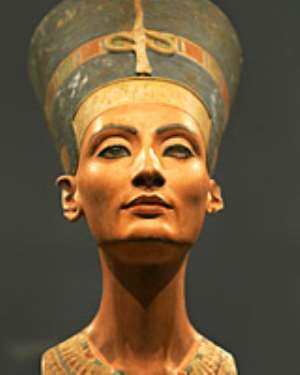
I was once asked by someone, who was aware of my view that African art objects in European museums should in principle be returned to Africa, which of the African queens in European museums, Nefertiti or Ida was the most beautiful. My answer, not surprising for him, was that I could only really appreciate the full beauty of the ladies now kept in European captivity when they are released and freely return to their home countries; that for me beauty was more than the physical appearance. I need to see these persons in their social and cultural environment and to appreciate the respect and the veneration their people bring to them. Surely, their charisma can only be understood when they are with people who regard them as part of themselves and their history. I need to hear the songs of praise that the existence and the activities of these persons have generated. I know this is perhaps difficult for many Europeans who attach great importance to physical appearance and have no use for the spiritual attributes of such persons.
Europeans are very likely to measure the nose and other parts of the body as they do with prisoners. The ethnologists, especially the Germans were famous for that. African art objects are not simply objects to be admired but objects with a function and raison d'être. We are what we are not because of the length of our noses and the size of our heads but because of the circumstances of our birth, our function in society and our own achievements.
But the famous African queens are not the only African cultural objects illegally held in European collections. There are all the Benin bronzes, Akan gold, Nok terra cotta, various kotas from Central Africa, stools, statutes and various sculptures from the Akan, Baule, Chokwe, Dan, Dogon, Fang, Guro, Hamba, Senufu, various religious and other cultural objects, including precious artistic manuscripts from Magdala, Ethiopia. The Louvre, Quai Branly Museum, the Ethnology Museum, Berlin, the British Museum, the Ethnology Museum, Vienna and a whole lot of museums in the USA, Germany, Britain, France, Portugal, Holland and Spain have stolen African objects in their inventories. But how did these objects come all the way to Europe and why have they not been returned?
I. HOW DID THESE OBJECTS COME TO EUROPE?
Most of the African art objects now in European and American museums came there as a result of some illegality or some dubious means during slavery, the colonialism and our present neo-colonial times. Most of them have been seized either through the use of massive force or threat of use of force, bribery and intimidation or stealth.
DECEIT
A. EGYPTSo much cultural objects have been stolen or illegally transported from Egypt that one cannot hope to do justice to the issue here. We have chosen to consider very briefly the best known case of unjust possession by European museums of cultural objects from Africa: Nefertiti, the Egyptian Queen, whose famous bust is everywhere presented and for some, the very essence of beauty. The Germans, who have been illegally detaining the African queen in the Altes Museum, Berlin for almost hundred years, now claim that she is a German, a “Berlinerin.” But how did this Egyptian queen end up in a German museum?
On 6 December 1912, when Egypt was still under Turkish domination (1) a group of German archaeologists and Egyptian assistants, under the leadership of the German archaeologist, Professor Ludwig Borchardt, dug out what turned out to be the bust of the Egyptian queen, Nefertiti. The practice at that time was that when such findings were made, they were presented to a committee that decided what part was to remain Egypt and what part would go to the country of the archaeologist who made the discovery. The committee at this time was always presided over by a European; in this case a Frenchman and many of the members were Europeans. In this particular case, Borchardt, was also a member of the committee. According to Gert v. Pacezensky and Herbert Ganslmayr, Nofretete will nach Hause; Europa - Schatzhaus der “Dritten Welt”, (2)Borchardt covered the find with a layer of grime, in such a way that the member of the committee who made the evaluation of the found did not see properly the whole lot and thus was not aware of the importance of the find. It was decided to leave the socle on which the bust stood in Egypt and let Borchardt have the bust. From documents later available, it was clear that the professor realized how important the found was and was planning to take it to German. When the bust came to Germany in August 1913 it was kept secret for some ten years and not exhibited so as to avoid the Egyptians getting to know about it. Finally, in 1923, after a decade, the bust of Nefertiti was shown in a book by Borchardt “Porträts der Königin Nofretete”. After this publication, the Egyptians started demanding that the bust be sent back. But the Germans have refused to return the bust.
PUNITIVE EXPEDITIONS
A. BENIN The best known example is the case of the Benin bronzes. The British attacked Benin in 1897, under the pretext that some British officials had been ambushed by persons from Benin whilst they were on their way to hold discussions with the Oba of Benin. The king had told the British official who had requested to visit Benin that the time chosen was inappropriate since there would be a traditional festival - yam festival - and during that period no foreigner was allowed to visit Benin City and therefore was dangerous for a foreigner.
The British invaded Benin City with a massive force, captured the City, stole the art works that were in the king's palace including door panels. They executed many Benin leaders and burnt the city. They terrorized the area for some six months in search of the king, Obi Ovomramwen and when they caught him, they sent into exile where he died. The truth of the matter is that the British were determined to get rid of the Oba who refused to submit to British rule and who controlled the trade in the area.
The British kept many of the Benin art works and sold the rest to finance the so-called Punitive Expedition of 1897. The Austrians, Germans and Americans bought these Benin art works. Thus we have in many museums all over the world these illegally obtained art works. Anja Laukötter, gives the following distribution, following Luschan: of the 2400 objects that left Benin: 580 in Berlin, 280 in British Museum, 227 in Rushmore, the Pitt Rivers Collection, 196 in Hamburg, 182 in Dresden,167 in Vienna, 98 in Leiden, 87 in Leipzig, 80 in Stuttgart, 76 in Cologne, and 51 in Frankfurt am Main.(3)
The current Benin exhibition, Benin Kings and Rituals Court Arts from Nigeria, now in Berlin until May 25, 2008, gives a good idea of what was stolen and who the present illegal holders are. (4)
B. ASANTE Less well-known than the British Punitive Expedition to Benin in 1897, was the British Punitive Expedition of 1874 to Kumasi, Ghana. The British had been trying to gain control over the lucrative trade in gold, slaves in the then Gold Coast but had found in the Asantehene, Kofi Karkari, the king of the Asantes from the interior of the Gold Coast, a formidable competitor who controlled effectively trade along the coast. The Asantes were known for their gold and the Golden Stool which was said to embody the spirit of the Asante nation and not even the Asantehene was allowed to sit on.
With such deliberate provocations and other acts of challenge by the British to the political authority of the Asantehene, wars inevitably ensued and gave the British the pretext they had been seeking to attack. The Asantes had besieged the British Fort at Kumasi and kept the British there surrounded for some time in 1867. In 1874 a British Punitive Expedition Army, under Sir Garnet Wolseley entered Kumasi. The Asantehene had left Kumasi, the capital but the town and the palace were taken by Wolseley and his troops who ransacked all the valuable objects they could find including, the king's sword, hammered gold masks in the shape of a ram's head, massive breast plates, coral ornaments, silver plates, swords, ammunition belts, caps mounted in solid gold, knives set in gold and silver, bags of gold and gold nuggets, carved stools mounted in silver, and other treasures including a 20-centimetre-high golden head, the largest gold work from anywhere in Africa outside Egypt. The town of Kumasi and the palace were destroyed by burning.
The British attacked Asante again in 1894 after Asante had refused an offer in 1891 from the British to be made a British protectorate. This time the pretext was that the indemnities levied after the 1874 had not been paid. The British expedition force entered Kumasi in January 1896 without meeting any resistance. The King and the Queen mother made their submission to the British authority by signing a treaty of protection. After the submission of Prempeh, the British soldiers collected all the gold-hilted swords, trinkets and other treasures from the palace. The Asantehene, Agyeman Prempeh was deposed, arrested and sent to exile in the Seychelles with his chiefs and their families. Britain annexed Asante and Fanti areas in 1896.
The last resistance of the Asantes to British domination came in 1900 when the remaining Asante chiefs, under the leadership of the Queen Mother of Edwisu, Yaa Asantewaaa, with an army lay siege to the British fort in Kumasi from March 28 to end September 1900 in what became known as the War of the Golden Stool or Sargranti War. Yaa Asantewaa and the other chiefs were also sent to exile in Seychelles to join Prempeh I in January 1902. Yaa Asantewaa died in exile some twenty years later. Prempeh was allowed to return in 1924 as a private person, later became Kumasihene. The title of Asantehene was only resumed by his successor, Agyeman Prempeh II in 1935.
Many of the stolen Asante items found their way to the Museum of Mankind in London and are in the Wallace Collection. There are also some Asante cultural objects in Pitt-Rivers Museum in Oxford and in the Glasgow Museum and Art Gallery. Many Asante gold objects are also in the Victoria and Albert Museum, London.
C. ETHIOPIA The Ethiopians have been demanding for years from Britain the return of the various precious imperial, cultural and religious treasures stolen by British troops in 1868. These objects include a golden crown owned by the Ethiopian Orthodox Church which is now at the Royal and Albert Museum and precious bibles, a chalice, silver processional crosses, gold and brass crosses as well as 350 illustrated manuscripts at the British Library. Six fine manuscripts are at the Royal Library at the Windsor Castle. Two manuscripts were presented by the commander of the British Expedition to the Royal Library in Vienna, two were sent to the German Emperor and another two to the Bibliothèque Nationale in Paris. Some further 200 volumes are at the Universities of Oxford, Cambridge, Manchester, and Edinburgh and other collections. Sacred documents and items of religious importance to the Ethiopian Church, some of them 400 years old, are being held by British institutions. Some altar slabs or tabots of the Ethiopian Church are also in Victoria and Albert Museum, London. Two embroided tents of the Emperor are in the Museum of Mankind. Pieces of the hair of the Emperor are also to be seen in National Army Museum in London! The list of Ethiopian treasures stolen by the British is simply too long to list here.
The acquisition tactics here were similar to those employed in Asante and Benin. The British sent an army expedition, under command of Sir Robert Napier, later on Lord Napier of Magdala, to release two British envoys and a group of European artisans and missionaries held by the Ethiopian Emperor Tewedros in Magdala, the then capital of the Empire apparently because the British Queen Victoria, had failed to respond to his letter. In the massacre, some 700 Ethiopians were killed, 2 British died and 18 were wounded. The Emperor released the captives but the British nevertheless stormed the capital. The Emperor recognizing his hopeless situation shot himself with a gun given to him as a gift by Queen Victoria. The treasures of the palace and the Church of Madhane Alam (The Saviour of the World) were looted and the city was destroyed. The fire was so intense that it could be seen miles away and thousands of houses were destroyed. A leading British historian of the Expedition reported to have seen the soldiers swarming around the body of the dead Emperor, pulling and tearing his clothes until he was almost naked. The Expedition's archaeologist, from the British Museum's Department of Manuscripts, reported to have seen a British soldier carrying the crown of the Abun, Head of the Ethiopian Church, said to be “solid gold chalice weighing at least 6 lbs”.
A few items have been returned to Ethiopia but the bulk of the looted items remain in Britain and there is no sign that they are about to be returned. It is interesting to note that in the cases where the British have returned an item and where there were two versions, they always sent the inferior version to Ethiopia.
Prof Richard Pankhurst states in his article, “Magdala and its loot”, (5) that when the British Museum, examined the request of the Emperor Yohannes IV for the restoration of a manuscript, “Kebra Nagast” or “Glory of Kings”, the museum authorities found out that they had two copies, they agreed to return the less interesting one. Again, when Ras Tafari Makonnen, the future Emperor Haile Sellassie went to Britain in 1924, the British decided to send the reigning ruler, Empress Zawditu, one of the two crowns of Tewodros. They selected the silver-gilt one and left the more valuable gold crown with the Victoria and Albert Museum.
The arguments of the British for not returning the items are the untenable familiar ones, including the insult about the Ethiopians not being in a position to guarantee the safety and security of the items. The thief requests from the owner of the stolen items a guarantee of their safety and security as a precondition for their return!
ITALY ATTACKS ETHIOPIA
Some African countries experienced not only an attack from one colonialist power but from several. Ethiopia had in addition from the British invasion also an Italian invasion.
Italy, under the fascist Benito Mussolini, attacked Ethiopia on 3 October 1935 at Wal Wal, next to the border of Italian Somaliland under the pretext that Ethiopia was threatening Italian citizens. This has never been established but it is clear that fascist Italy wanted to extend its control of North East Africa by annexing Ethiopia which was between Eritrea, already under Italian control and Italian Somaliland. Despite protest by Haile Sellassie to the League of Nations, nothing happened to Italy. The Italians had long been seeking revenge since the Ethiopians had defeated them in previous wars.
On May 2, 1936 Haile Selassie left Addis Ababa for exile in French Somaliland before the Italians reached his capital and he did not return until 1941. Emboldened by its first attack, on 5 May 1936 Italian troops reached in Addis Abeba with 500,000 Italian troops. The poorly armed Ethiopian troops were no match for the Italians who used chemical gas and planes. Italy annexed Ethiopia after six months of war.
The invasion resulted in the loss of the precious library of Haile Selassie, the Negus, works of art, archives and objects of religious and cultural value belonging to the Emperor or o Ethiopian citizens. Also stolen was a plane belonging to a daughter of the Emperor. Among the cultural items stolen by the Italians was a huge 180 tons obelisk which the Italians took and brought to Rome, erecting it on Porta Capena square, in front of the headquarters of the FAO (United Nations Food and Agricultural Organization). Even though at the end of the last World War a defeated had signed a treaty to return all cultural objects to Ethiopia within eighteen months from the signing of the treaty, it took more than half a century for Italy to return the obelisk this to Axum. (6) The obelisk was hit by a lightening and Italy returned the huge and heavy structure finally only in 2007.
D. DAHOMEY (Republic of Dahomey)
(Not to be confused with the Kingdom of Benin in Nigeria) Dahomey is usually recalled for its strong fighting female force, the Amazons, some 5000 strong all female army.
If you go to the Musée du Quai Branly, Paris you will see the throne and other regalia of King Behanzin, Dahomey. How did these symbols of kingly authority reach Paris?
Around the 1850's, the French wanted to control the port of Cotonu in order to protect their interest in the palm oil business. By the time Behanzin became king in 1889, the French had proclaimed a protectorate over Porto Novo. When Dahomean soldiers entered in 1890 areas that the French considered to be part of their protectorate, allegedly established on basis of treaty with Glele, father of Behanzin, they felt they had good grounds to make war on Dahomey. Again in 1892 the French sent an army of 200 French officers and thousands of African soldiers into Dahomean territory, on their way to Abomey.
Following the usual colonialist propaganda, the French accused Dahomey of slavery, human sacrifice etc. After a series of battles and unsuccessful negotiations for peace, Behanzin burned his palace and retreated to the north. Behanzin gave himself up later on in 1894 and the French made his brother, King. Behanzin died on December 10, 1906 in Bilda, Algeria where he had been in exile.
On the centenary of Behanzin's death, the Musée du Quai Branly,lent 30 major works, including the king's throne to Foundation Zinsou for an exhibition in Cotonou. The items were: regalia - throne and sceptre, bracelets, hat and staff.
SCIENTIFIC EXPEDITIONS
Another way the African art objects came to Europe was to organize an expedition to an area and then take, steal as many objects as possible. Leo Frobenius, German ethnologist was on such an expedition between 1904 and 1935 which brought thousands of objects to Germany. He was also accused of stealing some objects. A very good example was the French mission, Dakar-Djibouti Expedition 1931-33 led by the French ethnologist, Marcel Griaule which brought some 3000 objects to the Trocadero Museum in Paris. Marcel Griaule, had by authority of a French law, Loi Griaule to take from the colonies whatever he thought was necessary for scientific research!
A good testimony on this expedition was given by one of the participants, Michel Leiris in his book, Afrique Fantôme (7). We must thank Michel Leiris for leaving us detailed information about the methods used by the French to acquire cultural objects from Africa and elsewhere. When we read his accounts we start wondering whether the ethnologists were also trained in criminal methods. It seems clear the ethnologists considered that the inhabitants of many areas in Africa would not voluntarily give away their religious and cultural objects and a way had to be found to secure the objects. In the Dakar- Djibouti Expedition, as in all such expeditions by Europeans, all the methods of criminals were employed: intimidation, coercion, blackmailing, carrying of weapons and straightforward stealing and robbing.
Religious objects were treated without any reverence or respect and just carried away, sometimes before the very eyes of the local inhabitants who were unable to prevent sacrilege, were crying at their own powerlessness. These stolen objects as well as other objects stolen in other expeditions are now in the new Musée du Quai Branly, Paris, opened on 23 June 2006. The building of the museum is new but the objects there, some 350,000, are almost all stolen items from the Musée de l'Homme and the Musée des arts africains et océaniens.
RELIGIOUS AND MISSIONARY ACTIVITIES
As you know, one of the great changes brought about by slavery and colonization in most parts in Africa, was the conversion of the Africans from their traditional religious beliefs to European beliefs. It should be mentioned though that Ethiopia was already Christian in 4th Century BC following the conversion of their King Ezana, at a time when many European countries had not heard of Christianity.
The Christian missionaries, with varying degrees of success, convinced many Africans to abandon their African beliefs which were disqualified as heathen. All African sculptures were declared to be works of the devil and incompatible with the Christian religion; they were therefore to be burned in fire. But in many cases, the missionaries sent people to collect them or ordered these objects, called fetish by the colonialists (from the Portuguese, feitiçio). Miraculously enough, many of these Africa cultural objects which were supposed to have been consigned to fire, found their way to museums and private collections in Europe and America.
Dr. Greenfield, in her excellent book, The Return of Cultural Treasures states that the Vatican also has its own museum with African objects:
“In 1925 Pope Pius XI organized a missionary exhibition extolling missionary work all over the non-western world. About 100,000 items were sent and after the exhibition only about half were returned. The Pope proclaimed the formation of a new museum, the Pontifico Museu Missionario-Etnologico, so that the 'dawn of faith among the infidel of today can be compared to the dawn of faith which… illuminated pagan Rome”. (8)
I would have thought that if African cultural objects were pagan, the Vatican would have kept them away and not stored them in the holy Christian palace for fear of contamination. There are also in many European cities, small Christian museums with African collections.
II. WHAT ARE THE ARGUMENTS FOR NOT RETURNING AFRICAN CULTURAL OBJECTS?
A. LEGALITY OF ACQUISITION
Every European State, museum or individual alleged to have acquired illegally acultural object from Africa or Asia, immediately responds that their acquisition was perfectly legal. Yet, often a simple look at the object suffices to convince one that the object in question could not have been legally acquired. One look at the massive or precious objects in Louvre, Musée du Quai Branly, Musée Guimet, British Museum, Ethnology Museum, Berlin, Ethnology Museum, Vienna and one is sure they could not have been given away without some violence or massive force. Many of these objects have a spiritual or religious function.
Ever since Nefertiti was exposed to the public in 1923, the Egyptians have made all sorts of efforts, suggested different compromises but the Germans have consistently refused to return or even lend Nefertiti to the Egyptians, arguing that the bust of the Egyptian Queen was acquired legally through partage. But as we know, through deceit the relevant partage committee was not aware of what the German professor Borchardt was taking with him. All appeals from the Egyptians and German groups have failed to convince the Berlin authorities to let the Egyptian Queen go to Egypt even for a short period. Even the plea of the man who donated the bust of Nefertiti to the Berlin Museum, Dr. James Simon, that the bust should be returned to Egypt had no effect on the German authorities who remained steadfast and have refused to consider any request for restitution or loan. At one point, it seemed the Germans were ready to return Nefertiti to the Egyptians. All concerned, the museum directors and even Herman Göring had agreed until Adolf Hitler said “nein”. Are the present German leaders not worried at all by the fact that they are holding the same position as that evil man, Adolf Hitler? The fascination of Adolph Hitler by the bust of Nefertiti and his plans to build a gigantic museum in which the Egyptian Queen will be the centre piece should make one think. Hitler is credited with the following:
"I know this famous bust," the fuehrer wrote. "I have viewed it and marvelled at it many times. Nefertiti continually delights me. The bust is a unique masterpiece, an ornament, a true treasure!"
Hitler said Nefertiti had a place in his dreams of rebuilding Berlin and renaming it Germania.
"Do you know what I'm going to do one day? I'm going to build a new Egyptian museum in Berlin", Hitler went on.
"I dream of it. Inside I will build a chamber, crowned by a large dome. In the middle, this wonder, Nefertiti, will be enthroned. I will never relinquish the head of the Queen." http://www.ioltravel.co.za/article/view/3551832
Nefertiti no doubt in the twisted mind of the German dictator symbolized Aryan beauty even though she was an Egyptian from the African continent.
When one considers the amount of Egyptian cultural objects that the Germans have, for example, in the Egyptian Museum in Berlin and the other artefacts in their depots, it seems really shameful that the Germans should quarrel with the Egyptians over Nefertiti. Even if the bust of the Egyptian queen were legitimately acquired (and there are serious doubts and evidence to question this) surely, the most decent thing would be for the Germans to hand over the Egyptian queen to her people. But it appears the Germans are keen to continue the excessive commercialization of the image of the Egyptian queen, much of which is of very doubtful taste.
The Germans have also said that the bust is fragile to travel although the bust has been moved many times within Germany. Surely, modern technology and means of transport can safely send the famous bust to the desired destination. Incidentally, the Germans allowed an artist to attach the bust to a bronze statute of a naked woman and only put an end to this distasteful action when the Egyptians protested.
After Cleopatra, Nefertiti is the second Egyptian Queen who seems to have caught the imagination of Western Europeans. Even mature European men who should know better seem to be unable to escape the charm of the Egyptian queen and are apparently entranced by the mere glance at her face. Those of us who are not under her spell feel that whether she is the icon of beauty in the West or not, this does not justify the illegal holding of her bust in Berlin. With all due respect for the German fans, we think they could also visit her when she returns to Cairo. Indeed this might be a better test of their loyalty than simply taken a tram to the museum and ignoring the illegitimacy of her presence on the Museum Island.
The Germans have invested a lot of energy in persuading themselves and others that the Nefertiti is the epitome of beauty and it seems they cannot bear the thought that this beauty is anywhere else than in Germany and preferably in Berlin, the capital. Those of us who do not accept the attempts to impose certain canons of beauty are at a loss at the insistence of the Germans to keep a foreign lady at all costs. We understand they have turned her into a German! This is interesting in view of the fact that the Nigerian Queens from Benin have been in Germany since 1897, before Nefertiti was abducted in 1912, are not yet Germans. Maybe the colour or race of the Nigerians prevents a certain basic racism from making them icons of beauty in a country like Germany. Whatever it is, one should urge the Germans to settle this unseemly dispute with Egypt.
Egypt under Ottoman dominion was regarded as some sort of archaeological self-service supermarket in which the British, French, Americans and Germans took whatever archaeological or cultural object they fancied. In independent Egypt, with the reorganization of cultural services under the Supreme Council of Antiquities especially under the powerful and competent leadership of its Secretary-General, Zahi Hawass, a cultural pharaoh, nobody dares to take archaeological objects with impunity. Hawass, an archaeologist himself and the most famous Egyptologist, has asked the British Museum for the return of the Rosetta Stone, the Louvre for the Zodiac and is determined to recover all the important archaeological objects stolen from Egypt and given his determination and approach, he is bound to succeed. Will the rest of the African countries and the Asians take a lesson from Egypt and start vigorously pursuing their demands for the recovery of their stolen objects?
Sometimes, the defence is that the object was a gift from the people concerned or their king or that it was purchased. True there were some occasions when gifts were made or items sold but most of the time it was massive force or pressure that enabled the gift or purchase to be effected. We have account of Michel Leiris on situations when he and members of the French Expedition Dakar-Djibouti went to African villages and took whatever they fancied and told the chief of village the price they were willing to pay. It was either you accept the price or face problems from the colonial administration. Similarly, in the German colonies of Cameroon, Namibia, Tanganyika (Tanzania) where every white man could whip any black man, many such purchases or gifts could not be said to have been genuine or on valid legal basis. (9)
Another legal argument that we often hear is that the international conventions on this matter - The UNESCO Convention of 1970 (Convention on the Means of Prohibiting and Preventing the Illicit Import, Export and Transfer of Ownership of Cultural Propert, Paris) and the UNIDROIT Convention of 1995 (Convention on the Restitution of Stolen and Illegally Exported Works of Art and Culture, Rome) - do not affect transactions made before 1970 and the impression is left that those conventions somehow legalize or approve all acquisitions before that date; that there is no other law apart from the conventions. The impression is then created that since the Conventions do not operate retroactively, there is no legal basis for acquisitions made before 1970. How convenient! Most colonial acquisitions were before 1960.
With all due respect, the fact that the 1970 convention does not apply retroactively does not mean that the convention approves of all acquisitions made before 1970. Before the convention, there were rules of law in every legal system which prohibited illegal handling of the property of others.
“Law" in this context is understood by many to mean legislation, one element of law. There are also general principles of law such as unjust enrichment, lack of good faith "bona fides" and customary law. Many forget that the Statute of the International Court of Justice in its Article 38 (1) provides that the Court shall apply “international conventions, whether general or particular, international custom, as evidenced of a general practice accepted as law, the general principles of law recognized by civilized nations and judicial decisions and teachings of the most highly qualified publicists of the various nations…” Many opponents of restitution argue that in the absence of a specific legislation on a particular case or type of case, for example, restitution of property seized by the Nazis, there is no way of obtaining restitution. With all respect to those opponents, the need for specific legislation in Germany and Austria was largely due to the fact that a large part of the population and almost all the judges were on the side of the Nazis hence the need for specific laws. The laws of both countries contained sufficient elements and principles for the judges to rule in favour of restitution if they were so minded. It was never the law in Germany and Austria before the Nazis came into power that you could take the property of others without their consent and without compensation.
There have been enough general principles in almost all legal systems in Europe and in Africa since the 15th Century to justify restitution of illegally acquired property. Much of the transfer of cultural items from Africa to Europe and to America violated laws and principles regarding property, individual and collective rights. So why did the Africans not claim their objects back? This raises fundamental questions regarding the nature of the colonial enterprise. When a European Government, with army and navy took control of a country in Africa and in the process killed thousands of children, women and men, who will dare to think of and ask for a small bronze mask? And whom will you dare to ask, and thereby risk imprisonment and other forms of punishment? Recall that kings who resisted colonial rule were sent to exiles, thousands of miles from their home. The king of the Asantes (Ghana), Prempeh I was sent to exile in the Seychelles. In a colonial enterprise, a criminal enterprise, all laws were put aside so far as they could affect the interests of the colonizers.
UNESCO also has a body, The Intergovernmental Committee on Return of Cultural Property which offers its good offices to help countries in bilateral negotiations to solve questions of restitution between States. But some of the exchanges heard in bilateral meetings organized by the committee to help the contesting parties are not very encouraging. For example, Germany offered to provide Turkey with a replica of the Bogazkoy Sphinx whilst keeping the original and Turkey suggested that Germany keep the replica and return the original to Turkey.
The United Nations Assembly has passed several Resolutions urging States to return cultural objects to their countries of origin and requested to enter negotiations for that purpose. Western writers stress that the Assembly's resolutions have no legally binding force. However, the Assembly represents the majority of States and hence the world public opinion in these matters; that these resolutions require good faith on the part of Member States. The States that usually oppose the General Assembly on these issues are, not unexpectedly, the Western countries and their allies.
The international instruments have served to underline the complicated issues involved in these disputes over restitution of cultural objects but they have not been used effectively to resolve disputes. This is due primarily to the basic hostility of the Western States to any discussion of the question. They wish to regard the matter as a question of good will and not moral or legal right. But it should also be added that the African States have not, to put it mildly, been active enough to make use of the possibilities offered by the Conventions. Many African countries have not even bothered to ratify or accede to these instruments.
B. WAR BOOTY
Some have argued that these objects were seized as war booty and that at the time they were seized it was legal to do so. No specific laws are mentioned which allowed States to take over in times of war and to keep after war the cultural objects of the enemy.
First of all, African States were never considered as part of the European concert of nations. When the Europeans met at various conferences, for example, the Berlin Conference of 1885 and divided Africa among themselves, no African States were invited to the conference. How far the Europeans understanding of International Law can be said to be binding on the Africans is a debated issue.
In any case, it has never been accepted or practised in Africa that in a war you are entitled to take the enemies cultural and religious objects and keep them. It is clear that most African societies were proud of their own cultural and religious objects and would have had no need or indeed use, for the objects of the other. This argument is not often advanced these days but it takes another form, namely, that all these events relate to the past.
C. PAST HISTORY
We hear often that all the accounts of illegal seizure and stealing relate to history and that we cannot remake or rewrite history. You will find this explanation in the foreword to the catalogue of the current exhibition, Benin: Kings and Rituals - Court Arts from Nigeria
“History, whether tragic or glorious, lies forever behind us. We stand on its shoulders and direct our gaze to what lies ahead. We trust that this exhibition contributes to an ongoing dialogue between the past and the present, and between Africa and Europe and North America, and thus to the collective shaping of the future against the backdrop of the lessons offered by the past.” (10)
This is a very interesting exhortation to forget the past coming from a group of important museum directors in whose countries tremendous importance is attached to history. The functions of the museums directors are primarily to preserve evidence of history in the form of objects or documents. Here we have these scholars telling the people of Benin (and by implication all Africans) to forget history. They should forget the past and accept the present situation whereby their most precious cultural objects, taken by violence or stealth, are kept by western museums and private persons in the West. This is surely another confirmation of my theory that when it comes to discussing Africa, some western intellectuals and their governments often request us to suspend our common sense and our ability to think. How else can we explain such an extraordinary declaration? Can we imagine the writers of this statement making a similar declaration to the British, French, Germans, Austrians, Italians or US Americans?
As I have often said, we Africans are definitely less obsessed with the past than the Europeans. Indeed, it may well be the Europeans' unlimited fascination with the past that prompts them even to steal the past of others.
What concerns Africans and the peoples of the world are primarily the present effects of the acts of the past. We realize that because of acts of slavers and colonialists many of our cultural and religious objects are in museums in the West. We are not seeking to rewrite history, even if that were possible. We seek to correct the present and to prevent such acts in the future. Are we asking for too much?
D. ADVANTAGES OF STAYING IN EUROPE - VALUE ADDED AND SPREAD OF FAME.
Another explanation for keeping African art objects in Europe, which is not always clearly articulated presumably because even the Europeans are shocked by its boldness and arrogance, is that these objects have benefited by their removal from Africa! Some of this explanation and its arrogance are clearly visible in the foreword to the catalogue of the Benin exhibition:
“In 1897 a British punitive expedition seized outstanding works of art and ivory from the Benin royal palace. These subsequently entered museums across Europe, the United States, and Nigeria. From our 21stcentury perspective the military action taken seems unjustifiable; however, we must recognize the role it played in bringing these works of art to far broader attention. They are now forever on the map of world art and we are uplifted by the extraordinary aesthetic and cultural achievement they present……The present consideration of these works within multi-layered discourses on the past - and on identity in the competing contexts and claims of local tradition, the nation state, and globalization - is part and parcel of the continuation of shifts in meaning and the persistent viability of the material documents of the past. Rather than catering only to western notions of other cultures, museums strive to explain the general causes and specific articulations of the past and present cultural diversity of the world. This approach enhances the pleasure of aesthetic enjoyment, while providing the necessary basis for the understanding of the cultural content behind the visible forms.” (11)
What this argument states is that, no matter the initial mode of acquisition, because of the stay of these stolen objects in Europe, they have become better known and have gained universal reputation as work of art. They have also acquired another value in that they are not only a manifestation of a religious and political power of a civilization but are now admired for their own aesthetic value and craftsmanship. What an insulting argument. On this line of reasoning, one could also argue that how ever bad slavery may have been, it has enabled the rich variety and wealth of African culture to be known all over the world; that African music and dance are no longer confined to the Continent but are appreciated all over the world.
When the museums argue that African sculptures and other art works are seen by more persons in the museums in Europe, they ignore certain facts:
* Africans are excluded from seeing these objects since they cannot secure visas in order to enter European and US American towns; FRONTEXT, a special armed force has been set up specifically to prevent Africans from entering Europe.
* How many Africans can afford to travel to Europe in order to see these objects and pay the entrance fees of 10 Euros which exceed the daily earning of the average African?
* The stolen African objects are not always on display in the European museums for lack of space. They are usually in some depots and sometimes still in the original packing!
COPYRIGHT ISSUES
In the discussion on restitution, one issue that is almost always not mentioned is that of copyright. Copyright law is basically intended to protect our intellectual or artistic productions so that they are not used without our consent or that somebody makes profit out of our intellectual or artistic efforts without our getting any benefits. How does that stand with regard to the thousands of stolen artistic and intellectual productions of Africans that are in the various European and American museums? Do any of the African artists or their successors/ countries benefit from the profits the museums make from the entrance fees to the museums? Are the artists or their countries involved in the copyright decisions that the European museums make and payments that they make for granting rights of usage to others?
Should the copyrights in the stolen cultural objects not be transferred to the societies that originally produced these objects? After all, the Europeans made no intellectual input to the various cultural objects that were seized by European armies or thieves. Is force being substituted for intellect?
As things now stand, most of the books on African art are published by European and American museums or other publishers. Copyright of the materials, including the photos of the stolen objects are said to be with the museum or some American, French, British or German author or photographer.
A Nigerian who wants to use any of the material on Benin art, other than a citation, is obliged to ask for permission from the European museum or the writer or photographer. A person from a society whose art works have been stolen by the British is obliged to ask the British for permission so that he can inform his people about their own beautiful art works which the British have stolen and are showing in the British Museum. Where then is the argument that these African art works in Europe are given wider publicity in Europe?
One should also recall that most museums forbid the filming or photographing of any of the objects displayed in the exhibitions. The rational for this ban is not always evident. Obviously, some paintings should be protected from camera flashes but does this also apply to bronze, wood, gold and other metals? Objects that in Africa stayed exposed to the sun are now protected from the flashes of small digital cameras. We can only speculate that the ban is often more for economic reasons than for conservation purposes. Here again the economic benefit goes to those who stole the goods and not to the owners of the art objects. Should one not at least arrange that some of the benefits go to the original owners and their successors?
E. MAINTENANCE, SECURITY AND CONSERVATION
This last argument seems to appeal to many persons, including even some Africans. The argument is that Africans are unable to look after their cultural objects and it always comes up when the question of restitution is raised.
When my property has been stolen and I ask the person who stole it to bring it back to me, he replies that I am unable to look after my property and cites examples of thefts occurring in my house by other persons (to whom he or she is directly related) as a ground for not returning my property. Must we then offer proof or guarantee to those who have stolen or are in possession of stolen goods that we are now capable of protecting our property before they return them? Must we then include the ability to protect one's property against thieves as a necessary element for becoming a property owner? Who looked after African cultural objects for thousands of years before the Europeans came to plunder the continent? Some lost European tribe?
Would any court accept the argument of a thief that the owner of the property cannot look after it properly and therefore he is not going to return it? Should this principle be accepted, no one can be sure of his property for the fact that a thief is able to steal property will itself become his solid defence for refusing to return it.
Another related argument that we often hear is that Africans are not in a position to conserve or preserve the precious African cultural objects for which the Europeans believe the have a duty to preserve. An answer from the University of Edinburgh to a request for the return of Ethiopian manuscripts is typical of the position of many European museums.
“It is the considered view of the University that conservation of the documents is of primary concern. Since acquiring these documents, the University Library has exercised good curatorial management over the manuscripts in accordance with current best practice. It has a responsibility to ensure that they are properly conserved in the future.
Regardless of the outcome of any further consideration of this matter, the Court has agreed that the University should work in partnership with AFROMET and University of Addis Ababa, to ensure that the manuscripts are accessible to the Ethiopian people and to scholars through appropriate copies, such as microfilms and digital scans, and that these should be made available to the Institute of Ethiopian Studies at the University of Addis Ababa.
The manuscripts form a part of the overall richness and depth of the University's Collections. The University of Edinburgh plays a significant role as one of the world's leading research universities hosting scholars from all over the world and, through the use of leading edge technology, providing scholarly works to researchers. These manuscripts should be viewed within the context of an active research collection where the interaction of these items is important for scholarship both now and in the future.”(12)
The patent arrogance of such answers has been so often repeated that many Europeans and Americans do not see what is wrong with it. Since Africans have been generally painted as inefficient and irresponsible, the Europeans and Americans think they are doing us and mankind a great favour in preserving such stolen cultural objects.
It is also said that it is no use to return a cultural object to an African country since it will soon turn up in the open market. Surely those who are concerned about Africans ability to safeguard their cultural objects should be addressing themselves to those who support and encourage the thieves rather than use this inability as ground for refusal to return undoubtedly stolen property. The Europeans and Americans could ensure that their museums do not possess or buy stolen art objects and that those caught in this game will be severely punished. They could make their laws stricter. But all this is perhaps wishful thinking, for Europeans and Americans are those who dominate and manipulate the art market. The museums are not exempt from this illegality in so far as they purchase such objects. Those who have stolen our cultural objects could do us a favour by not adding insult to an injury.
It should be added that in view of the recent spate of art thefts in Europe, especially Switzerland and the daily occurrence of art thefts from museums, this argument sounds extremely hollow. However, the American authorities have now begun to check seriously art smugglers and the museums involved. The Europeans have not followed the Americans in this and dubious art dealers can work in full tranquillity in Europe.
F. DIGITALIZATION MAKES IRRELEVANT THE LOCALIZATION OF CULTURAL OBJECTS.
This is one of the most perverse arguments I have heard in connection with repatriation. Some have even coined the phrase “Digital repatriation”. It has been argued in all seriousness that in view of the possibilities of digitalization, there is no longer any real need for physical repatriation. This extraordinary line of thought is exemplified by this excerpt from the report on the Conference on Repatriation of Cultural Heritage at the Greenland National Museum and Archives, Nuuk, 12-15 February, 2007.
“Jonathan King (Keeper of Africa, Oceania and the Americas at the British Museum, UK and responsible for some collections including 350,000 ethnographic and archaeological objects from the Americas and Oceania and Africa) stated in his paper 'A View from the British Museum' that we breathe the idea of repatriation everyday, but that it is the old paradigm. Repatriation leaves contemporary difficulties unresolved, and we need to find new solutions based on cultural diplomacy and interaction.
As an alternative to physical repatriation, the British Museum advocates for other solutions, virtual and visual return as well as long term loans, co-curated museum exhibitions and other forms of cultural interaction. King made the point that not only do museums create collections and so assist in the construction of identity, but without museums there wouldn't be collections from the past. While museums in Ghana and Kenya serve nation building purposes, the British Museum has a universal scope. Consequently the Museum has an obligation towards all of humanity, not least in reminding us all of the tragic history of past and present phenomena such as slavery. (13)
No lessremarkable is the opinion expressed by John Friede, a collector and specialist on Oceanic art, during a colloquium held at the Musée du Quai Branly a day after the opening of the museum. Friede who was a member of the acquisition commission for the museum declared; “I do not believe that the art works from New Guinea belong to the people of New Guinea. I am of the view that every work of man belongs to the whole humanity”.(14) He went on to criticise those countries which prevent their art works from being transported abroad and burry them at the back of a museum where no one can see them as failing in their responsibility to humanity. He also stated that his collection and the collections of most American museums will soon be accessible through the internet. John Friede has a collection of considerable number of art works from New Guinea.
If those keeping illegal or stolen African art works do not want to return them, this is a matter for them and their conscience, taking into account what their reaction would be if Africans were to keep European stolen art works. But must they add insults to our deep-felt injuries by underestimating our intelligence? Is the venerable British Museum fulfilling an obligation towards humanity when it refuses to return the Benin art works which were seized by military force in 1897? What kind of humanity would that be that does not care for the rule of law and believes in the use of force for achieving its purposes, however illegal and immoral?
What is meant by “virtual and visual return which is offered as alternative to physical repatriation”? That we can see these objects via internet and also in the form of photos? What about the cultural objects we require for religious and ritual practices? Is the British Museum seriously suggesting that we introduce internet into our cultural and religious practices, including our dances and masquerades, instead of the physical objects which are kept in European museums and are not being used for any religious or cultural activities, except for visualization by museum visitors? Can someone tell me how we can dance with a digitally repatriated mask? So the Ghanaians who are involved in building national identity would have digitalized versions of golden sandals, regalia, earrings, masks, pots and statutes. The British who have no need for these objects will keep the originals for the visualization and aesthetic pleasure of visitors to the British Museum. How does one secure from my grandfathers, uncles, aunts and others, who cannot read nor write, respect for the Asante kingship and authority as well as veneration for our ancestors through the use of digital versions of cultural and religious artefacts? Will they not think there was something wrong with me if I turned up in Kumasi with my digitalization versions at a festival where others came with their kente cloths, Asante stools, fans, swords, spokesperson's staff, gold jewellery and huge drums?
Should there not be a minimum of respect for the religious and ritual practices of others? Or has the British Museum and its management not yet understood the nature and the role of most of our art works which they have been keeping for ages? Do they not read what the British anthropologists say about African art works and their functions in African society? Have they asked themselves seriously why Ghanaians should have digitalized versions of Ghanaian artefacts whilst the British keep the Ghanaian originals? Do they not sense immediately that there is something wrong here?
Maybe the British Museum and the Musée du Quai Branly could explain to the people of Benin the great advantages of the “virtual and visual repatriation” as opposed to “physical repatriation” and “long term loans”. How does one lend a stolen item to its original and rightful owner? But why do the Western museums not use the “virtual and visual” versions of these art objects and return the physical objects to Benin, Cameroun, Ghana, Mali, Nigeria etc? Could someone explain to the people of Benin how the virtual versions of plaques, the commemorative heads, brass shrines and other bronze works could function in their society?
The British Museum could perhaps explain this to all those Europeans who have fallen in love with the two famous African ladies, Nefertiti, Egypt, now kept in Berlin against her will and the queen mother Idia, Benin, Nigeria, abducted with military force by the British in 1897 and still kept against her will in the British Museum. What about the British Museum keeping the “virtual and visual” version of the Parthenon marbles and returning the physical version to Greece? That could be a great step forward in this question which will not die soon.
It is obvious that those who speak of “digital repatriation “ as alternative to “physical repatriation” have no idea about the conditions in which the average African lives, thanks to 500 years slavery and imperialism and 50 years of Independence. They probably do not realize that one cannot have electricity in every African village. What does this leave us with digitalization? They surely have not thought about the costs in securing computers and electricity, even if available. None of the supporters of digitalization has asked any questions about the language in which all this will happen. They think we are all English or French speakers. The majority of Africans are not.
How can museum directors from countries where a high premium is put on having original objects suggest to African countries digital versions of African artefacts? This is only possible on the assumption that Africans and their countries should always be second class. Their museums should also be second class. Even in the area of African art, the originals should be in Europe and the second class museums in Africa should have only second class copies of their own original art works. What a world we have!
Thus we are being condemned to standards lower than those of our forefathers and foremothers who at least had first class African sculptures and artefacts. And this drastic lowering of standards has been brought about by the very people who took over our countries on the pretext of bringing us civilization. Are we moving forwards or backwards?
G. WORLD CULTURE, UNIVERSAL CULTURE, AFRICAN CULTURE PART OF EUROPEAN CULTURE
We have a large variety of explanations which tend to argue that there is no longer any need for the Africans to press for the restitution of their cultural objects. One of them is that we now have a world culture and so there is no need for any particular country to seek the return of its cultural objects. We find this in the infamous Declaration on the Importance and Value of Universal Museums. In December 2002, agroup of the world's largest museums, including The Art Institute of Chicago. J. Paul Getty Museum, Los Angeles, Solomon R. Guggenheim Museum, New York, Louvre Museum, Paris, The Metropolitan Museum of Art, New York, the Museum of Fine Arts, Boston, The Museum of Modern Art, New York, Prado Museum, Madrid, Rijksmuseum, Amsterdam, State Hermitage Museum, St. Petersburg, signed a declaration instigated by the British Museum which did not sign it, with the aim of securing for themselves immunity against future claims for restitution. Among the arguments which were advanced was a statement that cultural objects which have been in these museums for a long time have in the meanwhile become part of the culture of those countries:
“Over time, objects so acquired — whether by purchase, gift, or partage — have become part of the museums that have cared for them, and by extension part of the heritage of the nations which house them. Today we are especially sensitive to the subject of a work's original context, but we should not lose sight of the fact that museums too provide a valid and valuable context for objects that were long ago displaced from their original source.”(15)
Thus on this line of reasoning the African objects in the British Museum, London, Ethnology Museum Berlin, Ethnology Museum, Vienna have become part of the culture of those countries. So are the Austrians and the British now believers in ancestor worship or veneration?
A similar argument is used by the Germans to defend their illegal detention of Nefertiti. They say she has become a Prussian or Berliner and can no longer be regarded only as an Egyptian. She has been in Berlin for some 95 years. And how long was she in Egypt? It is also said she is too fragile to travel! She did not seem to have been too fragile to travel to Berlin. Besides, modern transportation and technology are far more advanced than they were when she travelled to Berlin in 1912. A similar argument was also used by the British when they refused to lend a Benin hip mask to the Nigerians. They also added climatic change as a ground.
A variety of this argument is that we all now have a world culture and so there is no need to think that African cultural objects should be in Africa alone. A slight variation of this is to say that there are Africans in London and Paris who also deserve to have access to the objects from the culture of their parents. So the African Diaspora is brought in to establish an argument against African demands.
III. AFRICAN ART IN THE HISTORY OF MODERN ART?
If the Europeans are doing all they can to retain our art objects, there must be some reasons for this.
When Europeans first came into contact with African art, they had a fairly negative attitude. The grounds for this attitude had long been prepared by European philosophers such as Hegel, Vorlesungen über Philosophie der Geschichte, Kant, Beobachtungen über das Gefühl des Schönen und Erhabenen, Hume, Essays. (16) These erudite philosophers had poisoned the minds of Europeans instead of enlightening them by asserting that Africans had no history and had made no contribution to the development of mankind. We know today of course that the first human beings lived in Africa and if they had made no development, mankind should have become extinct. The false theories of the philosophers were generally developed to justify slavery and colonialism. There was a need to establish that the objects of slavery and colonialism were not as good as Europeans and were indeed, inferior. These same theories have been used to justify all sorts of cruel treatment of Africans, including apartheid which was supported by all European countries.
The myth of the inferiority of the Africans therefore coloured the views of the Europeans when they looked at African culture, including our religion, culture, music and dance. Thus their perspectives were deformed ab initio.
African arts, including sculptures, masks and paintings were considered by Europeans as “primitive” and not deserving the same consideration as European arts. In the meanwhile the colonialists and their agents were busy, as they are today, combing the whole continent, for masks, sculptures and other art works to decorate their houses and to put them in their ethnological museums and in art galleries selling the so-called “primitive arts”. But why “primitive”?
Having concluded that Africans were inferior beings, the Europeans had also to conclude logically that they could not produce works of art which could be considered as civilized and representative of the most beautiful and finest realizations of human taste as defined by Europeans. Europeans defined what was beautiful without bothering to find out if the Africans had their own conceptions of beauty. The Europeans were victims of their own pre-conceptions and propaganda. When they found African art which they considered beautiful, such as the Benin bronzes, they said it must be a work of classical Greece or some lost European tribe but definitely not a work of primitive Africa. Up to this day, there is still a dispute as to whether the art works of Africa should be placed in ethnological museums which deal with so-called primitive peoples or in the art galleries where we find art works from Europe and US America. Prejudices have a long life!
Nevertheless, the debt of all the great modern artists to African art is now generally admitted, Pablo Picasso, Braque, Modigliani, Brancusi, Matisse have all been heavily influenced by African art, especially, African masks. Colin Rhodes in his book, Primitivism and Modern Art, declares: “In Picasso's work, for example, between around 1907 and the beginning of 1909, we witness the artist working through his encounter with tribal sculpture towards a point at which its forms are fully assimilated in his painterly style. Consequently, direct borrowings from African art are clearly evident in the large oil sketch, Three Figures under a Tree (1907), but by 1908-9 when he had reached a definitive statement of this composition in Three Women this was no longer the case.” (17)
The author also declares: “Picassos's introduction to African sculpture around 1907 coincided with a radical change in the appearance of his paintings, which might be seen to threaten the claims often made for his originality.”(18)
Rhodes underlines the influence of African masks in Paris:
“African masks and figures, mainly from the Ivory Coast, Gabon, and the Congo, are probably the most common influences in Parisian artistic circles in the years before 1918. In sculpture, especially, there are many instances of the important role played by such works. Brancusi's Little French Girl (1914-1918) is a case in point. Formal similarities can be drawn between this work and much West African figure sculpture if we compare, for example, the stiff, frontal pose of Little French Girl with a Kulango figure from the Ivory Coast”(19)
Another author, William Rubin, in his excellent book, Primitivism in 20th Century: Affinity of the Tribal and the Modern, demonstrates amply the incontestable influence of African art on various modern European artists: Picasso, Juan Gris, Arman, Braque, Matisse, Vlaminck, Kandinsky, Kirchner, Modigliani, Paul Klee, Moore and Giacometti. According to Rubin, when Picasso saw for the first time an African sculpture at the Museum of Ethnology at the Trocadero, Paris, he declared “It was in this moment that I understood what art was”. (20)
When one reflects on all these matters, one cannot escape the conclusion that imperialist domination and colonialist brutality have made many Europeans less sensitive to the feelings of others and reduced considerably the level of shame normally existent in most persons. How otherwise is one to explain the frantic efforts to offer justifications and explanations for the retention of art objects forcibly taken away by Europeans? Moreover, these obviously self-serving justifications are offered by scholars and other learned persons from whom one would normally expect better answers.
It is certainly not the business of this writer to advise the opponents of restitution on what arguments or how their case should be presented but in the interest of fair and fruitful debate it would be agreed by all that such arguments, like those in the infamous “Declaration on Importance and Value of Universal Museums”, are more likely to exacerbate the discussion than to contribute to solutions acceptable to all.
None of the arguments in support of non-restitution seem to contain any real substance. On the contrary, most of them are really not worthy of the persons who make them nor of the countries they represent. I happen to have studied or lived in many of these countries - Great Britain, France, United States, Germany and Austria - and I often wonder what my old professors would have said if somebody presented them similar arguments. Take the argument that Nefertiti has become a “Berlinerin” and cannot travel or that African religious objects have become part of the culture of a predominantly Catholic country such as Austria. What would the late Professor Max Rheinstein, University of Chicago think of the pronouncements of James Cuno, Director of the Art Institute of Chicago?
But above all, what is remarkable is the absolute lack of shame on the part of Europeans to argue that African stolen goods belong to them. Take the Benin bronzes for example. We all know they were stolen or looted by British soldiers in 1897 and that the British sold some to the Germans and Austrians who knew they were stolen goods. How can anyone with good conscience not be worried by being linked with such stolen goods? Yet we have respectable professors and museum directors proudly proclaiming the ownership by their countries and museums of such stolen goods? Is there no more morality in our world? Is there no ethos?
At this point, you may think I am preaching. Yes I am preaching. I am preaching to Americans and the Europeans who are used to preaching to Africans but are not used to hear Africans preach to them. I am urging them not to confess and convert but to recognize and adopt. They must finally recognize that slavery and colonialism were not a blessing and that too many atrocious crimes were committed in the past. When it comes to dealing with cultural objects, it seems that many Europeans abandon all considerations of justice and morals. They must adopt an ethic which states that “Thou shall not steal” also applies to cultural objects. There is no reason why the poor and hungry man who steals a piece of bread should be condemned to prison but those who steal cultural objects are regarded as heroes. What kind of morality permits James Cuno, Director of the Art Institute of Chicago to lambast and condemn States for trying to control archaeological excavations and illegal exportation and at the same time praise robbers for their hard work and for risking their lives?
The assertion and assumption by Europeans that there is no civilization outside their own cultural area seems to lead them to seize control of any land where there is evidence of civilization and to steal cultural artefacts and symbols of others to confirm that indeed civilization can only prosper under their control. Hence stealing and plundering become acceptable means of acquiring cultural artefacts. They may even go so far as to declare that there is no link between present day peoples and their ancestors: “It is a stretch of the imagination,” says Cuno, “to link modern Egypt to ancient Egypt, modern Greece to ancient Greece, modern Rome to ancient Rome, communist China to ancient China. Nonetheless, countries like Italy, Greece, Turkey, China, and many others have laws that make any antiquity found on their soil automatically the property of the state.” (21)
Cuno and others seek with such absurd assertions to create the impression that certain European countries have even more connections with ancient civilizations than the peoples presently living in those countries!
When I read articles and books on stolen cultural objects, I sometimes wonder whether the Europeans and the Americans realize what damage they do to their image in the rest of the world. The vestiges of colonialism and imperialism have to be eradicated before we can think of a just world. Seldom do we see with such clarity and transparency, the marriage of illegality, illegitimacy and sheer hypocrisy in those who are always preaching the respect for the rule of law and human rights. The Europeans and Americans who are united in large scale robbery and illegal detention of stolen cultural property of poor and weaker countries should be ashamed to find themselves in such debates with African and Asian countries.
Finally, Europeans should stop expecting us to suspend common sense when they try to defend their unjustifiable possession of stolen cultural objects. We would then not have to listen to arguments such as one attributed to the Director of the Altes Museum, Berlin; that Nefertiti makes a better impression in the Berlin Museum whereas in the Cairo Museum, in the midst of all the many other figures, her presence would not be so outstanding. In this way, the Americans and the Europeans will rejoin the rest of the world in the approach to restitution of stolen cultural objects. We are driven to use somewhat drastic language in view of the fact that some Europeans and Americans use the moral bankruptcy of their position as if it were a badge of honour.
Kwame Opoku, 24 March, 2008
NOTES
* Revised text of a lecture delivered on 22 February 2008 during the Black History Week at the City Hall, Vienna, Austria.
* Britain declared Egypt a British Protectorate, gave Egypt in 1922 some Independence with many restrictions and right of intervention; 1936 Egypt gained more self government. Real independence came after the Second World War and British troops left the Suez Canal Zone only in 1956.
* C.Bertelsmann, München, 1984, pp.260-307; see also, Culture and Development, www.nofretete-geht-auf-reisen.de/echronol.htm
* Anja Laukötter, Von der “Kultur” zur “Rasse” - vom Objekt zum Körper, transcript Verlag, Bielefeld, 2007, p.160.
* Barbara Plankensteiner (Ed), Benin Kings and Rituals: Court Arts from Nigeria, Snoeck, 2007.
* Richard Pankhurst, “Maqdala and its loot”, http://www.afromet.org/history/; see also,Pankhurst, The Ethiopians,
Blackwell, London, 1998. The author has in this book very interesting comments on the duplicity of the French and the British and the despicable role they played in encouraging fascist Mussolini to invade Ethiopia. Ironically, it appears only Nazi Germany was willing to supply Ethiopia with arms in order to resist Mussolini. Pankhurst also relates Nkrumah's reaction on hearing of the fascist invasion of Ethiopia.
* See also Angelo Del Boca, “The Myths, Suppressions, Denials, and Defaults of Italian Colonialism”, in Patrizia Palimbo, (Ed), A Place in the Sun, University of California Press.London, 2003, pp.17-35.
* Gallimard, Paris, 1951; see Annex Ibelow.
* Jeannette Greenfield, The Return of Cultural Treasures, 3rd Edition, Cambridge University Press, Cambridge, 2007, p.100.
* See, K. Opoku, Benin to Berlin Ethnologisches Museum: Are Benin Bronzes made in Berlin? www.afrikanet.info/
* Barbara Plankensteiner, op. cit. p.17.
* B.Plankensteiner, ibid.p.17.
* University of Edinburgh press release 28 February.2005 http://www.afromet.org/history/
* Conference on Repatriation of Cultural Heritage at the Greenland National Museum and Archives, Nuuk, February 12th-15th, 2007 www.natmus.gl/con2007
* Le dialogue des cultures, Musée du Quai Branly, Paris, 2007, p.114.
* Declaration on the Importance and Value of Universal Museums. http://cool-palimpsest.stanford.edu/icom/pdf/E_news2004/See also, Tom Flynn, “The Universal Museum- A valid model for the 21 Century?” www.tomflynn.co.uk/
Mark O'Neil, “Enlightenment museums: universal or merely global? http://www.le.ac.uk/ms/m&s/Issue%206/ONeill.
(16) Hegel, Vorlesungen über Philosophie der Geschichte, Reclam, 1961, p.163, (Lectures on the Philosophy of History);
Kant, Beobachtungen über das Gefühl des Schönen und Erhaben, Fischer Verlag, 1991, p.102. (Observations on the Feeling of the Beautiful and the Sublime);
Hume, Essays, Routeledge, pp.152-153.
(17) Colin Rhodes, Primitivism and Modern Art, 1994 Thames and Hudson, London, p.110; see also, Peter Stepan, Picasso's Collection of African and Oceanic Art, Prestel, Munich, Berlin, London, New York, 2006.
(18) Colin Rhodes, ibid.p.116.
(19) Colin Rhodes, ibid.p.117.
(20) Museum of Modern Art, New York, 1984 pp; see also, Die Expressive Geste: Deutsche Expressionisten und afrikanische Kunst, Hatje Cantz,2007.
(21) www.boston.com/bostonglobe/ideas/articles/2008/02/10/finders_keepers/
ANNEX I
EXTRACTS FROM AFRIQUE FANTÔME, MICHEL LEIRIS
Gallimard, 1951. Translations from French are by K.Opoku.
28 August 1931
“After the journey. Dinner at Sido (128 km). Raid, as in the other village, of all that we can find by way of dance costumes, utensils, children's toys, etc.” (Ibid. p.96)
6 September
“On the left, hanging from the ceiling in the midst of a crowd of calabashes, an indefinable packet covered with feathers of different birds and in which Griaule feels that there is a mask.
Irritated by the equivocations of the people our decision is quickly made: Griaule takes two flutes and slips them into his boots, we place the other things in place and we leave.” (Ibid. p.103)
“Griaule decrees then and through Mamadou Vad, informs the chief that since they are obviously mocking us, they must, as reprisals deliver to us a Kono (a religious object) in exchange for 10 francs, on pain of the police, said to be hiding in our vehicle, coming to take the chief and the important persons of the village to San where they will have to explain themselves to the Administration. What a terrible blackmail!
With a theatral gesture, I gave the chicken to the chief and as Makan has arrived with the canvas sheet, Griaule and I ordered the men to bring us the “Kono” (religious object). With everybody refusing, we went there ourselves, enveloped the holy object in the canvas sheet and went out like thieves whilst the panic-stricken chief fled and at some distance, drove his wife and children to their home with a baton. We crossed the village, which had become completely deserted, in a deadly silence, we reached our vehicles…
The ten francs are given to the chief and we leave in a hurry, in the midst of general astonishment and crowned with the aura of particularly powerful and daring demons or rascals.”(Ibid. pp.103-104)
7 September
“Before leaving Dyabougou, visit to the village and the taking of the second “Kono”, which Griaule had spotted by entering into the reserved hut surreptitiously? This time it is Lutten and myself who have the responsibility for the operation. My heart beats very strongly for since the scandal of yesterday, I realize with more clarity the enormity of what we are committing.” (Ibid. p.105)
“In the next village, I recognised a hut for a “Kono” with a door in ruins, I point it out to Griaule and the action is decided. As in the previous case, Mamadou Vad announces suddenly to the village chief whom we have brought before the hut in question, that the commander of the mission has given us the order to seize the Kono and that we are ready to pay an indemnity of 20 francs. This time, I alone take care of the operation and penetrate into the sacred small place, with the hunting knife of Lutten in my hand in order to cut the links to the mask. When I realise that two men - in no way at all menacing, have entered behind me, I realise with an astonishment which after a very short time turns into disgust, that one feels all the same very sure of one's self when one is a white man and has a knife in his hand.” (Ibid. p.105)
“Towards the evening, the French teacher informed us that the mosque was the work of a European, the former administrator. In order to implement his plans, he destroyed the old mosque. The natives were so disgusted by the new building that they had to be punished with imprisonment before they would agree to sweep the building.” (Ibid. p.115)
“Departure to the Habés. From the first village visited problems. The Habés
are nice peoples who stand firm on their feet and do not seem to be ready to let others disturb them. Attempts to buy a few locks, even a purchase, they will protest and denounce a completed bargain; in a gesture of anger, Griaule breaks a “waamba” (a music instrument for the circumcised) which he had paid for and let it be said that he curses the village.” (Ibid. p.120)
12 November
“Yesterday, we were refused with shock several statuettes which were used to cause rainfall, as well as a statuette with raised arms, found in a sanctuary.
Taking away these objects would have been like taking away the life of the country, said a young man who, even though had been in the army, had remained faithful to his customs, almost crying at the thought of the disasters that our impious gesture would have provoked, and opposing our evil design with all his strength, had alerted the old men. Feeling like pirates: saying good-bye this morning to these affectionate old men, happy that we had spared them a disaster, we kept an eye on the huge green umbrella which was normally used to protect us but was today carefully bound. There was a strange bulge looking like the beak of a pelican: it contained the famous statuette with raised arms which I had myself stolen at the foot of the earth mound which served as its altar. I first hid it in my shirt… and then I put it in the umbrella… pretending to urinate in order to divert attention.
This evening, at Touyogou, where we are camping at a public place, my chest is full of earth: my shirt served again as a hiding place for a kind of double edged blade, as we left the cave of masks of this village.” (Ibid. p.156)
14 November
“In addition, the abductions continue and the information. Sanctuaries and holes in which one throws old masks are systematically explored.” (Ibid. p.157)
15 November
“Our friends, Apama and Ambara brought us secretly costumes of fibres for masques which we had asked them. They requested us, above all, to hide them well. Today, I am preparing with them cards on these objects. Apama and Ambara are very attentive to the slightest noise. A child who wanted to enter was scolded. No doubt; our methods have set an example and the two nice boys went to take the costumes of fibres in the cave of masks where they were hidden. The influence of the European...” (Ibid. pp.157-158)
18 November
“In another cave, we were authorised to take one of these objects (objects destined for causing lightning to fall on the heads of thieves). But when we put our hands on it, the people turned away from us, for fear of seeing us terribly punished for our sacrilege… To the right of the cave, in a small sanctuary, a beautiful wooden sculpture. We did not look at it too much in order not to draw too much attention; but it was agreed that this night, Schaeffner and I, we were going to seize it.” (Ibid. p159)
ANNEX II NEFERTITI
1.) Bitter battle over bust's true home
By Catherine Field

Queen Nerfertiti
PARIS - More than 3000 years after her reign as queen to a mysterious pharaoh, Nefertiti has sparked a row between Egypt, which wants her bust returned for an exhibition, and Germany, which is refusing to let it leave Berlin, where it is the city's greatest treasure. The painted limestone sculpture of the great queen is one of the most famous depictions of beauty and female power, showing a woman with exquisite features in the prime of life.
After lying in sand on the banks of the Nile for more than three millennia, the life-size bust was brought back into daylight in 1912 by a German archaeologist, Ludwig Borchardt.How Borchardt got his find home remains a controversy. One version is that he talked Ottoman Empire officials into letting him keep the bust. Another is that he smuggled it out of the country, falsifying an inventory.
In 1933, Egypt began what would be a long campaign to bring her home, but its request was quashed by Hitler. "Nefertiti continually delights me. The bust is a unique masterpiece, an ornament, a true treasure ... I will never relinquish the head of the queen," the Fuehrer wrote. Under a grandiose scheme conceived by Hitler to rebuild Berlin and rename it Germania, Nefertiti was to have been placed on a throne under a large dome, the centrepiece of a new Egyptian museum.
The quarrel has now stirred anew, for Egypt wants the bust to be lent for the opening exhibition in 2011 of a Grand Egyptian Museum, being built near the Great Pyramids.
"I really want it back," Egyptian chief archaeologist Zahi Hawass told the Egyptian Parliament last week."If Germany refuses the loan request, we will never again organise exhibitions of antiquities in Germany ... it will be a scientific war."
Hawass said the Germans were afraid the bust would never be allowed to return to Berlin. "They think we will be like the Raiders of the Lost Ark, that we will take it and not return it. "Germany's response is similar to the British Museum's rebuttal of Greece's demand for the Elgin Marbles, the frieze that once adorned the Parthenon. Dietrich Wildung, head of the Egyptian Museum in Berlin, said he was unfazed by the threat of an antiquities boycott, as Egypt had not lent anything since 1985 and there was already a rich collection in Germany.
He added that the bust was too delicate to be sent abroad: "Nefertiti is not a pop star that can simply go on tour." But Wilfried Rogasch, a German historian and museum curator, said political will was what was keeping Nefertiti in Berlin. "People are opposed to the loan, saying the bust might not return, but that's nonsense. "He described the real problem as grandstanding, in which culture officials seized on certain artefacts, elevating them to the status of national treasures, to boost their political stature.
Work of beauty
* Queen Nefertiti was the co-ruler of Egypt in the 14th century BC.
* Her name means "a beautiful woman has arrived".
* It is believed the bust of Nefertiti was made around 1350BC.
* The bust was unearthed at Amarnain, Egypt, by a German archaeologist, Ludwig Borchardt, in December 1912.
* Nefertiti's bust was taken to Germany in 1913 and has been on public display in Berlin since 1923.The New Zealand Herald:nzherald.co.nz
2.) Nefertiti should come back home 
By Zahi Hawass
I recently wrote to Bernd Neumann, deputy minister of culture in Berlin, to ask for the return of the bust of Nefertiti to Egypt so that it could be exhibited for three months on the occasion of the opening of the Akhenaten Museum in 2010. The museum is now being built in Minya, near to where the bust of Nefertiti was found. The bust was discovered at Tel Al-Amarna, the site of Akhetaten (Akhenaten's capital city), which lies south of Minya.
I am waiting for a response from Germany to my request. Egypt has never pressed for the return of the bust of Nefertiti to Egypt. Only once, in 1986, was such a request made.
Mohamed Abdel-Qader, former chairman of the Egyptian Antiquities Organisation (EAO), asked the German ambassador at that time to meet him in his office in Zamalek. At the meeting, Abdel-Qader asked him to return the bust to Egypt. However, the German ambassador did not like this idea, and he complained about it to the Egyptian authorities. Abdel-Qader was subsequently fired.
I am sure that our request will also be refused. Then we will have to pursue another strategy. I am writing this column to warn the Germans that a refusal by the Berlin Museum will damage the scientific relationship between Egypt and Berlin. As a result, it will be announced that we are cutting scientific relations with the Berlin Museum and will never send exhibitions to Berlin. I am also sure that they will say that we do not care.
We continually send our treasured objects to Germany because we know that the majority of the German people do not travel to Egypt, and we feel that it is our duty to educate the Germans about the Pharaohs. Previous exhibitions, such as those on King Tutankhamun and the Sunken Treasures of Alexandria, travelled to Bonn because we believe that the treasures of Egypt do not belong solely to us but to people all over the world. We also wanted to show our good intentions to the German people.
However, the people of Berlin should know that there is evidence that the bust of Nefertiti left Egypt illegally. Ludwig Borchardt, one of the excavators of Tel Al-Amarna, found the bust in a sculptor's workshop in December 1912. In 1913 the antiquities authorities made a division of the finds from the excavation in a tent at the site; at that time, the bust was in pieces and covered in dust. The people who made the division took the objects in good condition, and these are now exhibited in the Amarna room at the Egyptian Museum, Cairo; one of these is another bust of Nefertiti. The objects consisting of dirty pieces, however, were left. When the bust left Egypt, the Germans restored it and made it as beautiful as we see it now. Then the Egyptian authorities realised that they had been cheated and asked Adolf Hitler officially to return the bust. Hitler initially agreed, but the Germans told him that he should see it first. They brought the bust to him, and he fell in love with Nefertiti and refused to give it back. This story shows how the bust of Nefertiti left Egypt illegally.
We will file a court case to have the bust of Nefertiti returned to Egypt. We will also ask the directors of antiquities organisations in various countries that have unique artefacts in foreign museums to meet. The countries that we will ask to meet in Cairo to discuss the situation include: Mexico, Syria, Iraq, Turkey, China, Italy, Greece, Palestine and Lebanon. We will make a wish list of the artefacts that we would like returned, and we will go through UNESCO and the media to achieve our aim. I am sure that many people will support us. We are not asking for the return of all Egyptian artefacts, only those stolen objects for which there is conclusive evidence that they were illegally taken out of Egypt and their rightful place is here. With regards to the bust of Nefertiti, there is a just case!
The bust of Nefertiti needs to be exhibited in Egypt for three months for the opening of the Akhenaten Museum in Minya, particularly as the Germans have previously loaned it to other museums. We will guarantee its safety and its safe return to Germany. The Germans are afraid that we will not return the bust of Nefertiti, but we are not the "Pirates of the Caribbean". We respect our contracts and our word. I hope that the board of the Berlin Museum will accept our request, as we do not want a fight. There are good relations between us now, which should continue. The bust of Nefertiti is an icon of beauty, as Dieter Wildung, director of the Berlin Museum, has said: "we believe that it is an icon of the Egyptian identity and that it should visit Egypt."
Issue No. 849 Al-Ahram,Weekly On-line,14-20 June,2007
Posted at 12:45 pm in Similar cases
Zahi Hawass, the controversial head of Egypt's Supreme Archaeological Council talks about how Egyptian artefacts in foreign museums need to be more easily seen by Egyptians.
From:
Condé Nast traveller
A Conversation with Zahi Hawass
by Susan Hack
Published July 2007
The secretary general of Egypt's Supreme Council of Antiquities, Zahi Hawass is the guardian of the country's incomparable wealth of monuments, a flamboyant showman whose many books and television documentaries have made him the most famous Egyptologist since Howard Carter. He spoke to Condé Nast Traveler's Susan Hack about the need to balance tourism and conservation, Americans' overreliance on package tours, and why he wants his country's treasures back.
CNT: Why do so many travelers—a record nine million last year—want to visit Egypt?
ZH: People may come to swim at Sharm el-Sheikh, but they dream of the Valley of the Kings. They come because they know the Sphinx, the Pyramids, King Tut, and the mummies. Those are the four pillars of the magic and mystery of Egypt.
CNT: As Egypt receives more visitors, the very monuments they come to see become more fragile.
ZH: I've been trying to find an accommodation between the needs of tourists and the preservation of the monuments. Before, it was a big mess, with vendors selling djellabas on top of temples, and cars and tour buses parking right in front of sites. The first step was to build walls around many sites, move the parking areas, and create visitors centers. The second was to introduce the system of rotation, opening and closing tombs in Upper Egypt. I also need the Egyptian Tourist Authority to understand the value of Egypt.
CNT: Meaning?
ZH: We have nine million tourists when we can really deal with half that number. You need to raise hotel prices and bring in people who can afford to pay. There are good hotels in Luxor that sell rooms for ten dollars a night, and when I make a discovery, I'm afraid to publicize it because I know it means more people coming. The Egyptian Tourist Authority needs to understand that mass tourism harms monuments. A group of tourists who can afford to pay only a thousand dollars apiece for a trip are useless. Let them stay in their own country!
CNT: Do American travelers understand contemporary Egypt?
ZH: No. That's because they come with tour companies and only deal with people in the tourism industry. I say the organized tour should be the appetizer. Come by yourself for the main dish. Explore modern art museums, mingle with people in the bazaars and streets, go by yourself to antiquities sites and deal with the taxi drivers.
CNT: Are Egyptians happy to see Americans?
ZH: American politics are not liked by Egyptians. But the American people are loved.
CNT: You've asked for the return of Egyptian objects, including the bust of Nefertiti in the Berlin Museum and the Rosetta Stone in the British Museum. Aren't they also part of world history?
ZH: I need those objects to be seen by Egyptians and not to be left in the hands of foreigners. At the very least, we should be able to exhibit them on loan. Egypt sends exhibits all over the world. Why can't museums make loans to us? If there's no trust, then I don't need those countries to work with me here in Egypt.
CNT: The Louvre signed a contract to lease its name and objects to a new museum in Abu Dhabi.
ZH: It's a good idea, which Egypt should follow. We need billions to restore our monuments and continue our national program.
CNT: In Cairo, the past is present in buildings that represent 5,000 years of history. How does this influence people?
ZH: Egyptians feel proud. Our culture gives us an identity and makes us sure of ourselves.
CNT: Was there any particular trip that changed your life?
ZH: I live with the pharaohs. When I travel, Egypt is in my heart. I owe what I have accomplished to my education in the States. But that doesn't make me pro-America!

Queen Mother Idia, Ethnologisches Museum, Berlin.
Egyptian Queen or Prussian Woman?

Nefertiti, Egypt, Altes Museum, Berlin.

 One dead, fire officer hospitalised after bee attack at Quarry Site in Sokode Gb...
 Israel and Iran step back from further strikes after renewed clashes
 Patients stranded as doctors, nurses refuse to see new patients over KATH CEO su...
 Avenor Rural Bank CEO’s house destroyed by fire
 Three arrested in Winneba for illegal mining near GWL water lines
 Two pupils of Alice Elite Academy laid to rest after fatal school bus crash
 Here are areas to be affected by ECG's planned maintenance on Tuesday
 Family of civil engineer killed in alleged military shooting demands justice
 SHS teacher allegedly beats female student over unpaid hostel fees
 Blow to EU defence cooperation as France, Germany abandon joint fighter jet prog...



Comments
I'm just a humble jewelry designer from NY who is trying to get used to all this stuff!