




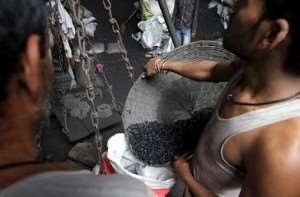
But now Mr. Jayaswal is embroiled in a $34 billion coal http://ghanaian-chronicle.com/scandal-poses-a-riddle-will-india-ever-be-able-to-tackle-corruption/3-at-a-coal-market-in-mumbai-india-natural-resources-remain-tightly-controlled-by-politicians-and-bureaucrats/ mining scandal that has exposed the ugly underside of Indian politics and economic life: a brazen style of crony capitalism that has enabled politicians and their friends to reap huge profits by gaining control of vast swaths of the country's natural resources, often for nothing. http://topics.nytimes.com/top/reference/timestopics/subjects/c/coal/index.html?inline=nyt-classifier
'Today in India, politicians are so powerful,' said Santosh Hegde, a former Supreme Court justice who recently led a sweeping investigation of a different mining scandal in southern India. 'All together, they are looting the country.'
Coalgate, as the scandal is now known here, is centered on the opaque government allotment process that enabled well-connected businessmen and politicians to obtain rights to undeveloped coal fields. Investigators are now looking at whether Mr. Jayaswal and Vijay Darda, a member of Parliament, conspired to fraudulently obtain five lucrative coal allocations. Naveen Jindal, another lawmaker and one of India's richest industrialists, is also reportedly under investigation.
Even as the scandal has renewed public anger about rising official graft and the state of the economy, Coalgate has provided fresh ammunition for those who say India's politicians have become so venal and feckless that they are no longer able or willing to address the country's entrenched problems. The opposition Bharatiya Janata Party, which was already on the defensive because it had been implicated in Mr. Hegde's investigation, has been so eager to score political points with the latest scandal that it shut down Parliament for weeks with floor protests. It refused to allow any debate — even of Coalgate — or any voting unless the prime minister resigned over the scandal. Almost an entire session was lost.
This sort of political dysfunction is hardly new in India and, in recent years, the economy was booming even as the politicians dithered. But now that the economy is slowing sharply, particularly in the ailing energy sector, analysts say India can no longer afford a government that so flagrantly fails to deliver what it promises.
On Friday, the government approved long-pending proposals allowing foreign retailers, airlines, broadcasters and other companies to enter the Indian market in an effort to shore up the faltering economy.
Source: New York Times
European Bank overhaul meets opposition from finance ministers
The stalemate was a reminder that pushing 27 member states to cooperate remains a challenge, even when they have already pledged reforms aimed at ending their three-year debt crisis. The scale of the opposition could be a blow to Spain, which is in most immediate need of the banking aid that the program could provide.
The proposals, drafted over the summer by the European Commission and formally introduced last Wednesday, would give the European Central Bank the task of regulating all 6,000 banks in the euro http://topics.nytimes.com/top/reference/timestopics/organizations/e/european_central_bank/index.html?inline=nyt-org area by Jan. 1, 2014. Ministers and European Union officials said negotiations on the proposals would continue in the coming months. http://topics.nytimes.com/top/reference/timestopics/subjects/c/currency/euro/index.html?inline=nyt-classifier
The proposals would also give the central bank powers to take away banking licenses, to require lenders to increase their capital and to levy fines on lenders that break the rules.
During the two-day meeting here, France, Italy and Spain strongly supported phasing in the plan on Jan. 1, 2013, as the commission recommended.
But Wolfgang Schäuble, the German finance minister, said at a news conference on Saturday that meeting that deadline 'will not be possible.'
German officials have warned that the proposals as currently drafted would strain the central bank's resources and could create regulatory black holes.
Earlier on Saturday, Mr. Schäuble criticized the plan for creating expectations that such a big change in regulation could be implemented so rapidly, according to two European Union officials who spoke on the condition of anonymity because the discussion among ministers was private.
Michel Barnier, the European commissioner for financial services who drafted the plan, said at a separate news conference on Saturday that it was both 'possible' and 'necessary' to implement the plan by the start of next year.
Any delays might be felt most directly in Spain, which is already reeling from a wave of street protests this weekend against belt-tightening reforms.
The government in Madrid needs the banking rules in place before it can apply to recapitalize its banks directly from a new European bailout fund http://topics.nytimes.com/top/reference/timestopics/organizations/e/european_financial_stability_facility/index.html?inline=nyt-org to avoid piling on more debt, which would increase its borrowing costs still further.
'We need to stick to the timetable,' Spain's economy minister, Luis de Guindos, told reporters on Saturday.
The finance ministers were at loggerheads a day after top officials from the central bank and the International Monetary Fund warned European governments not to squander the current period of relative calm in markets by backsliding on promised reforms.
Yet some ministers believe that a pledge by the central bank this month to buy short-term debt http://www.nytimes.com/2012/09/07/business/global/european-central-bank-leaves-interest-rates-unchanged-at-0-75-percent.html?pagewanted=all of vulnerable countries gave countries like Spain the relief they needed because borrowing costs had already fallen to more manageable levels.
Source: New York Times
 35-year-old teacher found dead in room at Akyem Anweam
 If 2024 anti-LGBTQ bill was good, why wasn't same given to Mahama for assent? — ...
 'Oga should be worried' — Kwaku Azar reacts as pressure mounts on Ofori-Atta af...
 Nigerians facing xenophobic attacks in South Africa are legal migrants — Foreign...
 AG to meet US counterparts on pending extradition requests — Kwakye Ofosu
 JHS graduate, another drown in Twifo-Atti-Morkwa rivers during heavy rainfall
 27-year-old jailed 4years for stealing church musical equipment at Hohoe
 Call 'Rambo-style' Mintah Akandoh to order — Minority tells Mahama
 Former MASLOC CEO Sedina Tamakloe returns to Ghana after extradition to serve 10...
 KMA to reintroduce enhanced ‘Samansaman’ sanitation enforcement system from July...


