




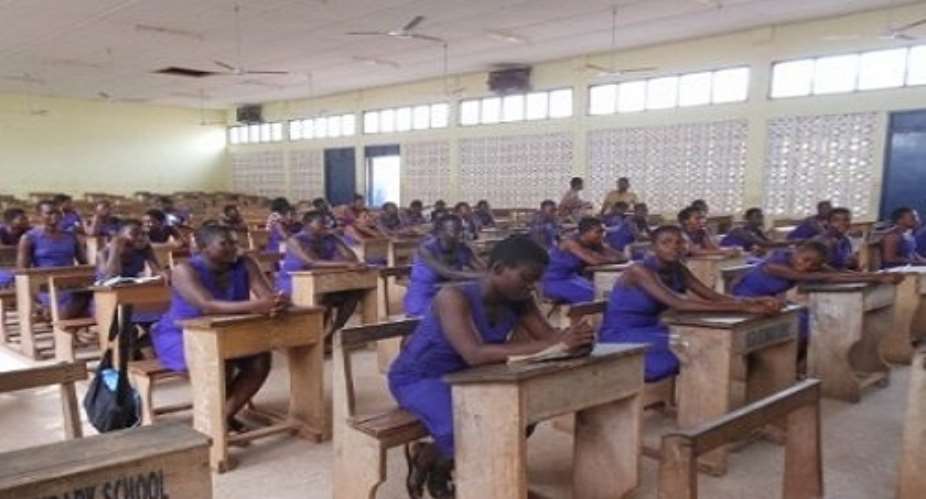
Innumerable arguments have been raised concerning the adoption and implementation of the Free Education Policy by the NPP government. This short essay aims at highlighting the shortcomings of the free education policy by the NPP government and contribute to it.
Indeed, Ghana needs free education. The hopes of most students of securing a secondary education are truncated due to inadequate financial support. This problem has negatively affected the lives of many young people in Ghana.
Majority of these children become waifs on the street and engage in all forms of vices. Education has become a prerequisite for a better future of every country therefore the free education policy will pave way for these young people to have access to education for them to contribute their quota to national development and minimize the case of several social deviants in the Ghanaian society.
The free education policy which is yet to be implemented by the NPP government was very instrumental in success of the New Patriotic Party. Other policies which resonated well with the Ghanaian populace were the one district-one factory, one constituency-one million dollars, as well as the restoration of nursing and teacher training allowances.
The free education policy seeks to eliminate admission fees, library fees, examination fees, laboratory fees and utility fees. In addition, students will be provided with free meals, free textbooks and free boarding. Day students would not be excluded from the policy as they would be provided with free meals. The policy will also cover vocational, agricultural and technical institutions at the high school levels.
There is no doubt that the free education policy will help solve the problem of access to secondary, vocational, agricultural and technical institutions in Ghana. The expected policy outcome would be that, students will only need to dress along with their bags and head to school.
This policy will also encourage most young people who are interested in pursuing higher education to do so as the most formidable barrier that hinder access to secondary education in Ghana will be eliminated. The free education policy will reduce the burden of most parents and enable them to efficiently cater for their children in all aspects of life.
My reservations on the free education policy have to do with the approach to the policy as regards its adoption and implementation. In the first place, I think the implementation of the policy is in a haste, the government could have delayed the policy to the 2018/2019 academic year. This is because Ghana is in a dire economic situation as evidenced in current gradual falls in our economic indicators.
The economy of Ghana is facing a lot of financial challenges hence solving this problem should gain a major priority on the agenda of every new government. This would enable the government to deal with the economic challenges and stabilize the economy. I think the government is implementing the policy in the 2017/2018 academic year because of fear of criticisms from opposition parties and from the citizens as they promised during campaigns that the policy will take effect immediately after election.
Consequently, the government is implementing it now to prove its capability of making it which should not be the case. Aside the haste in the policy implementation, let’s look at the beneficiaries of the policy.
According to the government, for a student to benefit from the free education policy, the student must meet the academic requirement of the West African Examination Council which is aggregate 24 and above. That is from aggregate 6 to 24. Also, students who completed Junior High School in previous years but could not pursue their high education due to financial constrain are also excluded from the policy.
Now let’s look at the deficiencies of the aggregate 24 as a yardstick for students to benefit from the free education policy. I think aggregate 6 to 24 should not be used to assess the academic performance of students to enable them benefit from the policy. In the first place, students only have five days to write their WAEC basic examination which is the requirement to attend high school.
Within this period, students write nine subject papers. However, a lot of circumstances may occur in these days which can have negative effects on the performance of some students in their exams. For instance, a student may fall sick.
One problem I have with WAEC is that if a student is exempt from writing the exams or a specific paper due to some circumstance, there is no reasonable accommodation provided to that student to write the exams or that specific paper again unless otherwise the student returns to the basic school and write the exams the following year.
For this reason, most students force themselves to write the exams even when they are in a serious state. Sometimes some students write the exams whiles on a sick bed at the hospital. The question is how can a student in this condition produce the best in the exams? So it will not be fair to exclude such students from the policy if they do not meet the requirement.
Aside the health aspect, most conditions also limits students’ performance in examinations. For example, there was a friend of mine in the Junior High School, this student was very brilliant and was always among the top five in our class, but unfortunately for him, he lost both parents a day before our WAEC final exams because of car accident.
This uncertainty deeply affected my friend both emotionally and mentally. But he forced himself to write the exams and attained aggregate 36 even though he was brilliant, and most of his friends he used to teach them had excellent exam scores.
This boy could not produce his best due to the death of his parents and in this case, he will be excluded from been a beneficiary of the free education. Also, there are a lot of students who are slow in terms of academics but as they progress to the higher level they become brilliant.
For instance, a student may get aggregate 40 in the WAEC basic education final exams but this same student will go to the high school level, perform very well to pass the final exams and finally graduate with a First Class Honors from the university. This is because psychologically, most students become brilliant as they grow. Only few exceptions are brilliant from the onset. Assessing the performance of students based on an exam they write within a short period of time is not justifiable.
In addition, natural disasters such as flooding can also negatively affect the performance of students who are living in coastal villages and deprived communities during examination period. Most students living in these areas must cross about two or three rivers before they get to the examination center.
Quite unfortunately, the period for writing the WAEC exams in Ghana is also a rainy season so a lot of flooding occurs in the coastal areas and students in these areas have no option than to cross to the examination center to write the paper.
Students therefore become confused and frustrated because they may be under pressure thinking of how to go back home especially when it rains whiles they are still in the exams center. These students therefore give partial attention to the exams which negatively affect the outcome.
All these factors contribute in diverse ways to discourage students from given out their best in exams. Another danger of aggregate 6 to 24 as a measure to have access to free education is that it is likely to give rise to examination malpractice. Aggregate 24 as a ticket to access free education means that by all standards, a student should get aggregate 24 or better in their final exams since every student wants to be a beneficiary.
Although students will learn and prepare very well before the exams but the worse side of it is that most students and even most schools will engage in examination malpractice to meet the expectation and this will be a threat to our educational system. For example, a student from a deprived school in a certain village will write the final exams on his or her own without any external influence or help and attain aggregate 30, another student from a well-organized school in the city with a lot of privileges and facilities at their disposal may also write the final exams with a lot of external support and graduate with aggregate 8.
The free education policy will give priority to the student who got aggregate 8 at the expense of the one who got aggregate 30. But on fair grounds, the student with aggregate 30 may be academically good than the one with aggregate 8. This shows clearly that the way in which the policy will be implemented will indirectly lead to discrimination. In this case the national cake is not fairly distributed among the citizens.
For a countries’ democracy to prosper, one outstanding feature is that all citizens must have equal access to state resources without any discrimination.
Let’s look at the exclusion of those who completed high school in previous years. The main reason why these children are still at home and others left on the street is as the result of lack of financial support to pursue their education.
Many of these children became inspired through the promises given by the government during campaign. The party did not made it clear that these children will be excluded from the policy. So, hopes and aspirations were very high and these children were preparing to pursue their secondary education.
The government then became neglectful when the intentions was made after winning the elections that students who completed Junior High School in previous years are not part of the beneficiaries of the policy. This implies that these children have three options to choose from.
The first is to pay for everything if they still want to pursue higher education. The second is to return to the basic school and write another WAEC final exams and graduate with aggregate 24 or better if they still want to benefit from the free education policy. And the third is to remain as they are and struggle for a living.
All these options pose a threat to the children. The first two options have to do with money which they do not have and the last option is dangerous because of its negative impacts on the lives of the children. These children been excluded from the policy is also a symbol of discrimination since their rights to a fair share of states resources will be denied and this also serve as a threat to our democracy.
My recommendations for an effective implementation of this policy is as follows. It should be an open policy in which every student who is attending Senior High in the 2017/2018 academic year will be a beneficiary devoid of any barriers such as aggregate or grade limits. Also, it must include students who completed in previous years.
This policy must be implemented in a way that the outcome will address three major problems that Ghana is currently facing in the higher educational system. In the first place, the policy must provide free education for secondary students, it must also improve academic performance of students in their exams both internal and final exams, and lastly it must solve the problem of whether the duration of attending secondary school in Ghana should be three years or four years.
The free education policy should be in the form of a scholarship package to students. All first-year students should have access to free education for the start including those who completed Junior High in previous years without any barrier but the condition should be that students will continue benefiting from the package only if they exhibit satisfactory academic performance in school.
The assessment of the performance of students in this instance should not be in the form of ranking the students from first position to the last position as per their academic performance in the exams they write in school but it should be in the form of individual subject assessment per each student.
This will help improve the performance of students academically. The reason is that, a student may get for instance 90% in Government, 87% in Social Studies, 35% in Science, 92% in English,31% in Mathematics and 89% in
Economics but will still be the first in the class based on their exam performance. The deficiency is that though this student is good, there is the likelihood that he/she will fail Mathematics and Science in the WAEC final exams.
The student been the first in the class means that the higher marks attained in the other subjects were used to complement Mathematics and Science.
Certain benchmark should be accorded to students with regards to the pass mark they should get in all subjects to continue benefiting from the scholarship. For example, let’s say the pass mark is 50% so students are expected to get 50% and above in all subjects to qualify for the package.
The rule should be this, if a student fails or get below 50% in more than three subjects in just one academic term that student will no longer benefit from the package. In effect, student will continue with his/her high education but will no longer be a beneficiary of the scholarship.
The amount of money the government is investing in this policy is very huge hence certain measures must be instituted to ensure that the policy yields its desired benefits. Without any conditions students will benefit from the scholarship and still perform very poor in terms of academics. If this happens it means the government has unwisely used states funds because efficiency and effectiveness will not be achieved.
The free education policy coming with these conditions will encourage students to develop interest in learning all subjects on equal grounds because students mostly love to read the subjects they like most at the expense of other subjects and this negatively affect their general performance in exams.
I think the policy been adopted and implemented in this way will do away with any form of discrimination because all first-year students will have equal share in the policy for the start. A student will therefore have him or herself to blame if they do not continue to benefit from the package.
This policy will also bring out the best in every student because students will perform academically well to continue benefiting from the scholarship. It will prepare students to be ever ready for WAEC exams. At the same time, the policy will help solve the controversy of either the duration of attending High School should be four years or three years because students will become more academically serious to the extent that even if the duration is two and half years they will still perform very well in their final exams. Much attention should then be on the tutors by encouraging them to give out their best.
In climax, free education is indeed necessary for Ghana and much commendation will go to the recent government in their effort to implementing this policy. As policy develops and increase in its scope as time goes on, I think the government would become aware of the deficiencies on the method of implementation and include certain measures through incremental means.

 One dead, fire officer hospitalised after bee attack at Quarry Site in Sokode Gb...
 Israel and Iran step back from further strikes after renewed clashes
 Patients stranded as doctors, nurses refuse to see new patients over KATH CEO su...
 Avenor Rural Bank CEO’s house destroyed by fire
 Three arrested in Winneba for illegal mining near GWL water lines
 Two pupils of Alice Elite Academy laid to rest after fatal school bus crash
 Here are areas to be affected by ECG's planned maintenance on Tuesday
 Family of civil engineer killed in alleged military shooting demands justice
 SHS teacher allegedly beats female student over unpaid hostel fees
 Blow to EU defence cooperation as France, Germany abandon joint fighter jet prog...



Comments
good article