




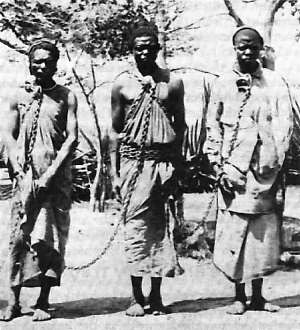
A castle dedicated to slave trade in Ghana was also the site of the country's first Christian chapel, delegates of a global church organization have heard. Members of the executive committee of the World Communion of Reformed Churches (WCRC) learned about the chapel during a guided visit to Elmina Castle in Ghana prior to beginning meetings today near the country's capital, Accra.
'How could the church pray over dungeons?' a pastor of the United Church of Jamaica and the Cayman Islands asked the group following the visit.
Collin Cowan, who currently serves as the head of the Council for World Mission, posed the question in a sermon preached at a service arranged at the castle by local Presbyterian congregations for the committee following the visit.
The Jamaican clergyman reminded those attending the service that the sale of human beings for profit continues today in a practice commonly referred to as 'human trafficking' in which children, women and men are tricked or sold into enforced labour as sex workers or agricultural labourers and prevented from returning to their home community.
'How do we pray among the atrocities being meted out in today's world such as child labour and human trafficking?' Cowan asked.
The castle's chapel built at the end of the 15th century was used by Portuguese Catholic traders. When the Dutch captured the castle and took over the trade in 1637, they built their own chapel for Protestant worship.
They continued to trade in slaves until 1814. Today the Portuguese chapel is a museum focused on the history of the slave trade.
Lydia Adajawah, a Ghanaian executive committee member, sees a strong connection between the history of the trade in African slaves and the issue of human trafficking today.
'I just returned from a WCRC consultation in Cuba on human trafficking where we saw the link to modern day slavery,' Adajawah says. 'We saw how we allow financial hardship to drive people to seek work in perilous conditions. They are desperate for work and then find themselves enslaved.'
'It is hard to admit but Africans were complicit in the slave trade,' Adajawah notes.
'At the consultation we saw how people around the world today too are implicated in modern slavery.'
WCRC's executive committee will hear a report on the Cuban consultation during its meeting that gets underway today and runs until 17 May at the Forest Hotel in Dodowa, in the greater Accra region. The committee is expected to make church response to human trafficking a programme priority for 2014.
The World Communion of Reformed Churches (WCRC) represents 80million Christians in 108 countries. Through WCRC, member churchesengage in ecumenical dialogue, promotion of church unity, theologicalstudy and worldwide initiatives supporting climate, economic andgender justice and church mission.
Editor's Note:Media Contacts:
Kristine Greenaway
Office of Communications
World Communion of Reformed Churches
Email: [email protected]
tel: +233 546 131 782
www.wcrc.ch
 BoG's $260 million building: It was Ato Forson who first proposed 'sell-and-leas...
 'We have to do soul-searching' — Mahama orders nationwide flood assessment
 Court orders woman beater to pay GHS5,000 compensation to midwife at Tema Commun...
 Over 12,000 women living with obstetric fistula in Ghana — Asokwa MP
 Mahama secures 1,840 farm equipment deal from Belarus
 Titus Glover slams Mahama’s flood report directive, calls it “waste of energy an...
 We have increased posting of doctors from 12 to 100 to underserved regions in 20...
 'You had the effrontery to call me struggling lawyer, you won't come back to pow...
 Belarus manufacturers to storm Ghana next week after President's visit
 Government to offer tax incentives for factories located outside Accra



Comments
Slavers had no problem with this because the Bible itself justified the ownership of slaves - read Leviticus 25 44:46. A teaching from the Old Testament which these days is usually overlooked.