




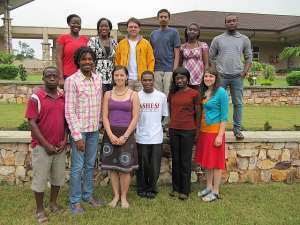
Ashesi University College (Ashesi), a world class university located on the Berekuso hills, Eastern Region, is undertaking two innovative research projects that will contribute to its goals of maintaining a green campus for the future leaders of Africa to study at. The projects are being conducted in collaboration with a team of students from Carnegie Mellon University (CMU), Pittsburgh, U.S., under the iSTEP summer internship program organized by the TechBridgeWorld research group at CMU. The project, dubbed iSTEP 2012 Ghana, brings together interns from CMU and Ashesi to develop systems for monitoring and managing water usage and waste generation on Ashesi's campus.
Ashesi believes strongly in environmental sustainability. As the university expands its infrastructure and enrolls more students, it realizes the importance of being pro-active about monitoring its impact on the environment and surrounding communities. This includes managing resources like water and monitoring the university's generation and disposal of waste. The CMU-Ashesi team has been conducting thorough background research and needs assessment of the water and waste projects and their findings are being used to develop solutions to suit the campus' needs. In addition, the team will provide suggestions on how these solutions can be incorporated into future phases of campus construction.
The team is developing a suite of technological tools to track consumption, collection and disposal of water and waste resources throughout Ashesi's campus. These tools include an SMS data recording application, a database content management system and a visualization interface for the data. The technology solutions that come out of these projects will be open sourced for the benefit of others in Ghana and the global community. It is also hoped that the awareness campaign solutions that come out of these projects will be useful to other organizations.
One interesting research finding was made during the team's June visit to Zoomlion Ghana Limited, where it was discovered that the composition of waste produced at Ashesi was similar to that collected in Accra by Zoomlion. The team's needs assessments have also revealed that 63% of Ashesi's waste is compostable, and a further 15% is recyclable in some way (paper, plastics, glass, etc.).
The team keeps a very lively online journal of their experiences working on the projects on their blog: http://istep2012.techbridgeworld.org. A copy of the final research report on the projects will also be made available at that link.
 Nyinahin Catholic SHS teacher seen fighting female student in viral video arrest...
 Beijing condemns US move to blacklist Chinese companies
 Trump gets a cold reception at NBA Finals game as Spurs beat Knicks
 One dead, fire officer hospitalised after bee attack at Quarry Site in Sokode Gb...
 Israel and Iran step back from further strikes after renewed clashes
 Patients stranded as doctors, nurses refuse to see new patients over KATH CEO su...
 Avenor Rural Bank CEO’s house destroyed by fire
 Here are areas to be affected by ECG's planned maintenance on Tuesday
 SHS teacher allegedly beats female student over unpaid hostel fees
 Blow to EU defence cooperation as France, Germany abandon joint fighter jet prog...


