




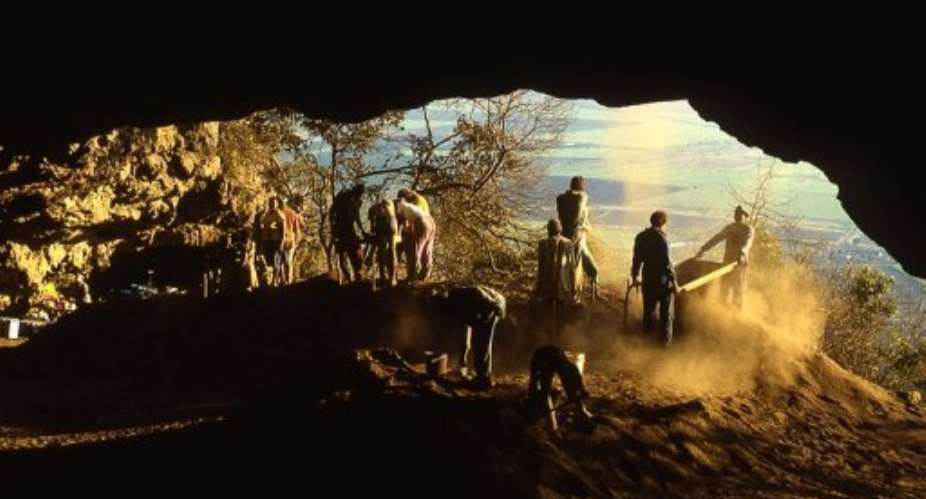
WASHINGTON (AFP) - The first signs of poison darts and beeswax used in toolmaking have been found in a South African cave, suggesting that a modern hunter-gatherer culture emerged earlier than previously thought.
Artifacts at the Border Cave, an archeological site on the border of Kwa Zulu Natal and Swaziland, have been reanalyzed and dated to 44,000 years ago, about twice as old as widely believed, said the research in the Proceedings of the National Academy of Sciences.
These signs of advancement, signaling perhaps the oldest traces of modern culture in what is known as the Later Stone Age, would coincide with the first known migration of humans from Africa to Europe, said the US-published study.
The research focused on items left by what are known as the San people, including ostrich eggshell beads, bone arrowhead points, wooden digging sticks, warthog tusks and beeswax likely used for making tools.
Women are believed to have used the digging sticks to unearth bulbs and termite larvae.
"These digging sticks from Border Cave are the oldest artifacts of this kind known from South Africa or anywhere else in Africa," said Paola Villa, a curator at the University of Colorado Museum of Natural History.
Advancing hunting technology was visible at this time, too, with thinner bone points that suggest the use of bows and arrows, and tips that were enhanced with poison in order to bring down medium and larger sized animals.
The poison used is believed to be ricinoleic acid, which can be derived from the seeds of castor oil plants.
"Such bone points could have penetrated thick hides, but the lack of 'knock-down' power means the use of poison probably was a requirement for successful kills," said Villa.
Researchers also found what is believed to be the oldest known use of beeswax, combined with egg and resin to help attach blades to the shafts of weapons like arrowheads or other tools.
"This complex compound used for hafting arrowheads or tools, directly dated to 40,000 years ago, is the oldest known evidence of the use of beeswax," said Lucinda Backwell, senior palaeoanthropology researcher at University of the Witwatersrand in South Africa.
The more refined analysis of the age of the artifacts was performed by an international team of researchers, led by Francesco d'Errico, Director of Research at the French National Research Centre.
Scientists used more precisely calibrated radiocarbon dates of organic artifacts to reach their conclusions, which add to the long-running debate over how and when modern culture emerged.
 Former MASLOC CEO Sedina Tamakloe returns to Ghana after extradition to serve 10...
 Tension in Birim North as angry NDC youth attempt to disrupt cooperative mining ...
 One dead, several injured in tipper truck and fuel tanker crash on Accra–Tema Mo...
 How 70-year-old building was finally demolished over fear of collapse in Osu
 Minority MPs thank Afenyo-Markin for capacity-building programme in Canada
 Ghana has everything needed to prosper yet graduates remain unemployed — Dr Step...
 June 9: Cedi sells at GHS12.50 on forex market, GHS11.85 on BoG interbank
 Stephen Amoah advocates mixed market economy to tackle rising cost of living in ...
 KMA to reintroduce enhanced ‘Samansaman’ sanitation enforcement system from July...
 Nyinahin Catholic SHS teacher seen fighting female student in viral video arrest...


