




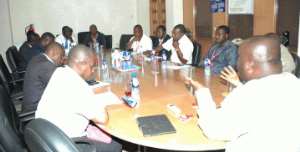
Mr Ken Ashigbey, Managing Director of GCGL addressing the meeting. The Graphic Communications Group Ltd (GCGL) has initiated moves to give equal, fair and adequate coverage to all political parties in the upcoming elections.
The coverage will centre more on issues than on political events and a fair presentation of a party’s policies on various sectors would be carried by the company’s newspapers to enable the public to make informed judgements.
The GCGL’s management stated this at a meeting with representatives of political parties at the company’s offices in Accra Tuesday.
The meeting, the first ever between the political parties and the GCGL,was to discuss the use of the company’s platform for communication and advertising by the political parties and the printing of party brochures,pamphlets and other paraphernalia.
Management of the GCGL were represented by the Managing Director, Mr Ken Ashigbey; the General Manager, Newspapers, Mr Yaw Boadu-Ayeboafoh; the Editor of the Daily Graphic, Mr Ransford Tetteh; the Deputy Editor of the Daily Graphic, Mr Breda Atta Quayson; the News Editor of the Daily Graphic, Mr Nehemiah Owusu-Achiaw; the Political Editor of the Daily Graphic, Mr Kobby Asmah; the General Manager, Marketing, Mr Frank Oduro, and the General Manager of Graphic Packaging (G-Pak), Mr Charles Antwi.
Representatives of political parties present were Messrs Kwame Jantuah and Nii Armah Akomfrah, Deputy General Secretary and Director of Communications respectively of the Convention People’s Party (CPP), Mr James Asante, Communications Director of the National Democratic Congress (NDC); Kofi Asamoah-Siaw, Samuel Ampah and Richard Nii Amarh, National Secretary, Deputy Communications Director and Volunteers Co-ordinator respectively of the Progressive People’s Party (PPP).
Members of the New Patriotic Party (NPP) and the People’s National Convention (PNC) failed to turn up although the parties had been invited and they had confirmed their participation.
Mr Boadu-Ayeboafoh stated that political parties would be required to tell the GCGL the policies and programmes they intended to implement in specific sectors such as health and education for publication and also supply the company with names of accredited spokespersons which the company’s newspapers should deal with.
He said the GCGL wanted to move away from the heavy concentration on political rallies and events and the populism that went with them and pay more attention to programmes that would enhance development and raise the current status of the ordinary Ghanaian.
He expressed the hope that when the company made the move to ascertain what policies and programmes the parties had, it would not be rebuffed with the excuse that the programmes would be found in the manifestoes when some of the manifestoes came out only after elections.
Mr Boadu-Ayeboafoh said the GCGL’s newspapers would also speak only to accredited spokespersons because sometimes people who were not authorised to speak on behalf of parties made statements that were sometimes inflammatory and outrageous.
He said reporters of the company’s newspapers would be assigned to follow presidential candidates of political parties as usual during the run-up to the elections to report on their campaigns.
He said training programmes would be held for the reporters who would be designated to follow the presidential candidates and urged them to co-operate with the GCGL in the endeavour.
In his contribution, Mr Tetteh said as a state-owned media, it was the responsibility of the GCGL and its newspapers to hold political parties accountable to the public and added that the relationship between the two should not be adversarial.
Anytime the parties had issues to raise about reportage in the GCGL’s newspapers, he said, they could contact the management for redress and advised against hostility.
Mr Ashigbey, for his part, said by the 1992 Constitution, the GCGL was mandated to give equal access to all political parties and the discussions were in furtherance of that mandate.
He said the December elections were all about choosing leaders to lead the country, and that the GCGL’s platform was available for them to use but cautioned against the use of abusive and inflammatory language that would breach the peace.
He said the GCGL would hold town hall meetings with the political parties in the regions to further provide platforms for them to articulate their policies.
Mr Ashigbey warned that although the GCGL would not, through its newspapers, repeat inflammatory language used by politicians, it would unmask people who used insulting language.
He expressed the hope that the elections would be peaceful to further enhance Ghana’s democratic credentials.
Mr Oduro announced that the GCGL would provide 25 per cent discount on all political adverts on pre-payment basis and 10 per cent rebate for subscription of each copy of the Daily Graphic.
He added that the GCGL would distribute the company’s newspapers at the regional and district offices of the political parties at its own cost if the parties so wished.
He encouraged them to use civil language to craft the political adverts, adding that they would be rejected if their language was found to be inflammatory.
Mr Jantuah urged the GCGL to serialise the Political Parties Code to educate the public on what was expected of them.
He expressed gratitude to the GCGL for deciding to focus on issues, saying that would “water down” the acidic discourse.
He expressed the hope that reporters would be trained to ask politicians questions that would steer politicians away from insults.
Mr Asante of the NDC and Mr Ampah of the PPP commended the GCGL for what they described as a laudable initiative and suggested that other stakeholders such as the GJA could organise similar programmes to deepen political party coverage and multi-party democracy.
 Nyinahin Catholic SHS teacher seen fighting female student in viral video arrest...
 Beijing condemns US move to blacklist Chinese companies
 Trump gets a cold reception at NBA Finals game as Spurs beat Knicks
 One dead, fire officer hospitalised after bee attack at Quarry Site in Sokode Gb...
 Israel and Iran step back from further strikes after renewed clashes
 Patients stranded as doctors, nurses refuse to see new patients over KATH CEO su...
 Avenor Rural Bank CEO’s house destroyed by fire
 Here are areas to be affected by ECG's planned maintenance on Tuesday
 SHS teacher allegedly beats female student over unpaid hostel fees
 Blow to EU defence cooperation as France, Germany abandon joint fighter jet prog...


