




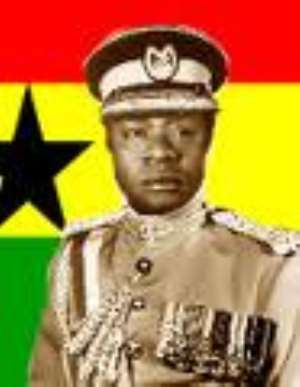
Today is March 30. 34 years ago today, something monumental happened to change the course of the history of this Republic. On that day, Ghanaians went to the polls in a referendum aimed at sanctioning into being a new political system for the country in which political parties were not to feature.
The originators of the concept dreamt up a system of Union Government in which the military and the Police were to join the civilian population to fashion out a concept of government in which political parties were to be kicked to touch forever.
Its origin was mired in the military's unwillingness to cede power to civilians after Ignatius Kutu Acheampong had seized power on January 13, 1972. From 1976, when the idea was first mooted until the actual vote on March 30, 1979, the political scene witnessed many associations masquerading around the concept and siphoning state resources for their operations.
The idea of Union Government, according to the originators was to address 'the need for a constitutional third way for a representative democracy based neither on Westminster style party system nor military rule, but on traditional values and practices of Ghanaians.'
At the University of Ghana, which was the bedrock of anti-UNIGOV, students followed the unfolding drama on the political scene with disdain. Every word of the Chairman of the Supreme Military Council was followed and interpretations given.
Explaining the concept at a public event broadcast live by Ghana Television and Radio Ghana, then Chairman Ignatius Kutu Acheampong was quoted by students thus: 'The Union government we are talking about is not the unity of one man but the unity of the individual.'
At a rally at Obuasi in the Ashanti Region, Acheampong had blamed smugglers for the shortage of essential commodities on the market in Ghana. He told a bewildering nation that while the shells at the GNTC, the Ghana National Trading Corporation were empty, Togo GNTC were full of goods smuggled from Ghana.
To fix the problem, he had decided to appoint an indigene of the Adansi Traditional Area, Mr. Kofi Badu, who became Managing Director much later, to distribute those essential items. 'If Kofi is unable to let the goods reach you, we would have to bring in the Biblical Peter to fix it.'
In spite of this assurance, opposition to his rule and the Union Government concept never abated. In his frustration, the then Head of State declared at a rally to canvass support for the concept thus: 'Nsuo Nto A Yese Acheampong. Acheampong Meye Nyame Na Mato Nsuo.' (Even when it failed to rain, Acheampong is blamed for it. I'm I God to cause rain to fall?' he queried.
It got to a point in time when students of the various universities were putting pressure for the military to vacate the scene. As the Supreme Military Council failed to be decisive on hand-over, students of the then three universities demanded a guarantee for the military to vacate the scene.
When told of the recalcitrant stance of the students, a rather disappointed Head of State remarked in Twi. 'Nkodaa No Se Wope Guarantee, ENso Obiara Amfa No Size Amba.' The children are demanding guarantee but none of them brought his or her size.
In spite of the fact that the military in government became authoritarian and sent armoured cars to run after the students on the least provocation, the various campuses were lively with students especially mimicking every word of the then Chairman of the Supreme Military Council.
In those days, when Kwesi Yanka's Abonsam Fireman in the Catholic Standard thrilled the nation, the adventures of Alhaji Blanket and Kungfu were legendary. It came to pass that student agitation would not cease. Chairman Acheampong surveyed the damage the agitation was doing to his regime. Bro' Kutu, as students fondly referred to the later Ex-head of State, at the time, called his advisors to strategize. It was when the most profound declaration was made.
'Nkran Legonfo No Koraa Die, Mommo Ye kakra. Na Kumasi Legonfo No Die, Wommo Nye Koraa. The Accra Legon people are slightly better. As for the Kumasi Legon People they are not good all. Apparently, in the diction of the then chairman of the SMC, Legon was the name for the university. Every university, according to Gen. Acheampong, was therefore Legon.
The conceptualization of the Unigov Concept marked the arrival in Ghana at public expense of Clara Prophet, a so-called American evangelist.
Her concept of the Union Government was captured along the lines of the Holy Trinity. In the opinion of Clara Prophet, the Father was represented by the military, the student population signified the Son while the civilian population was the Holy Ghost.
So much time on good old GBC and the two daily newspapers were used to propagate Union Government that there was very little else to broadcast or write about in the national dailies. Both the Daily Graphic and the Ghanaian Time were devoted to the promotion of the Union Government concept. The two newspapers had full page colour pages calling on the electorates to vote Yes.
It read thus: 'March 30 Eye Blue oo Blue.' Blue was the colour for Yes while the No vote had red as its colour. No campaigners had a simple slogan: 'Yegyaa Mu,' an Akan description for rejection.
One interesting aspect of the vote was the way the results of the Referendum were communicated to the people. When the first result was released it was that of Bawku East. Needless to state that at that point in time, the mobile phone had not been manufactured and electricity had not been extended to the north.
How Bawku East result came ahead of Osu Klotey, where the Electoral Commission had its offices told everything about the lie in the result. Apparently, the Electoral Commissioner had to scale the walls of the Commission offices and run away as soldiers were dispatched in the night to teach him a lesson or two.
Mr. Justice Isaac Kobina Abban became a house-hold name. His refusal to play ball with the military oligarchy stood him in good light. Long after the SMC had been toppled, Mr. Abban became Chief Justice in the First term of the Fourth Republic.
With the Electoral Commissioner out of the way, the Minister of Interior had a field day falsifying the figures. According to the official figures released, a total number of 4,497,8703 people were registered to vote. Out of this figure, 2, 282,813 actually cast their votes. According to official figures released, 1,372,427 voted Yes. This figure represented 60.11 percent of the total vote. No registered a total of 910,386 or 30.89 percent of those who actually voted.
The release of the figures rather increased agitation in society. The Professional bodies down their tools while students of the three universities abandoned the classroom. On July, 1, 1978, Lt.Gen. F.W.K. Akuffo, then Vice-Chairman of the Supreme Military Council and Chief of Defence Staff, announced the Palace coup that toppled Acheampong. The former head of State was stripped of his military titles and confined to his hometown Trabuom in the Ashanti Region.
One of the charges levelled against Achempong was that he had run a one man show. Obviously, Mr. Kutu Acheampong was not pleased with the charge. To prove that those leveling the allegation were lying, Acheampong responded: One man show. They must be jokers. Were we not eating Omo Tuo together every Sunday?
Akuffo's SMC abandoned Unigov and tinkered with the idea of forming a Transitional Interim National Government (TINAGOV). But that failed to placate agitators for a return to civilian rule. In the end, the military regime caved in and announced the time-table for the return to Constitutional rule. A Constituent Assembly was composed to draw a new constitution for a return to Constitutional rule. But the agitation continued in its various forms until Flt. Lt Jerry John Rawlings led an eight man mutiny on may 15, 1979. The mutineers were promptly crushed.
The mutineers were standing trial when junior officers and other ranks led by Capt. Kwodwo Boakye Djan stormed the Special Branch guardroom and released Flt Lt. Rawlings to lead a mutiny that became known as the Armed Forces Revolutionary Council on June 4, 1979.
The ARFRC executed eight leading officers in the armed forces including three ex-Heads of State and unleashed some of the most terrible human rights abuses on the people of Ghana. On this auspicious occasion, I dedicate this column to one head of state who caused so much fun and died so that anoher group of adventurers could exploit the system to move themselves from penury existence to become the Noveau Riche of society.
By Ebo Quansah in Accra
 Abandoned newborn baby found near gutter at Agona Swedru Woaraba
 Reparations Justice Forum questions imported schnapps for African libation ritua...
 35-year-old teacher found dead in room at Akyem Anweam
 If 2024 anti-LGBTQ bill was good, why wasn't same given to Mahama for assent? — ...
 'Oga should be worried' — Kwaku Azar reacts as pressure mounts on Ofori-Atta af...
 Nigerians facing xenophobic attacks in South Africa are legal migrants — Foreign...
 AG to meet US counterparts on pending extradition requests — Kwakye Ofosu
 JHS graduate, another drown in Twifo-Atti-Morkwa rivers during heavy rainfall
 27-year-old jailed 4years for stealing church musical equipment at Hohoe
 Call 'Rambo-style' Mintah Akandoh to order — Minority tells Mahama


