




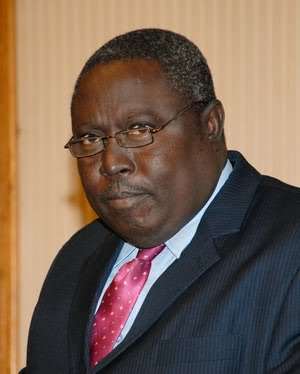
A statement from the President's Office is not a joke. It is issued in the name of every citizen of Ghana, though it may be drafted and signed by 'the President's Chief of Staff' or someone to whom he assigns the task.
Unlike a statement from the Ministry of Information, for example, it cannot be 'corrected' or 'amplified' by a higher authority, in this case, the President's Office.
That is why the statement from the President's Office announcing that the President had relieved the Attorney-General, Mr Martin Amidu, of his job, was so disappointing. It led to more questions being asked about the President's position on the Woyome issue; questions which, it should have been foreseen, would naturally be asked, and which should therefore have been anticipated and answered.
The most important question of all is: what, in the eyes of the President, constitutes a “misconduct”? Did Mr Amidu raise his voice against the President? Did he continue talking when the President was making a point?
Both can be considered as acts of 'misconduct', yes, but only a simpleton would conclude that one should not raise one's voice to the President under any circumstances. Suppose a snake was crawling towards the President's neck and one caught sight of it, wouldn't one yell at the top of one's voice: “GET UP AND RUN, MR PRESIDENT'?
Or, to take the question of impolite interruption: suppose one was in attendance at a meeting the President was having with foreigners and the President was in the process of unconsciously letting out a state secret, would one have committed a 'misconduct' if one found a way of stopping the President from doing so?
Now, nobody who was not at the meeting between the President and Mr Amidu is in a position to tell what took place at the meeting that appeared in the eyes of the presidency to be a “misconduct”. But let us presume that Mr Amidu was “boiling” with rage when he entered the President's Office. If he was boiling, it was because he suspected that the very President who had come for him, when he was “sitting his somewhere”, and asked him to accept an appointment as his Attorney-General and Minister of Justice, had secretly set his dogs of war on him. He had seen a campaign in “rented NDC newspapers” impugning his integrity and questioning his professional competence, which bore the signs – in Amidu's experienced eyes – of having been orchestrated by, at best, 'people close to the President,' who are known to insiders as "The Castle Mafia".
Amidu had been so stung by this suspicion that he had taken the unprecedented step of issuing a public statement in reply, in which he had made accusations he would not normally make unless he suspected treachery against himself. If, having made this very frank and angry public statement, he was then called before a group of people, including the President, whose purpose he recognised as constituting themselves into a 'kangaroo court' to give him the stick, what would be his natural reaction?
No-one behaves politely when confronted with a 'kangaroo court'. For a 'kangaroo court' harangues its victims. And the victims instinctively strike back. A 'kangaroo court' also heckles its victims. And, normally, when people are heckled, they get hot under the collar. They heckle back. Pity if one of the hecklers happens to be the President of the Republic. For there are some people on this earth who believe that all men are created equal, and no-one should be able to bully another just because he holds a superior office.
That having been said, even if any genuine 'misconduct' occurred at the meeting, the President would have been well-advised to take into account, the peculiar circumstances under which the meeting was being held. Mr Amidu claimed to have uncovered a 'gargantuan fraud' in which a fellow Minister of State had, by negligence, or conspiracy, sought to defraud the state, or both, by enabling an instantly recognisable huckster to pocket between C51 and C92 million from our state coffers.
Mr Amidu comes from the Northern part of Ghana, where every dry season subjects some of the people to hardships largely unknown to many of their Southern fellow-citizens. Lack of clean water; immense dust clouds caused by passing vehicles; and failure of crops due to a lack of rain, are some of these.
Everyone can see what can be done with C51 to C92 million in Northern Ghana.
But let's not be parochial. These huge sums can also be used to cover every smelly drain in our urban areas, tar the streets and save our people from dust.
They can be used to build underpasses to ease the traffic congestion in our cities.
Schools under trees or falling walls could be a thing of the past.
Our hospitals – like Komfo Anokye – which are leaving accident cases untreated because their equipment has broken down – would cease to be death traps.
It is totally understandable if Mr Amidu has been immensely outraged to find that in spite of our horrendous difficulties, due to “lack of money,” enormous 'judgement debts' have been eating away at our treasury. As a lawyer, he is in a better position than the rest of us to detect deliberate dereliction of duty by lawyers working for the Government. For who is to question their decisions? The interpretation of the law is often a subjective matter. You conceive a defence and then seek material to substantiate it. If such “discretion” is rather used in furtherance of fraud, who is to say nay?
Indeed, had it not been for the Auditor-General, who, in his findings (some of which he is apparently busy retracting, after sending them to Parliament!) the debate on the Woyome payment(s) would never have become public. For, under the 'Rule of Law,' a 'judgement debt' is usually honoured without quibble.
Mr President, if you were not outraged enough to demand the return of the money the moment you learnt of it, let me humbly inform you that Amidu and most of us are outraged beyond measure.
Your statement that you are not “criminally-minded” is irrelevant, I am afraid. As someone who knows the United States quite well, please remember that President Richard Nixon told the American people, during Watergate: “Your President is not a crook.” And yet it was subsequently discovered, from tapes he had made of his own conversations, that he had carried out obstruction of justice, employment and bribery of criminals, illegal use of ex-CIA agents and so many other serious misdemeanour's that had he not resigned, he would have been impeached, with the support of his own Party's members of Congress.
You still have the opportunity, though, to salvage the situation. The investigations you have ordered may be regarded by your enemies as a means whereby you can potentially carry out a whitewash of the Woyome saga. But you can lean on the investigators to be thorough enough to name and shame all those responsible for the “gargantuan fraud”.
If you do that, you will go down in history as a President who patriotically allowed the chips to fall where they might, when his own administration came under suspicion. If you are not well-versed in British political history, I suggest you Google and read about “The Night of The Long Knives”. In that episode, Prime Minister Harold Macmillan's Cabinet was racked by scandal and there were moves to get him thrown out of the leadership of the Conservative Party that was then in power. But he took the initiative and dumped most of the unsavoury members of his own Cabinet. As a result, he survived, and indeed achieved a reputation as the unflappable “Super-Mac”.
Please treat this matter with the greatest seriousness, Mr President. For there are always elements within our society who think that our constitutional system of government is a 'luxury' that a developing country like Ghana should not be allowed to have. But we have seen through their subsequent behaviour, that when such people use unconstitutional means to achieve power, it is money and self-aggrandisement that they are after, not probity in public affairs. Do not play into their hands, Mr President.

 Publish a clear and detailed BoG recapitalisation plan — NPP urges gov't
 Completely abandon idea of selling BoG headquarters — NPP urges gov't
 French President Macron to attend Ghana's Next Steps Conference on Reparatory Ju...
 Nyinahin Catholic SHS teacher seen fighting female student in viral video arrest...
 Beijing condemns US move to blacklist Chinese companies
 Trump gets a cold reception at NBA Finals game as Spurs beat Knicks
 One dead, fire officer hospitalised after bee attack at Quarry Site in Sokode Gb...
 Israel and Iran step back from further strikes after renewed clashes
 Patients stranded as doctors, nurses refuse to see new patients over KATH CEO su...
 Avenor Rural Bank CEO’s house destroyed by fire



Comments
This is a disgrace to the Mills Government. Allowing this Ewe f**l to milk the country of 58 Million Dollars. Money that can build a school in every village in Ghana. Money that can prevent women from dying in pregnancy and delivery Money that can vaccinate every child in Ghana. Mills must be impeached. This is treason!!! The A-G who wanted to get our money for us has been sacked. What recourse do we have as citizens of Ghana. Let us rise up and demand our rights. These P...