




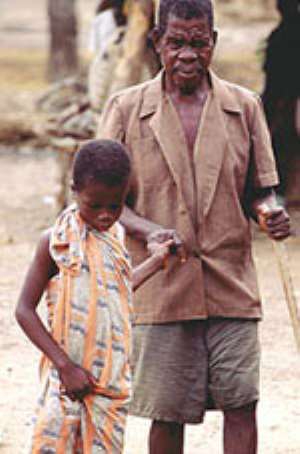
When walking through the city of Accra and some parts of its suburbs, one is sure of coming across a beggar almost every 300 metres. Begging for alms on the street is a worldwide phenomenon, however, it becomes questionable, when the number of people involved increase everyday at an alarming rate. In Ghana, begging is very common in almost all of the ten regions, especially, in the greater Accra Region, where people migrate to, looking for greener pastures. It is common among people who are physically challenged and do not have the financial support either from relatives or friends.
Each passing day, these people are found either in wheelchairs or being aided by someone in the middle of the streets. Who is to be blamed, is it the people with disability (PWD), or the government which has refused to make sure the disability law is implemented, or the citizens who are refusing to accept people with disability the way they are? The economic hardship, coupled with the level of superstitious belief of the citizens, leave people with disabilities no choice than to depend on alms begging on the streets.
PWDs in Ghana
For many people with disabilities, begging on the streets has been their source of livelihood for most part of their lives. The vicious cycle of poverty has becomes part and parcel of their generation, since they always have to beg to take care of their families. For those who have children, what they earn from begging, has never been enough to take their wards through the education they wish them to achieve.
In Ghana, begging of alms on the street is said to be against the law, however the case may be, this act of outlaw is rarely or never spoken off either by the media or government. The lack of government participating fully in the implementation of the disability law has made it impossible to stand up against the act of begging on the streets. Up till date, despite the law protecting people with disabilities, society has never being helpful in the process of giving these people a better place in the country. For many, they prefer begging on the street, despite the stigma and embarrassment associated with it.
PWDs and society
When interviewing some of them on the streets of Accra and Ashaiman, they disclosed that begging was a demeaning act, however, they prefer begging than engaging in any kind of business or going to hunt for a job. According to Madam Rita Efe Boamah, who is a mother of three, she used to be married to a man who was also physically challenged, but has passed away.
She said she used to sell groundnut cakes, but stopped along the line, since business was not going well.
In a sad narration, she noted that despite the effort she made to make the business survive, all she had was humiliation. According to her, some people refused to buy from her, due to her condition. The situation compelled her to try her luck in the various primary schools, where the pupils of the schools liked her groundnut cakes, however, business started running down when some of the food vendors in the various schools began saying bad things about her to the children. The children cultivated the habit of staring at her shrunken limbs in an uncontrollable manner, and whispered among themselves.
They stopped purchasing her groundnut cakes, and that was the end of her business in the various schools. She didn't give up, but started hawking the cakes in her wheelchair on the street, but as people were not purchasing, them she lost her capital. According to Madam Efe, it is dangerous begging on the street, but they have no choice, since sometimes, a few passengers in vehicles give them some coins. She said the friend she begs with recently joined her, as she was fired from her former place of work, with no tangible reason.
She said her friend was told by her boss that they were working at a loss, so needed to lay off some workers. Her friend later heard that she was not laid off because of the excuse her boss gave her, but rather because some of the customers complained they didn't like it when she served them.
PWDs on the streets
PWDs normally have aides when they are begging, especially, the blind ones, who they move around with, while they sing to attract the attention of pedestrians and vehicle passengers. Some of the aides take them to passengers in buses on the road when the traffic light turns red. They beg the passengers for money by saying many sad statements, but people rarely have sympathy for them. Some passengers quickly roll up their glasses and refuse to look to their direction when they see them coming, so they won't hear what they are saying.
Sometimes, they become a topic of discussion among passengers in buses, and in most of their discussions, they label them as lazy people, or evil people who if you give any alms to, in turn destroy your prospects in life. For the blind, who have no aides, they stand at one place and sing their hearts out just to gain compassion from people passing by. And with those who are totally crippled or lame, their aides bring them in the mornings to stay at a position by the road.
The sad aspect is that they stay there till their aides come back for them. They normally have no choice than to stay in the scorching sun or rain till a Good Samaritan offers to help them move.
Not long ago, this reporter boarded a bus, and in it was a woman in a wheelchair. When she came to board the bus, the driver's assistant helped her onboard and took her wheelchair into the booth of the bus. The assistant later came back to charge for the wheelchair, and to the dismay of the woman and passengers, the assistant charged her three times the actual fare, which was very unusual.
The woman begged him to reduce the price, but the assistant was reluctant to do so, while the passengers as well started pleading on the woman's behalf, but all to no avail. What the assistant said was, 'Huh! These people you don't have to have pity on them. Oh! You passengers don't know.' The woman, with a sad face, had no choice than to pay.
Government and PWDs
The passing of the disability law by Parliament on June 23, 2006, seemed to be just a formality to please PWDs, as the responsibility behind it has almost been neglected by both the government and society. According to research, the disability population in Ghana is estimated at 10% of the total population, which equates approximately 2.2 million people. This means that should the government pay attention to the progress of PWDs in the employment sector, then 2.2 million people would be able to enrich the labour force of the country.
Almost every day, there are reports in the various media about government interventions which are meant to help PWDs. The reports of these interventions bring a kind of hope to PWDs, however, in the end, many PWDs complain of not benefiting. Some PWDs complain that they were not allowed to participate with the explanation that the materials or money involved in the project was not enough for every PWD present, and that those who couldn't participate or benefit would have their turn later.
They give them false hope by taking sheets of papers around for them to write down their names, with the excuse that they are the first registered members for the next project. They wait for ages, but the so-called next project never comes to pass.
In the mid part of this year, there was a report that the government, through the Ghana Investment Fund for Electronic Communications (GIFEC), had given an amount of GH¢60,000 to the National Council on Persons with Disability, as support to the Disability Employment Project.
According to the GIFEC, the money is intended for the production of ten pilot trading booths for persons with disability in the regions 'to enable them sell telecommunications accessories such as phone recharge cards, USB data modems, SIM cards, and to carry out SIM registration.' The GIFEC said the deployment and installation of the booths began in July, 2011 in the regions, and that the project was a collaborative effort between the Council and the Ministry of Communications. It is the hope of PWDs this project reaches the turn of each of them
Conclusion
From all indications, eradicating beggars from the street will be very impossible, as society seems not to be prepared to change its habit towards people with disability. The government is always blamed for not doing its best in implementing the disability law. And from the look of things, as the government has done its part to enact this law, it is the people who are refusing to cooperate with it to implement the law. Since the people make up the government, it is their responsibility to prove their full participation in the implementation of the law, as it is a shared responsibility.

 Former MASLOC CEO Sedina Tamakloe returns to Ghana after extradition to serve 10...
 Tension in Birim North as angry NDC youth attempt to disrupt cooperative mining ...
 One dead, several injured in tipper truck and fuel tanker crash on Accra–Tema Mo...
 How 70-year-old building was finally demolished over fear of collapse in Osu
 Minority MPs thank Afenyo-Markin for capacity-building programme in Canada
 Ghana has everything needed to prosper yet graduates remain unemployed — Dr Step...
 June 9: Cedi sells at GHS12.50 on forex market, GHS11.85 on BoG interbank
 Stephen Amoah advocates mixed market economy to tackle rising cost of living in ...
 KMA to reintroduce enhanced ‘Samansaman’ sanitation enforcement system from July...
 Nyinahin Catholic SHS teacher seen fighting female student in viral video arrest...



Comments
I agree that governments over the years is not doing much to address the issues of average Ghanaians as a whole. However, i take a stance when people repeatedly have been associating begging with physcially challenged persons. i must say as a PC, that this phenomenon has been increasing and is giving a bad image about the physically challenged. indeed there are so many PCs, like myself who are doing so much for themselves and are making it big. Over the year i have had reports from other PCs ...