




THE name 'Bottom Tree or Location' is a household name among workers of the cash-strapped Ghana Railway Company (GRC) and residents in the Sekondi-Takoradi metropolis
This is because Bottom Tree or Location is the live wire of the GRC, where real artisanal works such as the repair of coaches, engines and manufacturing of rail tracks among others are done.
It is an asset owned by the cash-strapped company, but at the same time struggling to pay dividend to the company. This is because it (Bottom Three) has not been appreciated as the livewire of the company.
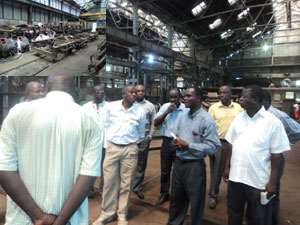
Indeed, when for the first time, the Minister of Transportation, Alhaji Collins Dauda, visited the site, he came face to face with the daunting challenges facing the various artisanal departments of the company.
From department to department, the Minister was apprised of the challenges the artisanal departments were facing, with regard to lack of availability of materials and poor environmental conditions.
The visit of the Minister, since he assumed office, first took him to the Machine Shop, where boring machines are used to cut rail tracks.
In this department, though the boring machine is still functioning, the last time it cut a rail track was five years ago. Since then, the machine has been lying idle, simply because there is no material available.
The main function of the boring machine is that it cuts the material into sizes to fit the coaches and engines. Another function of this department is where dismantled train engines are repaired, put into shape, and eventually put on the rail tracks for commuting. That apart, it is also used to manufacture bolts and nuts.
The Machine Shop is up to standard, with local expertise manning it, but the only challenge is the availability of materials.
Interestingly, the number of personnel working at the Machine Shop is eight in number, with the most of them nearing retirement. There are fears that when these personnel eventually reach retirement age, there would be no one to manage the shop.
This is because, those trained to take over the Machine Shop, for reasons unknown, abandoned the job upon completion of their apprenticeship.
The next step of the Minister's inspection was the Foundry, where brake blocks are prepared for locomotives. The company is now importing material (coke) from outside Ghana at a cost of $25 an ounce to produce the brake blocks. The coke is material melted into cast iron to produce the brake blocks.
At the Sawmill, the place was leaking and subject to flooding whenever it rains.
The Carriage and Wagon Department is the most important section of the company. This department addresses the problems of malfunctioning coaches, which are repaired and put into shape.
In this department, a number of malfunctioning coaches are lined up awaiting repairs, but the material for the work was not readily available. The department is also has a leaking roof and floods whenever it rains.
The Axle and Boring Department repairs worn out wheels, and is also exposed to leaking and flooding, making work difficult whenever it rains.
Having been exposed to these daunting problems and challenges, the Minister for Transportation, when addressing the workers, admitted that he was stunned at the level of artisanal works being undertaken by the workers in spite of their poor conditions of service.
He added that the government would not sit unconcerned for the rail company to collapse, adding that it would do all it could to put the company back into shape.
Continuing, Alhaji Collins Dauda further admitted that there was the urgent need for the government to begin rehabilitating the western rail sector. This is because the western rail line carries the bulk of revenue for the company, giving the assurance that the government would not start putting the rail lines into shape without beginning from the western line.
He added that an amount of $400 million was needed for the rehabilitation of the western rail line.
The Transportation Minister rekindled the hopes and spirit of the workers by giving the assurance that by the end of this year, the rehabilitation of the western rail line would begin, and said, 'If the western rail line does not start, all other lines will be put on hold.'
The General Secretary of the Railway Workers Union, Mr. Daniel Esso, bluntly pointed out that the company was collapsing and needed swift government intervention to save the situation.
He said the company had only one coach hauling manganese from Nusuta to the Takoradi Port, which he described as unacceptable. Mr. Esso added that the Hunni-Valley Awaso rail line had experienced three derailments, where in one instance one of the engines fell into a river. To date, the engine has not been recovered.
History of the Railway
Ghana has a relatively small rail network which is confined to the Southern half of the country, and covers a total distance of 947 kilometres.
Freight traffic remains the mainstay of the system, and accounts for over 90 percent of revenue. Much of the freights are primary commodities meant for export through the Takoradi Port, which are bauxite, manganese and cocoa.
From the onset of rail operations in 1903, the company has contributed immensely to the increase in trade both internally and externally. At the height of its operations in 1965, Ghana Railways carried over two million tonnes of cargo, and eight million passengers, and this included all the 420,000 tonnes of cocoa produced in the country at the time.
Successive governments did not use the revenues accruing from the export of the primary commodities to maintain national assets like the Ghana Railways, which were important for ensuring future revenues.
Therefore, starved of funds for maintenance, the railway assets and infrastructure started to decline. By 1983, the once proud and efficient GRC was down on its knees, and had virtually collapsed.
The Economic Recovery Programme embarked upon by the government in 1982 recognised railways as vital to the transport needs of the country. The subsequent rehabilitation between 1983 and 1988 partially restored to the railway its lost capacity.
Thereafter, there was no further investment to maintain the rehabilitated system and utilize the capacity and potential of the railway. Rail sector investment is a capital intensive venture, and for it to be fruitful, needs to be a complete package which must tackle all components, including human resource.
The bad nature of investment in the rail sector has inhibited the realisation of the full potential of the sector.
As at now, only about 45 percent of locomotives and wagons required to run and achieve set freight targets are available for service, and this is due to the lack of spare parts to bring the rest back into service, as some of the mineral wagons are over 50 years old and need replacement.
There is difficulty in the carting of cocoa produce since 2007, as a result of poor track infrastructure from Dunkwa to Kumasi. Cement and timber carting trains cannot run to and from Kumasi for the same reason.
The Signal and Telecommunications system which was installed in 1984 has completely broken down, resulting in the use of mobile phones, with its attendant delays and risks.
Since 2008, the GRC has relied on the support of the Ministry in the payment of wages and salaries, and this is due to the poor traffic performance and its resultant low revenue.
 Abandoned newborn baby found near gutter at Agona Swedru Woaraba
 Reparations Justice Forum questions imported schnapps for African libation ritua...
 35-year-old teacher found dead in room at Akyem Anweam
 If 2024 anti-LGBTQ bill was good, why wasn't same given to Mahama for assent? — ...
 'Oga should be worried' — Kwaku Azar reacts as pressure mounts on Ofori-Atta af...
 Nigerians facing xenophobic attacks in South Africa are legal migrants — Foreign...
 AG to meet US counterparts on pending extradition requests — Kwakye Ofosu
 JHS graduate, another drown in Twifo-Atti-Morkwa rivers during heavy rainfall
 27-year-old jailed 4years for stealing church musical equipment at Hohoe
 Call 'Rambo-style' Mintah Akandoh to order — Minority tells Mahama


