




A couple of days ago, I came across an article captioned “The Other Side of Dr. Kwabena Adjei's Bombshell” (Modernghana.com 8/21/10) and couldn't stop myself from guffawing with laughter. And, in fact, in Sartrean terms, I laughed so hard that I began to cry. I began to cry, in retrospect, because I probably worried about the vacuous tendency of some Ghanaian intellectuals to deliberately and sophistically attempt to mystify the purely pedestrian. For when one gets down to brass tacks, as it were, there is absolutely nothing either obscure or arcane, or even recondite about the abjectly raw and crass threat of death issued by the characteristically rambunctious chairman of the ruling National Democratic Congress (NDC) to Chief Justice Georgina Wood and the entire bench of the Ghanaian judicial system.
Not surprisingly, in a rather facile attempt to make Dr. “Amedeka” Adjei's inexcusably criminal threat seem utterly benign and even reflective of public impatience with Ghana's judicial culture, irrespective of ideological suasion, the apologist, a pathologically partisan NDC “fellow traveler,” alludes to the infamous Sallah Case, in which then-Prime Minister Busia vehemently kicked against a ruling from the bench, almost as if to imply, somehow, that the public expression of exasperation with judicial rulings has normative precedence, and that even personalities with far greater political influence than the NDC chairman have ventured that seemingly bizarre way before.
Needless to say, such facile ratiocination is tantamount to what Americans call “the incongruent comparison of apples and oranges.” Such fallacy also begs the proverbial question, because it both pontifically and presumptuously assumes the practically nonexistent. In other words, the fact remains indisputably that neither Prime Minister Kofi Abrefa Busia (1913-1978) nor any high-ranking member of the Progress Party (1969-72) threatened the judiciary or systematically orchestrated the abduction and brutal assassination of Supreme Court judges with whose bench rulings the PP government vehemently disagreed. Besides, in the Sallah Case there was a flagrant conflict of interest between the presiding judge and the plaintive that is often conveniently overlooked by Busia critics.
It is, thus, clearly the foregoing observation that makes Dr. “Amedeka” Adjei's death threat to the judiciary akin to falsely shouting “Fire!” in a crowded American movie/performing arts theater. There is, in essence, a glaring difference between freedom of expression and the patently lurid language of there existing “many ways [and/or means] of killing a cat,” the exact psychological and linguistic salvo lobbed by Dr. “Amedeka” Adjei at the Ghanaian judiciary at large. And why, for instance, hadn't the assailant uttered some sort of rhetorical variation on his “cat-killing” imagery, such as “there are many ways of healing/reviving a cat”? Needless to say, the latter expression would have more effectively and positively signified the imperative need for a dramatic improvement in our nation's judicial culture, at least as perceived by the critic, without the kind of belligerent vitriol signified by the use of the former expression.
Likewise, it is only abject hypocrites who can pretend as if the all-too-characteristic threat issued by Dr. “Amedeka” Adjei, somehow, met the traditional criterion of a bombshell. To be certain, the unusually high level of public outrage that met with the NDC chairman's anti-judicial death threat had more to do with the fact of the P/NDC possessing the unique track-record of systematically orchestrating the Mafia-style assassination of Ghanaian Supreme Court judges than the fact of, let's say, “a mild-mannered” Dr. “Amedeka” Adjei unexpectedly exploding with anger at what he may have perceived to be a patent case of judicial travesty!
The author of “The Other Side of Dr. Kwabena Adjei's Bombshell” also claims, rather quaintly, that it is actually the prime target of abuse, or the victim, that is to blame for being institutionally and functionally weaker than the other two branches of government, namely, the Executive and the Legislature. No observation of the relationship between the executive and legislative branches of Fourth-Republican Ghana could be more disingenuous and deviously false! Indeed, even as I write (8/22/10), a Constitution Review Commission (CRC) singularly and peremptorily appointed by President John Evans Atta-Mills, rather than by Ghana's Parliament, as clearly stipulated by the Constitution, has been sitting around the country listening to the citizenry and making express recommendations regarding changes that ought to be effected in order to render our 1992 Republican Constitution more functional and democratic. And so how can the author of “The Other Side of Dr. Kwabena Adjei's Bombshell” claim, rather preposterously, that our National Assembly is as operationally strong as the Presidency itself?
Anyway, to make a long story short, while, indeed, the Ghanaian judiciary has been traditionally rendered weak and dependent by the executive branch since 1957, nonetheless, there is more than ample evidence to prove that, indeed, the two bloody Rawlings-chaperoned “revolutionary” decades of a political culture of “virtual silence,” call it Ghana's “Dark Age,” did near-irreparable damage to the standing and qualitative output of the Ghanaian judiciary than at any other time in recent Ghanaian memory. And unless the foregoing is honestly and truthfully understood as such, no amount of rhetorical fudging would change the facts on the ground, as it were.
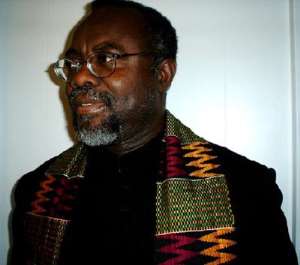
*Kwame Okoampa-Ahoofe, Jr., Ph.D., is Associate Professor of English, Journalism and Creative Writing at Nassau Community College of the State University of New York, Garden City. He is a Governing Board Member of the Accra-based Danquah Institute (DI) and the author of 21 books, including “Dr. J. B. Danquah: Architect of Modern Ghana” (iUniverse.com, 2005). E-mail: [email protected].
###

 One dead, fire officer hospitalised after bee attack at Quarry Site in Sokode Gb...
 Israel and Iran step back from further strikes after renewed clashes
 Patients stranded as doctors, nurses refuse to see new patients over KATH CEO su...
 Avenor Rural Bank CEO’s house destroyed by fire
 Three arrested in Winneba for illegal mining near GWL water lines
 Two pupils of Alice Elite Academy laid to rest after fatal school bus crash
 Here are areas to be affected by ECG's planned maintenance on Tuesday
 Family of civil engineer killed in alleged military shooting demands justice
 SHS teacher allegedly beats female student over unpaid hostel fees
 Blow to EU defence cooperation as France, Germany abandon joint fighter jet prog...



Comments
Modern Ghana, why are you allowing an article from the rapist of a 2 years old baby girl by Kwame Okoampa-Ahoofe on your website? Kwame Okoampa-Ahoofe is a child RAPIST.