There is no such thing anywhere in the world as perfect election arrangement, but if democracy in Africa is to succeed, then it requires solutions to the basic instruments of rigging, which undermine it.
The problems which led to the disenfranchisement of hundreds of UK voters during the May 6 general elections attest to that. Hints from the head of UK's electoral commission point to future reforms involving election automation technology.
Last year, Indian, a developing nation, showed that electronic voting is the best way forward for democracies around the world. The Danquah Institute believes that the Philippines on Monday, May 10, made an even stronger case for Ghana to consider seriously the proposals to introduce e-voting here.
The Philippines used e-voting for the first time in the Asian country's general elections. In short, they deployed 76,300 voting machines or Precinct Count Optical Scanners (PCOS) for a voting population of 45.5 million people.
Only 465 (0.6%) of the machines malfunctioned on election day but they were quickly replaced without any major disruption to voting. Voting closed at 7pm and by 10pm, two-thirds of the results nationwide were known. This is something that until Monday, was unheard of and considered impossible to happen.
At around 10 p.m., the Comelec (the electoral commission) had been reporting millions of counted votes in the presidential, vice presidential and senatorial races, marking a new page in the country's electoral history.
Thus, Filipinos had a clear idea on who was leading in the race just before they called it a night on election day. There were nine presidential candidates.
The Philippines, noted for electoral violence and killings, faced problems similar to those confronting us in Ghana, namely; a bloated voter register, ballot box stuffing, ballot box theft and destruction, multiple voting, voter impersonation, spoilt ballots, intimidation and violence at the polling station, alteration of counted ballots before declaration, and the tensions and results manipulation which take place during the long periods between the closure of polls and the declaration of results.
December 2008 and the general elections in Ghana were supposed to do one of two things – renew hope or seal democracy's gloomy fate in Africa.
After two constitutional terms of President John Agyekum Kufuor, his party was returning to the electorate with a new presidential candidate, former Foreign Minister Nana Addo Dankwa Akufo-Addo, for a record third term.
Challenging that programme was John Evans Atta Mills. He was Vice President under President John Jerry Rawlings and lost to Mr Kufuor in the 2000 election.
That was the first time a democratically-elected government had lost power in an election and peacefully handed over power in Ghana. Would it happen again?
Those of us present in Ghana, those of us involved in last December's election, those of us who were glued to our radio stations by fear, those of us privy to the goings-on in and around the offices of the independent Electoral Commission, the political parties and in trouble-spots across the regions, cannot forget how excruciatingly close Ghana came to the kind of election break-down and violence we saw in Kenya and Zimbabwe.
And neither should we. The main political opposition party (led by Prof. John Evans Atta Mills) was so ruthlessly efficient in developing in the minds of their hardcore supporters and also in that of some security personnel that the Electoral Commission and the ruling party were conspiring to rig the election results.
These words, uttered to journalists by the founding father of the NDC and former military ruler, President Jerry John Rawlings, after he cast his vote, captured the atmosphere build-up on December 28:
“We welcomed democracy and elections through the ballot box and said good bye to coups d'états some years ago. But when the right of the people's choice is tampered with then we will have no choice than to protect our will in which ever way we can.”
In fact, both the ruling NPP and the opposition NDC were efficient in accusing each other of manipulating results in their respective strongholds. And the charges from both sides were credible. It was an electoral coup against the people's authentic franchise.
In Ghana's volatile and charged partisan political environment, it is extremely important that we have a trusted election process, where elections will be regarded as reasonably fair, even by the losing side.
How Poll Automation in the Philippines Works
Statistics of the Phillipines 2010 polls
• Total Number of
registered voters: 45,487,634
• Voting Machines
deployed: 76,300
• Polling stations: 36,679
Candidates
On December 15, 2009, about half a month after the deadline of filing of certificate of candidacy aspirants for local and national positions, the Commission on Elections announced the official shortlist for presidential and vice-presidential candidates. From the original 99 applicants for presidential race, only nine people were admitted to join the elections.
On the other hand, there were also eight people out of 20 vice presidential hopefuls who were given the chance to campaign for the elections
Results
The candidate in each position with the highest amount of votes is declared the winner; there is no runoff. Congress shall canvass the votes in a joint public session.
When there are two or more candidates who have an equal and highest amount of votes, Congress, voting separately via a majority vote, will choose among the candidates who have an equal and highest amount of votes to be the president.
The Supreme Court shall "be the sole judge of all contests relating to the election, returns, and qualifications of the President or Vice President".
Pre-Election Procedures
To ensure that the PCOS machines are accurate and functioning well, at least three days before election day, the Comelec conducted a dry run of the PCOS machines by inviting members of the public to accomplish test ballots. These ballots were counted manually, and election returns showing the results were prepared.
Then, the same set of ballots was counted by the PCOS machines and the results compared with that of the manual counting. It showed that the results were the same and the participants certified the veracity of the results by signing on the printed elections returns.
The PCOS machines were delivered to the 80,136 clustered precincts around the country where they were stored and sealed until Election Day - the only time they were opened and in the presence of the public.
During this time, the machines were not connected to any transmission lines, so as to prevent hackers from having access to them. The public, particularly candidates and their representatives, could secure the area where the machines were stored.
Pre-Voting Procedure
For every voting precinct, there was a Board of Election Inspectors (BEI) consisting of a chairman, poll clerk and a third member, that supervised the elections.
Before voting began, the BEI initialized the PCOS machine in the presence of the public, usually poll watchers and other election watch groups, and showed that the ballot box was empty.
Initialization meant the BEI made sure that the machine was zeroed out or there were no votes or entries stored in the machine's memory.
An initialization report was thereafter generated by the machine as proof of this fact.
Paper-Based System
Since voting was done through optical mark reader-type machines, paper ballots were still used during the voting process.
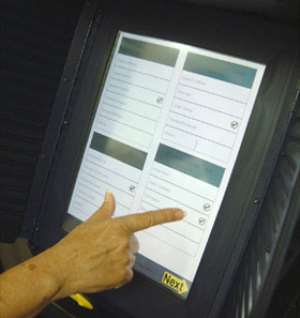
In countries using the direct recording electronic (DRE) machines, voting is done by touching selections on the computer screen, like in touch screen ATMs.
The ballot contained the names of candidates for every position, and the parties under the party-list system. There were ovals opposite each name and party.
The ballot was used front and back. Considering the number of positions filled from the national to the local level, as well as the number of candidates, the ballot was long.
The Voting Process
Voting in an automated election is simple and fast. The procedure is as follows:
• Voter's name is verified on the list of registered voters.
• Voter is given a ballot, a secrecy folder (to cover voter in making his/her choices) and a pen.
• Voter proceeds to a voting booth or spot.
• Voter darkens or shades the ovals opposite the names of candidates and parties of his/her choice.
• Voter feeds or inserts the completed ballot into the PCOS machine ballot slot (the ballot can be fed to the machine in any orientation: top, bottom or either end).
• The machine reads or scans the votes (marked ovals) on both sides of the ballot simultaneously.
• The scanned ballot is ejected through the other end of the machine and is dropped in the ballot box.
By Qanawu Gabby
 Former MASLOC CEO Sedina Tamakloe returns to Ghana after extradition to serve 10...
 Tension in Birim North as angry NDC youth attempt to disrupt cooperative mining ...
 One dead, several injured in tipper truck and fuel tanker crash on Accra–Tema Mo...
 How 70-year-old building was finally demolished over fear of collapse in Osu
 Minority MPs thank Afenyo-Markin for capacity-building programme in Canada
 Ghana has everything needed to prosper yet graduates remain unemployed — Dr Step...
 June 9: Cedi sells at GHS12.50 on forex market, GHS11.85 on BoG interbank
 Stephen Amoah advocates mixed market economy to tackle rising cost of living in ...
 KMA to reintroduce enhanced ‘Samansaman’ sanitation enforcement system from July...
 Nyinahin Catholic SHS teacher seen fighting female student in viral video arrest...