




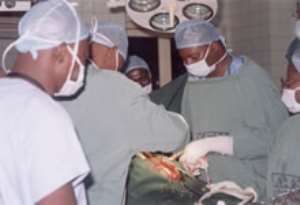
Ghana has been selected to host the 25th General Assembly Meeting, “GHANA 2010” of the Federation of African Medical Students Associations (FAMSA).
The General Assembly would be held Sunday, 16th to Friday, 21st May, 2010 at the University of Ghana, Legon Campus.
Under the auspices of the University of Ghana Medical Student's Association (UGMSA), participants will share ideas and participate in activities that concern health care delivery in Africa and the world at large.
Established in 1968, the Federation of African Medical Students' Associations is an independent, non-political association of Medical Students' Associations (MSAs) in Africa. FAMSA was founded as a Ugandan, Ghanaian and Nigerian initiative to foster the spirit of friendship and cooperation among African medical students. FAMSA is a project oriented medical students body and is recognized as the official international forum of African medical students.
It is the forum for medical students throughout the African continent to discuss topics related to health, education and medicine, formulate action plans from such discussions and carry out appropriate activities.
Its Vision is to continue to be a strong network of medical students, constantly aware of global health issues and responsive to contemporary questions facing the medical profession and global health.
The General Assembly is the highest authority and policy making arm of FAMSA with the purpose of formulating FAMSA activities and electing FAMSA officials.
Scientific sessions are held on topical health issues, with students and resource persons presenting papers regarding the theme of the General Assembly.
In addition, workshops are held to discuss the issues that emerge in the papers. The aim of the workshops is also to draft the resolution of the General Assembly. These resolutions are then discussed and adopted at a plenary session.
OPTIMAL HEALTHCARE FOR RESOURCE-POOR SETTINGS:
THEME BACKGROUND
African countries are among the poorest in the world. This translates into reduced funds available for anything more than subsistence, thus inadequate for catering for any health emergencies or exigencies that may and do occur. Poverty has been shown to perpetuate a vicious cycle of poor healthcare, disease and more poverty.
Indeed, poverty, and by extension, low socio-economic status, is a risk factor for the vast majority of Africa's health problems. Some of the problems we contend with are overpopulation, illiteracy, harmful socio-cultural practices, poor infrastructure, conflicts and human displacement, corruption, a myriad of easily preventable diseases, all of which perpetuate the cycle of resource poverty and poor health. Unfortunately, defective infrastructure and inadequate resources continue to ensure that our responses to these challenges threatening to eliminate us are minimal or absent. The poverty Africa contends with is not human resource poverty. Indeed, Africa has produced some of the best crop of administrators, and professionals in every field, health not being the least of these. We need to come to a place where we decide what has been so far not worked, and forge ahead into a new future.
The principle of self-determination demands that the concerned party takes the foreground in engineering solutions to their problems. We are the best people to solve our problems. For Africa to take responsibility for her own future and well-being, there is the need to manage her health effectively in these resource poor times and from thence secure a better future for the African continent.
At this year's General Assembly Meeting, our aim, among others, is to discuss the skills and strategies involved in designing health care solutions adapted to Africa to secure a change in indices from the worst to the best.
Apart from developing the awareness about these issues, we also hope to further encourage medical students, who constitute an untapped pool of health workers, advocates and interventionists to get actively involved in Health education, enlightenment advocacy and basic medical services, while equipping themselves effectively for service in the future.
 June 9: Cedi sells at GHS12.50 on forex market, GHS11.85 on BoG interbank
 Stephen Amoah advocates mixed market economy to tackle rising cost of living in ...
 Publish a clear and detailed BoG recapitalisation plan — NPP urges gov't
 Completely abandon idea of selling BoG headquarters — NPP urges gov't
 French President Macron to attend Ghana's Next Steps Conference on Reparatory Ju...
 Nyinahin Catholic SHS teacher seen fighting female student in viral video arrest...
 Beijing condemns US move to blacklist Chinese companies
 Trump gets a cold reception at NBA Finals game as Spurs beat Knicks
 One dead, fire officer hospitalised after bee attack at Quarry Site in Sokode Gb...
 Israel and Iran step back from further strikes after renewed clashes


