




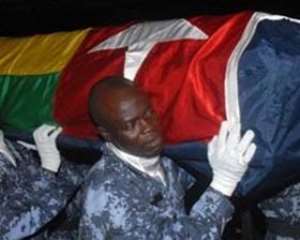
It was a heart-breaking and emotionally charged atmosphere as mournful faces welcomed the Togo Presidential plane which brought the players of the Togo national team and their two dead officials from Cabinda.
The plane touched down at the Gnassingbe Eyadema International Airport at exactly 11.15 pm last Sunday night.
The players were welcomed by a small but significant crowd of worried supporters anxious to see their idols safely back home after their harrowing experience in Cabinda, Angola.
Prime Minister Gilbert Fossoun Houngbo, looking melancholic, missed a few steps as he led a team of concerned government ministers to the tarmac.
Some of the Togolese players wore bandages on their arms to cover their bullet wounds sustained in the armed attack against the team.
But security was tight as the players, wearing gloomy faces, led by Emmanuel Sheyi Adebayor the captain, were whisked away to their hotel in Lome.
When the mortal remains of assistant national coach, Amelete Abalo and Stan Ocloo, Togo Football Federation Communication Director, were rolled out of the Presidential aircraft, hell broke loose, with wailing and the profuse shedding of tears by wives, uncles, children and other relatives.
DAILY GUIDE SPORTS spotted an octogenarian break down crying and saying, “Why have they done this to me?”
Some women who were uncontrollable with grief threw themselves on the ground, weeping freely, as they were supported by sympathizers.
“A big loss for Togo, a sad day for Togolese football, and a shameful occasion for African football,” PM Gilbert Houngbo said.
Togbe Aklassou, a traditional ruler of Be area of Lomé said, “We do not understand what is happening to us in Togo. Our boys went to Angola to celebrate the best in African football but they came back with dead bodies and bullet wounds. This is sad.”
Togbe Nyamedzro, Chief Priest, attributed the ill-luck which occurred to Togo to a supernatural curse.
“We have to perform traditional rituals to remove this national curse,” he said.
“At first we lost our officials in Lungi Airport in Sierra Leone in 2007 during a CAN qualifying match. And now it is Angola. Something spiritual must be wrong,” he declared.
The Togo government declared three days of national mourning in memory of those who lost their lives in Cabinda.
Meanwhile, a statement attributed to the Togolese Sports Minister suggesting that Togo may return to take part in CAN 2010 has been condemned.
The statement appears to be a controversial personal suggestion which has not gone down well with a large section of the Togolese population who have been caught up with grief and mourning.
It is also a contradiction to the Togo Prime Minister's declaration that “we cannot expose the precious lives of our players to further security risks.”
“Once bitten, twice shy,” declared a football fan in Lome.
The Togolese players had initially wanted to take part in the tournament in memory of those who passed away; but they were impressed upon by the country's authorities to take a flight to the Togolese capital of Lome on Sunday night.
As he boarded a plane in Cabinda, Togo captain Emmanuel Adebayor said: "We have to mourn our dead. We go back home to do this."
The BBC's Russell Fuller in the Angolan capital of Luanda said that the decision seemed to be based on politics rather than practicalities.
"The politics of African football are quite extraordinary. Maybe CAF want to be seen as being in control of things but it would not have been logistically impossible," he told Radio 5 live.
"It might have meant that the last group matches could not have been played simultaneously. It may have been that the television schedules would have to change or that the players played more often than they are used to.
"But in these circumstances I don't think any of these obstacles would have been insurmountable."
Angolan state media reported on Monday morning that two unidentified suspects had been arrested over the attack which took place as Togo's convoy crossed from the Republic of Congo into Cabinda.
An assistant coach, press officer and bus driver were killed while several other players were injured.
A faction of the separatist group, Front for the Liberation of the Enclave of Cabinda (FLEC), has claimed responsibility for the 30-minute attack.
In the tournament's opening ceremony in Luanda, Angolan President Jose Eduardo dos Santos condemned the attack and a minute's silence was observed before the first match.
Adebayor revealed he spoke to members of the Ivory Coast and Ghana camps and agreed with their decision to remain in the competition.
"They expressed their support by saying they were ready to leave the competition if we did," revealed Adebayor.
"[But] at the end of the day, we realised that they were ready to continue. It is still a continent where a World Cup will take place in South Africa.
"If we speak of the dead, the competition should have been cancelled but the Confederation of African Football has decided otherwise.
"We're going back and we wish good luck to those who will remain, especially to Burkina Faso, Ivory Coast and Ghana.
"What I have told their leaders is that they may be attacked at any time in Cabinda. I hope they will be cautious."
Team-mate Thomas Dossevi said part of the players' motivation for wanting to stay was to honour those killed and French paper L'Equipe quoted another player, Alaixys Romao, as saying the team would not "leave like cowards".
From Ebow Godwin, Lomé
 How 70-year-old building was finally demolished over fear of collapse in Osu
 Minority MPs thank Afenyo-Markin for capacity-building programme in Canada
 Ghana has everything needed to prosper yet graduates remain unemployed — Dr Step...
 June 9: Cedi sells at GHS12.50 on forex market, GHS11.85 on BoG interbank
 Stephen Amoah advocates mixed market economy to tackle rising cost of living in ...
 Publish a clear and detailed BoG recapitalisation plan — NPP urges gov't
 Completely abandon idea of selling BoG headquarters — NPP urges gov't
 French President Macron to attend Ghana's Next Steps Conference on Reparatory Ju...
 Nyinahin Catholic SHS teacher seen fighting female student in viral video arrest...
 Trump gets a cold reception at NBA Finals game as Spurs beat Knicks



Comments
this can of crazy things never heard ,African countries must take this very serious and put stop on it.it's very sad,angola must find those people .