




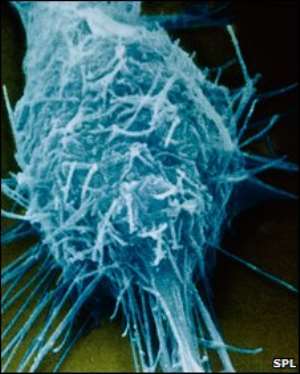
Scientists are to test if boosting the immune system can prevent the return of the childhood cancer neuroblastoma.
The disease - a cancer of developing nervous system tissue - is most often found in under-fives and accounts for about a sixth of child cancer deaths.
The European trial builds on early promising results from a US study which found immunotherapy improved the chances of survival from the disease.
Cancer Research UK is funding the trial for 160 UK children over four years.
The cancer develops in specialized nerve cells, called neural crest cells.
These primitive cells are involved in the development of the nervous system and other tissues.
Tumours often develop in one of the adrenal glands but may also form in nerve tissues in the neck, chest, abdomen, or pelvis.
Overall, six out of 10 children are successfully treated through treatment such as surgery and chemotherapy - but the prognosis is not as good for children with advanced forms of the disease.
Doctors estimate about 40 children per year in the UK would be eligible for - and potentially benefit from - the new treatment.
It works by hunting down neuroblastoma cells that have survived conventional treatment and attaching antibodies to specific molecules on their surface.
These antibodies then mobilize the body's immune defences to attack and destroy the cells.
The UK arm of the trial - part of a larger European one, and funded by the charity Cancer Research UK - will run in all 20 childhood cancer clinical trial centres across the UK, recruiting 160 children over the next four years.
Lead researcher Dr Penelope Brock, a consultant paediatric oncologist at Great Ormond Street Hospital, said: "Early results from the US trial found that children who received the immunotherapy treatment had less chance of the disease coming back two years later, compared with the patients who did not receive the immunotherapy.
"We need to build on these results and devise better immunotherapy approaches that improve survival further."
The UK trial - in which all eligible children will receive immunotherapy - will attempt to reduce the severe side effects seen in the US study.
James McGuire from Harrow Weald in North London has a two-year-old daughter, Sophie, who will take part in the trial.
He said: "Based on the positive outcomes from the earlier trial, I am hopeful that this treatment will play a critical role in saving Sophie's life."
This trial will be open to high-risk neuroblastoma patients who are nine months from diagnosis and within four months of the last round of aggressive treatment to control the tumour.
 One dead, fire officer hospitalised after bee attack at Quarry Site in Sokode Gb...
 Israel and Iran step back from further strikes after renewed clashes
 Patients stranded as doctors, nurses refuse to see new patients over KATH CEO su...
 Avenor Rural Bank CEO’s house destroyed by fire
 Three arrested in Winneba for illegal mining near GWL water lines
 Two pupils of Alice Elite Academy laid to rest after fatal school bus crash
 Here are areas to be affected by ECG's planned maintenance on Tuesday
 Family of civil engineer killed in alleged military shooting demands justice
 SHS teacher allegedly beats female student over unpaid hostel fees
 Blow to EU defence cooperation as France, Germany abandon joint fighter jet prog...


