




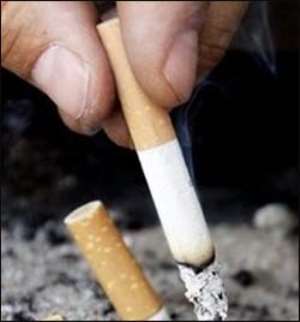
use kills at least 5 million people every year, a figure that could rise if countries don't take stronger measures to combat smoking, the World Health Organization said Wednesday.
In a new report on tobacco use and control, the U.N. agency said nearly 95 percent of the global population is unprotected by laws banning smoking. WHO said secondhand smoking kills about 600,000 people every year.
The report describes countries' various strategies to curb smoking, including protecting people from smoke, enforcing bans on tobacco advertising, and raising taxes on tobacco products. Those were included in a package of six strategies WHO unveiled last year, but less than 10 percent of the world's population is covered by any single measure.
"People need more than to be told that tobacco is bad for human health," said Douglas Bettcher, director of WHO's -Free Initiative. "They need their governments to implement the WHO Framework Convention."
Most of WHO's anti-tobacco efforts are centered on the Framework Convention on Control, an international treaty ratified by nearly 170 countries in 2003. The convention theoretically obliges countries to take action to reduce tobacco use, though it is unclear if they can be punished for not taking adequate measures, since they can simply withdraw from the treaty.
Other experts questioned how effective WHO's strategies were.
"It's like the well-intentioned blind leading the blind," said Patrick Basham, director of the Democracy Institute, a London and Washington-based think tank. He said WHO's policies were based more on hope than evidence.
Basham said measures like increasing taxes on tobacco products and banning advertising don't address the root causes of why people smoke. Smoking levels naturally drop off — as they have in Western countries — when populations become richer and better-educated.
use is the leading preventable cause of death and WHO estimates that, unless countries take drastic action, tobacco could kill about 8 million people every year by 2030, mostly in developing countries.
Basham said officials should focus on anti-poverty measures to stem the smoking problem, though that is beyond WHO's mandate as a health agency.
"The cynical view is that the anti-tobacco lobby has itself now become an industry and we will never be able to do enough to stop smoking," Basham said. " use will change, but it has very little to do with the kinds of things WHO is promoting."
 One dead, fire officer hospitalised after bee attack at Quarry Site in Sokode Gb...
 Israel and Iran step back from further strikes after renewed clashes
 Patients stranded as doctors, nurses refuse to see new patients over KATH CEO su...
 Avenor Rural Bank CEO’s house destroyed by fire
 Three arrested in Winneba for illegal mining near GWL water lines
 Two pupils of Alice Elite Academy laid to rest after fatal school bus crash
 Here are areas to be affected by ECG's planned maintenance on Tuesday
 Family of civil engineer killed in alleged military shooting demands justice
 SHS teacher allegedly beats female student over unpaid hostel fees
 Blow to EU defence cooperation as France, Germany abandon joint fighter jet prog...


