




(*Ten Tall Men is the title of a film about the heroic deeds of ten men, against severe odds. The actors included the late Burt Lancaster.)
To “stand tall” does not necessarily mean that one is physically tall.
It only means that one has done something that should normally be done by a “tall person” -- in the sense that tall men, especially if they are also big, are associated with deeds of incredible valour. Thus, in the Bible, when the idea needed to be conveyed that Goliath was a fearful fellow, he was described as a man of gigantic proportions, who, should, in the normal course of events, have made the young, puny David take to his heels at first sight.
Similarly, whenever Ghanaian footballers encounter Brazilian footballers, our boys are supposed to go rigid with fright.
“Brazil? Kai!” They are not good at all. We regard them as figures of legend, who were gifted with football-playing ability from birth, and compound their gift with a resort to total recall -- recollections of the feats of Garrincha, Jairzinho, Socrates and, of course, Pele. Recollections which the give birth to others-- Ronaldinho, Ronaldo, Rivaldo, Romario, Roberto Carlos, Bebeto. Where does one stop?
The human being has not been born who, having seen these names in action, wouldn't tremble on coming face to face with the yellow jerseys and blue shorts on a football pitch. It happened to the Ghana Black Stars in Germany in 2006. We had begun the World Cup in incredible fashion, losing to Italy but incredibly whacking the awesome Czech Republic 2-0 on 17 June 2006 and following up with a 2-1 victory over the USA.
Then came 27 June 2006. We came face t face with Brazil. And the name undid us. We forgot our feat against the Czechs of only ten days before, and froze on the grass. Our silly coach, for some reason, decided that we should curb our natural flair and go into defence mode against the master dribblers of the world. Naturally, they drew rings around us.
Not only that -- our coach decided to try and catch the Brazilians with “offside traps”. But you can't catch Brazil with offside traps. They move so fast and so smoothly that they mesmerise both the referee and his assistants, and even when they do commit an offside, they create the illusion that they had been running all the while and that they had simply flatfooted the opposition. Our timidity and strategic backwardness were severely punished: 3-0! And we were out of the 2006 World Cup. Many were the tears that were shed for the unnecessary suicide we had committed.
So, come Friday 16th of October 209, and we have many Brazilian ghosts to exorcise. Once again, it looks as if we are going to let the name do the job for the Brazilians. Unbelievably, our passing is very poor! Our boys can hardly connect with any passes. Each time they get a ball that has the promise of being useful, they kick it to a Brazilian. Meanwhile, they are unable to intercept the Brazilians' own passes. My heart is in my mouth -- I suppose, like millions of my fellow countrymen and women.
They say troubles come in multiples. And they are right. For even as we play a match fit for mediocre sides, not Ghana, we are reduced to ten men by a referee whose powers of deduction must have been crafted in Mars. The rule is that if a player violent fouls another who has only got the fouler between himself and the goal, then it is a sending-off offence.
Our defender did stupidly foul the Brazilian. But he was not the last man between the Brazilian and the goal. There was another defender behind him. So only a foul should have been given, But an ignorant referee reduces our team to ten men. What! How? Is this possible? Is one dreaming or not? It is reality, however. And man wants to weep!
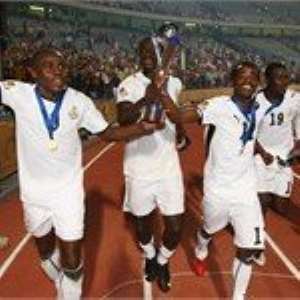
But our Ten Tall Men play and play and play. And it is Zero-zero after extra time! Ghana have taken Brazil to extra time and emerged zero-zero. With ten men Amazing. Impossible. It looks as if we have been spared. But what about the penalties?
Brazil's first penalty goes in. Ayew, our Captain, replies in kind and it's 1-1.
Brazil's second penalty also goes in. Inkum, then puts Ghana's penalty in. So it's 2-2.
Brazil gets a third in. Then, Jonathan Mensah loses our third. The sense of doom that I have felt all evening returns with a vengeance. It is Brazil 3 Ghana 2.
But then, Agyei saves one from the Brazilian Souza! Amazing Agyei.
But Addae comes and spoils it all. Handsome boy like that -- how could he have denied himself the status of a hero by taking such a feeble shot? It's a matter of training, you know. As soon as he failed to go back far enough before he took the shot, I knew we were done for. And so it proved to be.
Moican, the hero of Brazil's game against Germany comes next. I mean he must score, surely? My heart is…! But he shoots over the bar!
But it's still 3-2 against Ghana.
Then Adiyiah, our golden boy, with I think the most goals of anyone in the tournament already under his belt, comes along. And he dispatches it. Beautifully and indubitably. here is life after death!
We are now in sudden death. And Toxeira from Brazil comes and shoots.
MAGICALLY, AGYEI SAVES!
If Ghana scores the next penalty, we are the Champs.
And who should come but Agyemang-Badu. This guy carries the resonant, weighty name of a famous Dormaa Paramount Chief. Will he do justice to his name? At such a crucial moment? Can he?
Agyemang-Badu shoots!
AND IT IS A GOAAAAAAAAAAAL!
Ghana are world champions. After beating Brazil.
I put pen to paper: only a poem will do justice to this moment. This is what pops out:
is this the most unbelievable day or what?
we get reduced to 10 men by some 'referee' t*w*t;
we are dispossessed each time we get the ball,
we look like shadows -- no hope at all
and yet
and yet
in the most dangerous moment
when you cannot repent
if your shot misses the goal
we beat brazil by a penalty goal
and we are champions of the world!
champions -- champions -- of the world!

 One dead, fire officer hospitalised after bee attack at Quarry Site in Sokode Gb...
 Israel and Iran step back from further strikes after renewed clashes
 Patients stranded as doctors, nurses refuse to see new patients over KATH CEO su...
 Avenor Rural Bank CEO’s house destroyed by fire
 Three arrested in Winneba for illegal mining near GWL water lines
 Two pupils of Alice Elite Academy laid to rest after fatal school bus crash
 Here are areas to be affected by ECG's planned maintenance on Tuesday
 Family of civil engineer killed in alleged military shooting demands justice
 SHS teacher allegedly beats female student over unpaid hostel fees
 Blow to EU defence cooperation as France, Germany abandon joint fighter jet prog...


