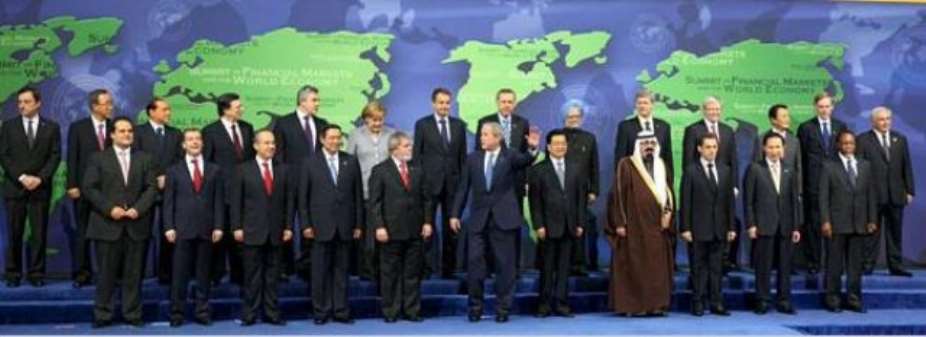
There has been a lot of razzle-dazzle about the unprecedented global financial crisis that outshines that of the great depression in the 1930's. And as a result pundits and prognosticators have avowed emphatically that the “world has changed beyond recognition”. The global financial crisis is only a tip of the iceberg if leadership all over the world does not change their modus operandi- pursuing their own parochial interests. The global financial crisis is not just an ephemeral, evanescent event appearing on the stage of world history, but it is an event with an eternal meaning, for it symbolizes the failure of leadership to act in order to avert calamitous situations. I found myself in full accord with a phrase from Dr Martin Luther King: "A time comes when silence is betrayal." And that time has come for us not to keep mute but up and doing on matters concerning leadership and as Edmund Burke also postulated “All that is necessary for evil to succeed is that good men do nothing”. The time has come for us to tackle the problem of leadership once and for all or be overwhelmed by events. The problems of the world are daunting and few problems today lend themselves to simple solutions. The world has been seared in the flames of withering bad leadership and cannot help but to believe that the bank of competent and visionary leadership is bankrupt. Leadership in countries, both local and international organizations like the UN, EU, AU, ECOWAS, SADC, NAM, IMF and the Arab League among others have drastically failed and so the ideological focus for their establishment have met its waterloo. While it is true that world leadership has improved in certain areas in the last few months, the improvement, when juxtaposed with the failures, waste and lost opportunities is indeed significant. The recent developments reinforce the image of purposeless and confused leaders.
In order to paint a vivid picture of the significance of the event, it is necessary to take a glance back to the just ended 64th Session of the UN General Assembly Meeting have suddenly turned a three-ring circus where world leaders met to espouse their own personal philosophies and concepts and not reach a resolution on how to tackle the seeming intractable but tractable problems of the world. Politicians like the dictum goes are professionals who place much premium on arguments rather than action and as a result, this session was no exception as leaders propounded theories with no practical solutions. According to Gordon Brown, the UK Prime Minister in a paper he presented at the 64th Session of the General Assembly Meeting he opined “We have five urgent challenges that demand momentous decisions- decisions that I would argue are epoch-making-on: climate change, terrorism, nuclear proliferation, poverty and shared prosperity”. Like Abigail Adams said “We have too many high sounding words and too few actions that correspond with them” and so characteristically the world leaders flamboyantly failed to propound solutions to the epoch-making decisions aforementioned and as a result have advertently rescheduled deliberations on these sensitive and delicate issues to another of such “Talk Shops” in December at Copenhagen. The Libya leader Muammar Al-Qhadafi in a paper he presented at the General Assembly meeting also said it has become a place where “You just make a speech and then you disappear...” It is painfully palpable that it was a talk shop as usual. In relation to Copenhagen the UK PM harangued that “If we do not reach a deal in Copenhagen, if we miss this opportunity to protect our planet, we cannot hope for a second chance some time in the future” and further argued that “Each of us has a duty of leadership to make it happen”.
Let me refer to Dr. Martin Luther King's letter from the Birmingham City Jail in which he wrote “…We are caught in an inescapable network of mutuality, tied in a single garment of destiny. Whatever affects one directly affects all indirectly”. It therefore means that failure of leadership in one country affects the other indirectly. For instance, because of the failure of leadership to resolve conflicts in some parts of the world, other countries suffer because refugees from one country seek political asylum and refugee status in other countries. There are over 1 million Afghanis living in Pakistan as refugees. Leaderships' inability to resolve the conflict in the Darfur Region of Sudan has caused the death of more than 200,000 people in the three year genocide and 5.3 million people left Sudan to neighboring countries like Chad to seek refuge. Not only Darfur Region of Sudan but also mention can be made of the Israeli-Palestine war, Iraq, Afghanistan, Lebanon, Congo, Somalia, and the Niger Delta in Nigeria among others. Displaced people from these war areas are sent as refugees to other countries. For example the Bujumbura Refugee Camp in Ghana for the Liberian refugees, Palestine refugee camp in Lebanon, camp in Guinea for Sierra Leone refugees etc. According to the 2005 World Refugee survey conducted annually by the US Committee for Refugees and Immigrants (USCRI),” a staggering 33million people worldwide are currently deracinated from their homeland to other lands. Of that number, 12 million are refugees and asylum seekers living in countries other than their own.” The Conflict in Columbia displaced 2.9 million people form Columbia to other countries also according to USCRI statistics. These are just tips of the iceberg in a long list of countries impacted by this tragedy. So in effect, host countries for refugees indirectly are affected by the war. To quote Julius Caesar “all bad precedents began as justifiable measures”. The acts of war and violence in these countries began as justifiable measures but the question is whether or not acts of war and violence are by any means justifiable?
The fact of global interdependence-I apologize for the jargon-is nothing new and given our interdependence, any world order that tries to elevate one group of people over another will inevitably fail. Like our worlds order that has elevated the US, UK over countries like Zimbabwe, Somalia etc has failed and will continue to fail if the status quo is not revolutionized. To borrow Dr. King's words “The Western arrogance of feeling that it has everything to teach others and nothing to learn from them is not just” The first principle of the UN charter affirms that “All member states have sovereign equality”, whether large or small. The veto power bestowed upon the five permanent members of the Security Council is, therefore, against the provisions in the Charter. This course of action has produced deep rooted division of opinion in the world. The veto power bestowed on some countries reinforces the world order that elevates one group of people over another which invariably explains the failure on the world stage. There are equal votes in the Assembly and so therefore one expects that there should be equal votes in the Security Council. The super-Powers had complicated interests and used the United Nations for their own purposes. Al-Qhaghafi unequivocally expressed in his tirade at the said meeting that “the Security Council did not provide the world with security, but gave it “terror and sanctions”. He has his own dissatisfaction and reservations and so was “not committed to adhere to the Council's resolutions, which were used to commit war crimes and genocides”. He reiterated that the “Council did not provide security and the world did not have to obey the rules or orders it decreed, especially as it was currently constituted”. The Sudanese government for example has rejected a UN Security Council resolution authorizing the deployment of UN troops and police to Darfur according to a BBC report and as a result a small force of 7,000 AU peacekeepers are struggling to protect the civilians against the Arab Janjeweed attacks in the absence of the UN contingent despite haven killed some 200,000 civilians.
The New African magazine reported in their May edition that, “By October 2007, the ICC had 2,889 communications about alleged war crimes and crimes against humanity in at least 139 countries, and yet by March 2009, the prosecutor had opened investigations into just four cases: Uganda, DRCongo, Central Africa Republic and Sudan/ Darfur -all in Africa”. Examples abound in both the past and present to sustain the argument that injustice, manipulations and prejudice has been the modus operandi of the ICC, an arm of the UN. The unfairness and bias in respect to Africans, further buttresses the fact that the UN elevates one group of people over the other and as stated earlier “any world order that tries to elevate one group of people over another is likely to fail”. Injustice anywhere is a threat to justice anywhere. The Bush administration embarked on “genocide” in Iraq and Afghanistan leaving people displaced and maimed. What happened to the principle of the UN which states that “Countries must try and settle their differences through peaceful means?” To paraphrase Shakespeare a rose flower by any other name still remains a rose flower. War crimes are war crimes no matter the names we try to give to it. Analysis of the year's body count from the Iraq Body Count Project says “81,174 - 88,585 civilians' deaths have been recorded as at January 1, 2008 through the body counts extensive monitoring of media and official report.” The report further states that “Theses figures, though undoubtedly incomplete, are the most comprehensive and well established currently available and show beyond any doubt that civil security in Iraq remains in a parlous state.” These statistics of death excludes that of Afghanistan and other war torn areas in the world. The ordinary citizen suffers the follies of their leaders. The African continent has no monopoly over war crimes and crimes against humanity and so the radar of war crimes should not only be on Liberia, Darfur, Sierra Leone, Rwanda, DRCongo but also on Afghanistan, Iraq, Palestinia amongst others. All these wars have occurred contrary to the basic aim of charter that members states would ever be determined to save this generation from the scourge of war.
Suffice it to say, world leadership has failed and it is imperative and prudent that we rededicate ourselves to the long and bitter, but beautiful, struggle for a new world. The forerunner of the UN was the League of Nations, established in 1919 under the Treaty of Versailles “To promote international cooperation and to achieve peace and security” but ceased to its activities after failing to prevent the second world, accordingly one would only wish that the UN haven unambiguously and precisely failed to meet the provisions in the preamble, reorganizes its structures in order to avert the pending danger awaiting the world if the status quo is not reversed. For instance, worse things can happen, if the leadership of Iran and North Korea and nuclear threats remains adamant to renounce their nuclear power and the domino effect of America's inability to win the war over Islamic terrorists in Iraq and Afghanistan would have on the world. World leaders year after year spend more money on military defense than on programs of social uplift and so have piled up deficits upon deficits, mortgaging our future and our children's future for temporary convenience of the present but have still failed security wise. For instance America's DOD budget is slated to be $651 billion in 2009 making up 21% of the federal budget which is almost as much as the rest of the world's defense budget combined. Congressman Barney Frank said “Americans' well-being is far more endangered for substantial reductions in Medicare, social security or other important domestic area than it would be by cancelling weapons systems that have no justification….” And if we will only make the right choices and decisions, we will be able to transform this pending cosmic elegy into a creative psalm of peace. After so many years of its existence, in spite of the wonderful work done by the Special Agencies such as UNESCO, ILO, FAO, WHO the UN slogan to keep world peace has come to naught. The question arises as to why this should happen. The answer is: 'it is due to leadership failure.'
By: Stanley T.K Gyamfi, UCC
Development / Ghana / Africa / Modernghana.com
 Former MASLOC CEO Sedina Tamakloe returns to Ghana after extradition to serve 10...
 Tension in Birim North as angry NDC youth attempt to disrupt cooperative mining ...
 One dead, several injured in tipper truck and fuel tanker crash on Accra–Tema Mo...
 How 70-year-old building was finally demolished over fear of collapse in Osu
 Minority MPs thank Afenyo-Markin for capacity-building programme in Canada
 Ghana has everything needed to prosper yet graduates remain unemployed — Dr Step...
 June 9: Cedi sells at GHS12.50 on forex market, GHS11.85 on BoG interbank
 Stephen Amoah advocates mixed market economy to tackle rising cost of living in ...
 KMA to reintroduce enhanced ‘Samansaman’ sanitation enforcement system from July...
 Nyinahin Catholic SHS teacher seen fighting female student in viral video arrest...