




Obama's Trip to Ghana Inspires Envy in 'Giant of Africa'
When the White House announced two months ago that President Obama would visit Ghana this week, Nigerians read a different, glaring message between the lines: The American leader was not coming to their country.
"The first country to be chosen by the American people should be Nigeria," said Samuel Ayankoso, 57, a taxi driver in Lagos, Nigeria's largest city. "We are the giant of Africa."
That Obama also is not visiting about 50 other African nations seems beside the point. Here in Africa's self-enthroned behemoth, Obama's sojourn to small but stable Ghana has spawned an outpouring of soul-searching and self-flagellation about Nigeria's image and dubious democracy.
"Why would Obama want to come to Nigeria? To lend credence to the putrefying edifice that the nation has largely become?" one writer asked in the Guardian newspaper. Wole Soyinka, a Nobel prize-winning writer, said he would "stone" Obama if he legitimized Nigeria by visiting.
It is unsurprising that Obama's first visit as president to sub-Saharan Africa, an Obama-obsessed region that views him as a native son, would inspire continental envy. But in a country where democratic expression has been stunted by flawed elections, the move has given critics a fresh opportunity to stick it to their government. They call it a clear indictment of Nigeria's ever-present corruption, President Umaru Yar'Adua's slow progress, the conflict in the oil-rich Niger Delta and what some here see as cooled relations with the United States.
"Most people believe it's deliberate, not a mere oversight, and it's a statement and the message is well conveyed," said Reuben Abati, editor of the Guardian. "Nigerians are very angry with their government."
Nigerian officials, for their part, shrug off the angst. "It was a nonissue," Jibrin D. Chinade, Yar'Adua's special adviser on foreign affairs, said in an interview. "There is no message."
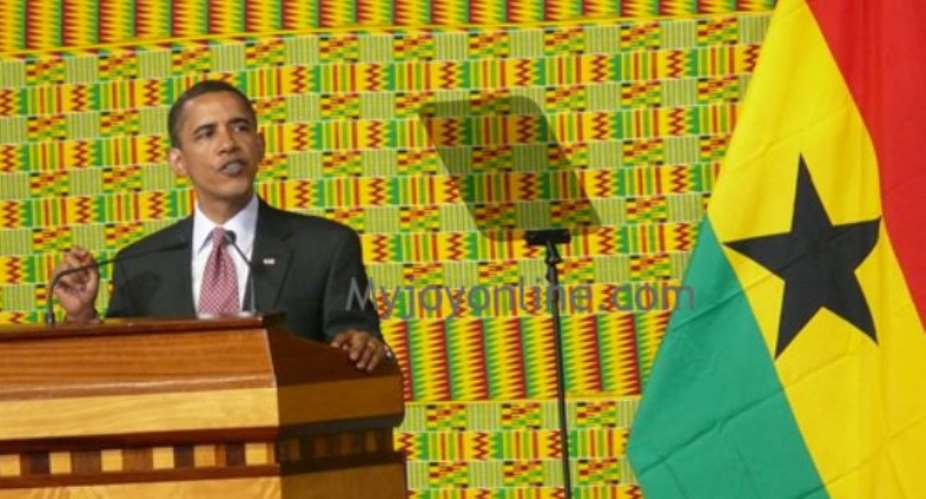
Obama arrived for an overnight stop in Ghana on Friday. White House officials said he will emphasize good governance and U.S. commitment to Africa, to which President George W. Bush massively increased aid.
An Obama administration official declined to say whether the president considered visiting Nigeria but said Ghana was chosen because it is "a model for other countries" in a region beset by "troubled elections and coups."
But in those words is an essential truth: When it comes to democracy in Africa, Ghana is a rising star. Nigeria, on the other hand, seems trapped in a black hole.
Ghana became in 1957 the first African country in Sub-Saharan to gain independence; it is a poor but steady nation in a rough corner of the continent. It won international praise last year for an ultra-close and peaceful election that marked its second transfer of power since a military ruler re-launched democracy in 1992. Investors praise Ghana's open-market economy, which is likely to be boosted by recently discovered oil.
Nigeria, Africa's most populous nation with 150 million people, has long thought of itself as the continent's beating heart. Its economy is Africa's second-largest, and its international peacekeeping force -- the world's fourth-biggest -- patrols across the region. But corruption that watchdogs rank among the world's worst has kept most Nigerians in poverty. Infrastructure is poor, and generators power much of the country. The Niger Delta is simmering with low-level warfare over oil.
Still, Nigeria is a key U.S. ally in West Africa, where drug trafficking and piracy are on the rise. Nigeria also is the fifth-largest oil supplier to the United States. Bush, whose anti-terrorism efforts were backed by then-Nigerian President Olusegun Obasanjo, visited the nation in 2003.
"Nigeria is, for a variety of reasons, the most important country in sub-Saharan Africa, bar none," Assistant Secretary of State for African Affairs Johnnie Carson told AllAfrica.com, which covers sub-Saharan Africa.
But the dialogue has chilled since 2007, foreign policy experts say, when the United States joined a global chorus in criticizing the Nigerian elections that brought Yar'Adua to power. He took office promising reforms of the electoral system, electricity sector, the Niger Delta and other problems, but little progress has been made. Adding insult was Washington's recent feting of two fierce Nigeria critics: one, a former minister in Obasanjo's administration; the other, Nigeria's crusading former anti-corruption czar, who testified before Congress about being forced from his job after accusing 31 former governors of looting.
"Even in the best of times, I don't know of any Nigerian leader who has access to Congress," said Akinjide Osuntokun, an international relations professor and government adviser.
The announcement about Obama's visit to Ghana was another blow, he said. That was followed by one of the more bizarre moments in recent U.S.-Nigerian relations. In May, a top ruling party official accused the opposition and the U.S. Embassy of plotting a "diabolical delegation" to meet with Obama in Ghana in an attempt to undermine the Nigerian government. The ruling party distanced itself from the allegation, and the U.S. Embassy denied it.
Schemes aside, Osuntokun said, there is a sense among Nigerians that their nation, which recently launched a "rebranding" effort to polish its image, is losing influence.
Although Ghana holds the distinction of being Africa's first independent country, it has also depended much on Nigeria. In the 1970s, millions of Ghanaians fled their tumbling economy for oil-rich Nigeria. In 1983, as the economy soured in Nigeria and xenophobia rose, it expelled 1 million Ghanaians.
Today, Ghana is the draw for thousands of Nigerians seeking more business-friendly climes and a calmer environment for their families. International companies including Michelin have decamped from Nigeria for Ghana.
Nigerian officials insist their country is still a major world player, noting that they recently received Russian President Dmitry Medvedev and were invited to attend the Group of Eight summit in Italy.
And not everyone in this busy, dynamic country has time to agonize over Obama's stop in Ghana, as evidenced by lawyer Cephas Caleb, 24, who was shopping at a bustling Lagos street market the other day.
"There are more important problems for us as a nation," Caleb said, "than having the American president visit for two days or not."
Credit: Karin Brulliard
Washington Post Foreign Service
Saturday, July 11, 2009
Staff writer Michael A. Fletcher, traveling with Obama, contributed to this report.
 BoG's $260 million building: It was Ato Forson who first proposed 'sell-and-leas...
 'We have to do soul-searching' — Mahama orders nationwide flood assessment
 Court orders woman beater to pay GHS5,000 compensation to midwife at Tema Commun...
 Over 12,000 women living with obstetric fistula in Ghana — Asokwa MP
 Mahama secures 1,840 farm equipment deal from Belarus
 Titus Glover slams Mahama’s flood report directive, calls it “waste of energy an...
 We have increased posting of doctors from 12 to 100 to underserved regions in 20...
 'You had the effrontery to call me struggling lawyer, you won't come back to pow...
 Belarus manufacturers to storm Ghana next week after President's visit
 Government to offer tax incentives for factories located outside Accra


