




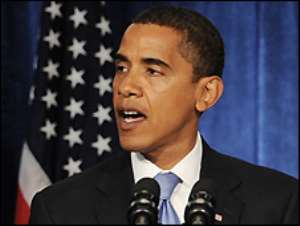
OF course, the shine has worn off Obama a bit. Some of his own supporters in the US have begun to grumble about his unwillingness to cut himself free from some of the Bush administration's policies, such as the trial of suspected terrorists by military tribunals, and the suppression of some of the unpublished photographs of Americans torturing people they'd caught, whom they suspected to be terrorists. So much so that a recent headline in the Washington Post asked: “Has Obama betrayed the left?”
I am afraid Obama's failures only illustrate the statement that 'politics is the art of the possible.' The USA is a big country, and US politics is a naughty oak of an enterprise. No politician, once he gets to the top of the tree, can altogether disregard the branches that support it.
The antlers of the security system, in particular, are extremely hard to claw. So Obama may detest the torturers as much as anyone else. But he has been forced to recognise that it is the system they abused that also puts on his desk each morning, as accurate a reading of the world situation as it is possible for intelligence agencies to put together. You can't alienate the arms of the security industry and still expect it to deliver safety for the nation and yourself. It's a terrible truth, but you can't change it in five months.
So we must give Obama a very warm welcome, whatever our disappointments may be, while wishing that he will soon feel strong enough, soon, not to make the idealistic young people upon whose faith he rode to power, regret that they backed him so enthusiastically. Becoming strong means developing the ability to persuade enough Congressmen to pass his legislative measures. And you can't persuade the Congress without making compromises. Or carrying out that detestable practice --”making deals” with Congressional leaders.
If we don't understand that this is how the American system works, our expectations will be too high and we shall be most disappointed. Abraham Lincoln, the great libertarian, Franklin Roosevelt of 'New Deal' fame, J F Kennedy and his “New Frontier”, Lyndon Johnson's “Great Society” -- name it -- they all had to go through Congress. Otherwise, their authors' aspirations would have remained words and nothing else.
As far as our own nation is concerned, we must seriously take it in that when we conduct ourselves in a seemly manner, other nations do take notice. And vice versa. Who would be visiting us if we had allowed our last election to go the way of Kenya and some other African countries? Or if there was the slightest chance that Government and Opposition would hold different views on whether the Obamas should be warmly welcomed or not?
It is because others are always watching us that we should conduct our national affairs with a lot more courtesy and -- consensus - than we have been doing so far. The impression being given by the activities of some members of the Mills administration is that the only thing that matters to them is to retrieve motor vehicles from members of the past NPP Government. By all means retrieve vehicles from people who have unlawfully taken them. But please do so without using methods that betray so much acrimony.
For it may be necessary, for the nation's sake, to call upon the expertise of some members of the past administration, when a national assignment like hosting the Obamas and their entourage, comes along. Co-operation almost always achieves better results than conflict. Indeed, if one tries the method of co-operation with people one has been regarding as one's enemies, the results may surprise oneself.
If one takes soldiers or policemen to go and retrieve vehicles that could have been retrieved by a simple, courteous telephone call, what has one achieved? After the vehicles have been retrieved, sometimes apologies are rendered. Explanations give rise to further explanations.
And all the time, a bad taste remains, not only on the tongues of those directly involved but also on foreign observers, who will say, “But we thought Ghanaians had better things to occupy them than motor vehicles? Oh -- and we also thought they were such a friendly people. Maybe they are not the people we thought they were.”
I once heard that statement, “They are not the people we thought they were”, from the lips of a diplomat, who was speaking about a government that had just been voted into power. It was so painful for a proud Ghanaian to hear the Government of his country spoken about in that way. All my boasting about how great Ghanaians are was turned to ashes. Because the statement was confirmed as true by the facts on the ground!
We may sincerely wish to convince strangers that we want to be friendly towards them. But they will watch our actions and come to their own conclusions. For it would be an idiot who would believe that you will demonstrate unfriendliness towards your own fellow citizens, while adopting a different attitude towards strangers. You are what you are.
All of us must put on our best behaviour, for it cannot be over-emphasised that in choosing Ghana as the first sub-Saharan country to visit as President, Obama has paid our country a very very nice compliment indeed. People had expected him to go and show himself to Kenyans, who, after all, are his biological 'brethren.' Other countries in Africa, if we are to believe what is being said on their internet forums, also believe that Obama should have gone to them first.
Well, he did not. He's coming to us. And we should do our very best to make sure not only to give him a fabulous welcome, but also do it efficiently.
We are lucky, because we've had the experience of hosting two previous US presidents -- Bill Clinton (who visited in March 1998) and G W Bush (who came in February 2008.) Other African countries might as well be jealous; ours is a record to be proud of, on a continent often looked at with contempt. It shows what good word of mouth recommendations can do. I am sure Mrs Hilary Clinton, Obama's Secretary of State, remembers what she saw in Ghana in 1998, and told Obama about it. The many African-Americans among whom Obama moved before he became President, must also have told him about the “Ghana Experience” at one time or another. We mustn't ruin the image that we have etched on the memories of our former visitors. For a good image cannot be bought, despite the PR hype about 'rebranding'.
How do we maintain that image, then? We must remember that Obama will come with a media circus that will be larger than anything we have ever seen. The story will be a huge one on every news editor's agenda: 'The first Black President visits his first Black African country.' We've got to do everything humanly possible not to allow ourselves to be portrayed as a people who have no idea of how to live hygienic lives in the 21st century.
That means identifying certain priority projects and putting our heads together to achieve them. Priority Number One, in my opinion, must be to cover all open and smelly gutters. We cannot afford to allow the whole world to see them portrayed as they are, on TV. And if they exist, TV will fid them. We cannot imprison all the TV reporters and prevent them from photographing them. Better too ELIMINATE THEM. If they are not there, they cannot be photographed. So, please, let neither money nor effort stand in the way.
Another place where our image can be damaged is our famous markets. Our market women are generally cheerful and full of smiles, and strangers love just to walk around the markets and bargain with the women. But often, their surroundings smell bad. The women should therefore be organised to form small groups which will self-police one another to ensure that in the area allocated to each group, no rubbish whatsoever can be seen, and that dust will be swept away the moment it appears.
It's a big ask. But we can do it. So let's do it. Obama has brightened all Black People's faces in the world. We must not let him down.

 One dead, fire officer hospitalised after bee attack at Quarry Site in Sokode Gb...
 Israel and Iran step back from further strikes after renewed clashes
 Patients stranded as doctors, nurses refuse to see new patients over KATH CEO su...
 Avenor Rural Bank CEO’s house destroyed by fire
 Three arrested in Winneba for illegal mining near GWL water lines
 Two pupils of Alice Elite Academy laid to rest after fatal school bus crash
 Here are areas to be affected by ECG's planned maintenance on Tuesday
 Family of civil engineer killed in alleged military shooting demands justice
 SHS teacher allegedly beats female student over unpaid hostel fees
 Blow to EU defence cooperation as France, Germany abandon joint fighter jet prog...


