




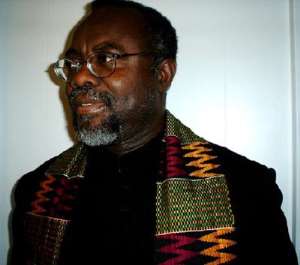
By Kwame Okoampa-Ahoofe, Jr., Ph.D.
I read Mr. Desmond Ayim-Aboagye's article titled “President of National House of Chiefs: Why [Not] Asantehene?” (Modernghana.com 4/26/09) with more than a little amusement. First of all, the article contains the kind of ratiocinative hollowness that one readily associates with a teenager, an intellectual amateur, to be frontally exact. It thus seemed all too logical that the author would parenthetically append the “Ph.D.” to his name. For such tentative gesture readily conveys the damning impression that the author, after all, is fully aware of the fact that he doesn't know what he is talking about. And also that having apparently bitten far, far more than his testicular mandibles are capable of containing, he ought not to be taken seriously.
And here, we must hasten to put paid to the facilely predictable and outright bromidic. In sum, the question ought not to concern merely the fact of whether His Majesty, the Asantehene, ought to be named to the hypothetical position of “Life-President” of the National House of Chiefs but, rather, whether in its current ethno-politically-oriented form and structure, the title and mode of succession to the Osei-Tutu Stool – and here the brazenly unmistakable allusion is to Otumfuo Osei-Tutu I, the founding patriarch of the celebrated Asante Federation and the direct ancestor of the present writer – could not be broadcast or elasticize to embrace all the identifiable ethnic polities that constitute the modern, postcolonial state of Ghana.
In other words, if the current position and title of the Asantehene is to be elevated to that of the symbolic representation of Ghanaian chieftaincy, in general, then it also must logically stand to reason that the pool of hereditary candidates from which future Asantehenes are selected ought to be remarkably broadened to include not only all non-Asante but Akan paramountcies – after all, the author of the article titled “President of National House of Chiefs: Why [Not] Asantehene?” unreservedly acknowledges the common provenance of all Akans and our collective historical, cultural and ideological achievements – but also all the other non-Akan paramountcies that constitute an integral part of the postcolonial Ghanaian state. Consequently, a Togbui Afedi of the Asogli micro-state, for instance, could be brought into the pool of viable candidates eligible to contest the newly elevated hypothetical title of “Otumfuo, Ghanahene,” or “His Imperial Majesty, the King of Ghana.”
I have absolutely no doubt in my mind that contrary to what “Dr.” Ayim-Aboagye would have his readers believe, an overwhelming majority of Ghanaians are far more apt to subscribe to the life-presidency of an Otumfuo whose selective/elective criteria encompassed all the royal paramountcies of the country among its pool of prime and potential candidates.
Such a process could be aptly characterized as the “Catholicization of Ghanaian Chieftaincy.” As evidently ossified as it now stands, entrusting only one ethnic polity with the privilege of determining for the rest of the country who best qualifies for the crucial title of Life-President of the Ghana National House of Chiefs, is tantamount to the pathological advocacy, or promotion, of ethnic-super-ordination (or supremacy) over the progressive modernization and salutary development of postcolonial Ghanaian chieftaincy.
On the question of whether an organicized and legally and constitutionally empowered National House of Chiefs ought to run parallel to our current Republican democratic system of governance, perhaps “Dr.” Ayim-Aboagye could have served himself and his readers far better to have delved into the origins of the idea for the establishment of a National House of Chiefs, and also the original headquarters of what eventually became known as the National House of Chiefs. Then, of course, the evidently “Monarchicratic” “Dr.” Ayim-Aboagye would have begun to more soundly appreciate the veritable originator of the raging debate regarding either the relevance or otioseness of chieftaincy in postcolonial Ghanaian political culture.
In conclusion must we duly emphasize the fact of the original idea for the establishment of a National House of Chiefs, primarily for purposes of both the auspiciously necessary modernization and preservation of traditional Ghanaian political culture, as well as moral values, being the veritable and indispensable brainchild of Osagyefo Nana Sir Ofori-Atta I. Most of the seminal constitutional apparatus, however, was set up by Dr. J. B. Danquah, a constitutional lawyer and scholar non-pareil, and putative Doyen of Gold Coast and Ghanaian politics, with the original headquarters being located at Dodowa. Anyway, who said the sun ever stopped rising from the east?
*Kwame Okoampa-Ahoofe, Jr., Ph.D., is Associate Professor of English, Journalism and Creative Writing at Nassau Community College of the State University of New York, Garden City. He is the author of 20 books, including “Ghanaian Politics Today” (Atumpan Publications/lulu.com, 2008). E-mail: [email protected].

 One dead, fire officer hospitalised after bee attack at Quarry Site in Sokode Gb...
 Israel and Iran step back from further strikes after renewed clashes
 Patients stranded as doctors, nurses refuse to see new patients over KATH CEO su...
 Avenor Rural Bank CEO’s house destroyed by fire
 Three arrested in Winneba for illegal mining near GWL water lines
 Two pupils of Alice Elite Academy laid to rest after fatal school bus crash
 Here are areas to be affected by ECG's planned maintenance on Tuesday
 Family of civil engineer killed in alleged military shooting demands justice
 SHS teacher allegedly beats female student over unpaid hostel fees
 Blow to EU defence cooperation as France, Germany abandon joint fighter jet prog...



Comments
Did not reckon with Okoampa putting seriousness aside and being sarcastically funny. But, Kwame, Odehye Nana, please use the language that I can understand without reading over the sentence again. I want to just enjoy reading what you write. I am too old to begin with learning your post colonial english.