




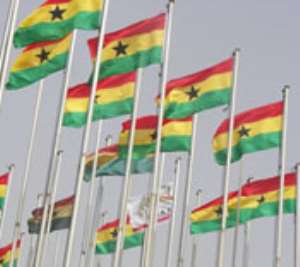
When Ghana swears in a new president on Wednesday, it will be installing an opposition candidate who has defeated the candidate of the incumbent government in a free and fair election.
People in other African countries will marvel at this, especially those in Kenya, who elected a new leader in 2007 but are still encumbered with the old one, President Mwai Kibaki.
The people of Zimbabwe will also wonder how an African country such as their own can hold elections in which not a single life is lost, while in their country Morgan Tsvangirai said of the 2008 election: "This is not an election, but a war."
That is not to say that the Ghana election didn't throw up scary moments of its own. The first presidential election, held on 7 December last year, had failed to produce a clear winner. According to Ghana's constitution, the winner must obtain more than 50% of the vote, and neither the candidate of the sitting government, Nana Addo Dankwa Akufo Addo, or the opposition candidate, John Atta Mills, achieved that. The result was as follows: out of a total of 8,465,834 valid votes cast, Nana Akufo Addo polled 4,159,439 votes (49.13%) while Atta Mills polled 4,056,634 votes (47.92%).
So a runoff was called. This took place on 28 December. It became clear, as soon as the new results began to roll in, that the previous tight result would be maintained. In fact, the outcome was so close – 50.13% for Atta Mills and 49.87% for Akufo Addo – that the chairman of the Electoral Commission, Kwadwo Afari-Djan, decided he would not announce a winner until voting had taken place in a single constituency, Tain, in the Brong-Ahafo region. There had been no voting here on 28 December because electoral materials for the constituency had not arrived in time and, according to Afari-Djan, the 53,000 registered voters there could affect the outcome of the election as a whole.
At this point, the uncertainty and tension combined to create a climate of fear in the country. As charges of electoral fraud flew – with the government claiming that the opposition stronghold, the Volta region, had been turned into a no-go area for its agents, while the opposition counter-claimed that the government stronghold, Ashanti, had been rendered equally unsafe for its representatives – the tension could have been cut with a knife.
As everyone wondered whether Ghana was "on the way to Kenya", the governing party announced that it would boycott the election at Tain, and many regarded it as a declaration of war, no less. The tension increased when the governing party also announced it was filing a court case against the chairman of the Electoral Commission to stop him from announcing a winner. Crowds from both sides of the political divide began to congregate near the Electoral Commission headquarters. Would the police be able to control them without calling in the army? If the army came in and was forced to shoot, would it stop there, or go on to carry out a coup d'etat? It was touch and go.
Then the outgoing president, John Kufuor, displayed statesmanship by advising his party to allow the result to be declared so that the constitutional deadline of 7 January 2009 could be met. It could settle any complaints by due process later, he said.
The chairman of the Electoral Commission then duly announced John Atta Mills as the winner. Most Ghanaians heaved a deep sigh of relief. The past week had been like a cup final in which there had been an initial draw, a replay also ending in a draw, then extra time also yielding a draw, penalties which no one won, and the result decided by the toss of a coin. Well, that's how it felt.
What has became clear from the election is that despite 51 years of independence and its boast that it was the first British African territory south of the Sahara to gain nationhood, ethnic divisions in Ghana are as sharp as ever. The fears of the ruling NPP and the opposition NDC about each other's "strongholds" – the Volta region for the NDC and Ashanti for the NPP – are rooted deeply in fact. It is like a boil on Ghana's foot, which has swelled into an ulcer during each election, since way back in 1969. Unless an ingenious way is found to lance the boil, it will one day grow big enough to cripple Ghana altogether. And that awful day may not wait for another 30 years to pass before it makes its terrifying appearance.
Credit: Cameron Duodu
Source: guardian.co.uk

 Nyinahin Catholic SHS teacher seen fighting female student in viral video arrest...
 Beijing condemns US move to blacklist Chinese companies
 Trump gets a cold reception at NBA Finals game as Spurs beat Knicks
 One dead, fire officer hospitalised after bee attack at Quarry Site in Sokode Gb...
 Israel and Iran step back from further strikes after renewed clashes
 Patients stranded as doctors, nurses refuse to see new patients over KATH CEO su...
 Avenor Rural Bank CEO’s house destroyed by fire
 Here are areas to be affected by ECG's planned maintenance on Tuesday
 SHS teacher allegedly beats female student over unpaid hostel fees
 Blow to EU defence cooperation as France, Germany abandon joint fighter jet prog...


