




The thing about democracy is that you never really know its worth -- until you have lost it.
I remember the euphoria we felt, as growing lads, when the 1954-56 political crisis that nearly derailed our independence, was settled by two hard-fought general elections -- one in June 1954 and the other in July 1956.
Waiting for the results was one of the most exciting moments most us were ever lucky enough to experience. We used to crowd around radio boxes and listen breathlessly to the announcement: "This is the Gold Coast Broadcasting Service. The general election." Then would come the the detailed results, constituency by constituency.
If you were a CPP sympathiser, you yelled your head off when the CPP won; if you were an Opposition sympathiser, you tried to outdo the CPP chap's shout of joy, when your side won. The greatest shouts were reserved for constituencies where a sitting MP was defeated, or where the result was unexpected.
The results didn't please everyone, but they were accepted by everyone. Where foul play was suspected, there was a clear procedure laid down for filing an 'election petition', and that's how those who were not happy with the results obtained satisfaction, or failed to obtain satisfaction.
The cost of engaging in foul play during campaigning and on polling day was quite heavy -- the 'elected' candidate who had been found guilty of engaging in foul play was not allowed to take his seat in Parliament and the seat was rather given to the cheated opponent! No two ways about it. As a result, candidates were careful not to engage in behaviour that could provide evidence that they had broken the election laws. Also, if you were found guilty of breaking electoral laws, you could be barred from contesting future elections. Quite a deterrent.
Unfortunately, after we had practised democracy for all to see and had been rewarded by being granted our independence on 6 March 1957, the idea of free elections and democracy took a severe knocking. By the time of the next election -- in April 1960 -- the obnoxious Preventive Detention Act had been used to deplete the numbers of Opposition Mps in Parliament. In the presidential election of 1960, only one person, Dr J B Danquah, had the courage to stand against President Kwame Nkrumah. The Opposition leader himself, Dr K A Busia, had had to flee into exile to avoid being arrested.
There is no doubt that Danquah's supporters were, in the main, too frightened to show their hand by voting for him -- he only got 10 percent of the vote, whereas in the 1956 Legislative Assembly elections, the Opposition had won nearly one-third of the 104 seats --33 to the CPP's 71. To the eternal shame of Dr Kwame Nkrumah, Danquah died in Nsawam Prisons.
Another election was held in 1965, but by then Ghana was -- officially -- a one-party state and everyone but the CPP regarded the election as an academic exercise or a farce. After the 1966 coup, an election was held that was clean, but it was vitiated by the fact that the CPP was banned from taking part in it as the CPP. Sure, the National Alliance of Liberals (NAL) did attract some CPP voters, but by no means all, as ethnic politics reared its head in the election campaign. Furthermore, NAL was led by Komla Gbedema, who had broken with the CPP and had fled into exile long before 1966.
The 1979 election was also clean, but, the conditions under which it was held were not too propitious. The AFRC, which was ruling when the election was held, had frightened a lot people out of their wits, and much guesswork took place among voters as to where the AFRC wanted the victory to go.
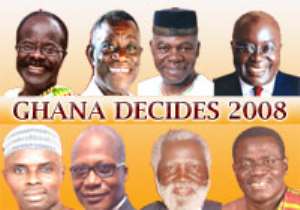
After a long hiatus of nightmarish proportions lasting from the 31 December 1981 coup to December 1992 an election was held that was partly boycotted by the Opposition. There was no boycott in 1996 but many still disputed the declared result. So 2000 and 2004 chalked good marks for Ghana in the clean elections record book. And that's what we must strive to repeat this year.
When parliamentary democracy is working well, it's one of the most beautiful forms of government on earth. It isn't easy to accept an institution -- the Opposition -- whose sole function is to tear into the Government and trash its policies day after Parliamentary day. Yet when this function is fully accepted, it helps the Government itself to perform better in every respect. It forces Ministers to prepare well before going to Parliament, for if you don't, the Opposition will show you up to be incompetent.
You see, no matter how hardened one's skin is, it will corrode or wilt if one is shown at every turn to be incompetent. One's own colleagues will go and report to the President that one is "letting the side down". If they don't, the public will: you can never tell who is sitting in the public gallery of Parliament, watching and listening. And the views of some of these people can bounce to the presidency. And then one's name will feature in a Cabinet reshuffle.
Unpleasant though the constant criticism of an opposition is, it must not only be tolerated but the best proposals in the criticism muxt be adopted, where necessary, and employed to replace bad policies with good ones. For bad policies cannot be hidden. The electorate can see with their own eyes, things which a Government has done wrong and which will influence the electorate when they go to cast their votes. So, in a way, by listening to the Opposition, a wise Government will be making the Opposition work against itself and for the Government! Many of the policies the Labour Party is using to solve the current economic crisis in Britain, for instance, could well be Conservative Party policies.
I remember talking to a barely 'educated' friend of mine after the 2004 Ghana election. He showed me his thumb -- with traces of the indelible ink which is stamped on it during voting, still on it -- and said, "This is my power. If they don't work to improve our lives this power will show them what we think of them". That was a voter with his eyes open all right.
Thumbprint power. That is the only legitimate power in a civilised country. Everyone understands it. Anyone can observe the ballot papers with thumbprints on them, being counted at a polling station. When one pile of ballot papers stands higher than the other(s), then it is obvious to everyone that the name or party symbol on that has won. Everyone can and should accept that, because everyone who is quaified has had a chance to vote, and also to canvass for votes for one's point of view. If the result goes against one, that's just too bad. Peoplewho understand this simple method of democratic voting should patiently explain it to those who want to breathe fire to force their point of view on others.
So, then, countrymen and women, please finish the campaign peacefully, and also either celebrate, or bemoan, the result peacefully. God created all of us equal, and that's why everyone of the specified age, has been allotted one vote. Trying to use force or any underhand method to negate the votes of others, makes the person trying to do that set himself or herself up to have a greater right in the say of how his/her country is run, than others. And that is an abomination unto God. For if God had wanted to create some men/women who are more equal than others, He would have given them two heads and four hands each, or something similar. But in His wisdom, He didn't, so -- one man, or woman, one vote! End of story.

 Nyinahin Catholic SHS teacher seen fighting female student in viral video arrest...
 Beijing condemns US move to blacklist Chinese companies
 Trump gets a cold reception at NBA Finals game as Spurs beat Knicks
 One dead, fire officer hospitalised after bee attack at Quarry Site in Sokode Gb...
 Israel and Iran step back from further strikes after renewed clashes
 Patients stranded as doctors, nurses refuse to see new patients over KATH CEO su...
 Avenor Rural Bank CEO’s house destroyed by fire
 Here are areas to be affected by ECG's planned maintenance on Tuesday
 SHS teacher allegedly beats female student over unpaid hostel fees
 Blow to EU defence cooperation as France, Germany abandon joint fighter jet prog...


