




Thirty-six years after his demise, the first Prime Minister of Ghana, later Life-President, continues to engage the imagination of many an African intellectual and scholar. The tragic reality, however, is that such engagement has tended to heavily involve non-Ghanaian Africans even as most astute Ghanaian intellectuals and scholars who had a first-hand experience of the man and his vaulting political ambition and immitigable tyranny scratch our heads in search of something diplomatic and scholastically objective to say about our treasured, albeit clinical, megalomaniac.
And so those of us who had to endure 15 apocalyptic years of Nkrumaism were not in the least bit surprised when a Nigerian author and his publisher recently launched a 1,500-page volume titled “Osagyefo Dr. Kwame Nkrumah: The Legend of African Nationalism” (Ghanaweb.com 10/17/08). We were not in the least bit surprised because unlike Nigerians, as an elderly Ghanaian scholar once pointed out to me, Ghanaians have been uniquely blessed with an apparently disproportionate share, relatively speaking, of progressive and erudite statesmen and politicians.
Our major problem, however, has been our apparent inability to remarkably appreciate these foresighted leaders with whom we were richly blessed. For a ready example, one only needs to take a peek at our latest monetary currency. And on the latter score, of course, I am unmistakably alluding to our celebrated BIG SIX founding fathers, three – or fifty-percent – of who were this writer's relatives.
The question thus becomes: How come it that only one personality among the BIG SIX should warrant the publication of a 1,500-page book? You see, I have resisted the easy temptation of describing Prof. Martian Chukwuka Okany's “Osagyefo Dr. Kwame Nkrumah: The Legend of African Nationalism” a tome, because the very suggestive premise of the book's title readily gives away its likelihood of merely being a paean, rather than a serious and dispassionate work of scholarship in the manner that, for instance, such distinguished African and Africanist historians as Ade Ajayi, Basil Davidson and Adu Boahen would accord the same.
First of all, anybody who knows anything worthwhile about the historiography of African Nationalism knows perfectly well that it is rather in the more expansive realm of “Pan-Africanism,” as opposed to African Nationalism proper, that any legendary niche could be creditably and uniquely conceded Mr. Kwame Nkrumah. And that for all practical intents and purposes when one speaks of “African Nationalism,” the unbested pioneer remains Joseph Ephraim Casely-Hayford, founding spearhead of the landmark National Congress of British West Africa (NCBWA). However, when “African Nationalism” is properly predicated upon geopolitical territoriality, as it were, then, of course, the first legend of African Nationalism is none other than the celebrated and putative Doyen of Gold Coast and Ghanaian politics and the philosopher-scholar-statesman and literary artist whose singular erudition engendered the postcolonial rebirth of the erstwhile Gold Coast as Ghana.
And, of course, the foregoing allusion is unmistakably and directly to none other than Dr. Joseph (Kwame Kyeretwie) Boakye-Danquah (1895-1965), the first continental African to be conferred with an earned doctorate by any reputable Western academy in the twentieth century.
Needless to say, the kind of African Nationalism connoted and/or evoked by the title of Prof. Okany's book is Diaspora-African-oriented, that is, the largely mythopoeic brand of African Nationalism that envisages the entire geographical landmass of the primeval Continent as an organic whole. That kind of African Nationalism it was which the sterling likes of Martin Delaney, Alexander Crummel, W. E. B. DuBois and Edward Wilmot Blyden passionately championed.
Incidentally, and significantly, it was the U. S. Virgin Islands-born Dr. Blyden who coined the term as well as propounded the geo-cultural concept of the “African Personality.” And as Mr. K. B. Asante has observed on record, Nkrumah was to expediently and deviously cannibalize the concept and facilely and dishonestly pass it off to his minions as his ex nihilo invention (See Kwame Arhin's The Life and Work of Kwame Nkrumah).
Launching his book in Accra was, perhaps, the most politically expedient thing to do even though, commercially speaking, Lagos would have been a much more conducive environment. On the other hand, and for good measure, the book ought to have been launched in Abuja, the post-modern Nigerian capital which also presently doubles as the capital of the Economic Community of West African States (ECOWAS). Needless to say, launching the book in Abuja would have historically brought Nkrumah's widely advertised “vision” of African unification partially full-circle, assuming that, indeed, the “Osagyefo” was approving of the organic regionalization of African countries as part of the gradual process towards ultimate and total continental African unification.
Indeed, when Mr. K. B. Asante asserts that: “It is a pity that no comprehensive account of the life of Kwame Nkrumah has been carried out by men [and also women] of learning in Ghana,” the former diplomat and close Nkrumah associate is merely being disingenuous, unless by “comprehensive” he implies that no 1,000-plus-page book has been authored by any Ghanaian on Nkrumah. The question of whether any work, or study, on the African Show Boy ought to be of a certain number of pages is, obviously, one that is moot. Indeed, as I remarked earlier on regarding Mr. Asante's assertion, there is almost nothing new left in Nkrumaist studies, or scholarship, if one may be permitted to presume the latter. The reality, it can hardly be gainsaid, is that Nkrumah has been overexposed, with his perceived achievements being almost criminally exaggerated to the utter impoverishment of the rich tapestry and diverse agency of postcolonial Ghanaian history. To be sure, it is the equally significant and seminal likes of Dr. J. B. Danquah, Messrs. Kuntu-Blankson, Casely-Hayford, Mensah-Sarbah and Kobina Sekyi who deserve extensive and meticulous study. For, it can hardly be gainsaid that Dr. Danquah did far more to shape the direction of African philosophy and culture than Nkrumah could achieve in three lifetimes!
It is also significant to highlight the fact of Mr. Asante being an Octogenarian who faithfully served “Master” Nkrumah and is thus uniquely invested in the historical fortunes of Nkrumaism. The preceding notwithstanding, Mr. Asante is also one of the infinitesimally few Ghanaian intellectuals to courageously acknowledge the plagiaristic tendencies of his former boss, and he ought to be lauded for that (See Kwame Arhin's The Life and Work of Kwame Nkrumah).
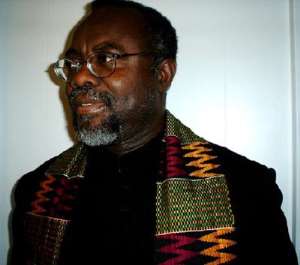
*Kwame Okoampa-Ahoofe, Jr., Ph.D., is Associate Professor of English, Journalism and Creative Writing at Nassau Community College of the State University of New York, Garden City. He is the author of 18 books, including “Dr. J. B. Danquah: Architect of Modern Ghana” (iUniverse.com, 2005). E-mail: [email protected].

 Nyinahin Catholic SHS teacher seen fighting female student in viral video arrest...
 Beijing condemns US move to blacklist Chinese companies
 Trump gets a cold reception at NBA Finals game as Spurs beat Knicks
 One dead, fire officer hospitalised after bee attack at Quarry Site in Sokode Gb...
 Israel and Iran step back from further strikes after renewed clashes
 Patients stranded as doctors, nurses refuse to see new patients over KATH CEO su...
 Avenor Rural Bank CEO’s house destroyed by fire
 Here are areas to be affected by ECG's planned maintenance on Tuesday
 SHS teacher allegedly beats female student over unpaid hostel fees
 Blow to EU defence cooperation as France, Germany abandon joint fighter jet prog...


