




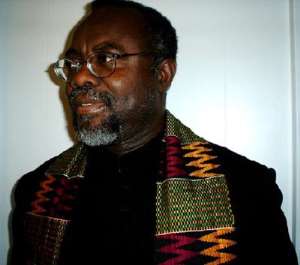
When Mr. P. V. Obeng notes that “the notion that Ghana is a peaceful country and cannot be plunged into a civil war may be misleading,” the former unofficial prime minister of the so-called Provisional National Defense Council (PNDC) junta is merely engaging in bromide, or the commonplace (Ghanaian Times 2/25/08).
To be certain, in both June 1979 and December 2001, a secret and unilateral civil war, in retrospect, was launched against the defenseless Akan-ethnic majority of Ghana by then-Flt.-Lt. Jeremiah John Rawlings. Both wars were unilateral, because it was only the agents of deadly provocation, institutionally disguised as the Ghana Armed Forces, who were armed. The wars were also “secretly declared,” because both the so-called Armed Forces Revolutionary Council (AFRC) and the Provisional National Defense Council (PNDC) pretended that it was the cross-ethnic and popular discontent of Ghanaians that had provoked both murderous Rawlings juntas.
In the ensuing mayhem, deftly orchestrated by Mr. Rawlings and his flunkies, more than 2,000 Ghanaians, largely Akan civilians, were brutally massacred by Ewe-dominated juntas. In 1982, three Akan Supreme Court judges and a retired Army major were abducted from their homes by Ewe gunmen, with the approval of at least two non-Akan cabinet members of the PNDC junta and brutally murdered, Mafia-execution style, and their corpses nearly burnt to ashes, in the culprits’ bid to erasing any traceable evidence. Then again, earlier on, in 1979, eight senior military officers, including three former heads-of-state, all of them Akan, were executed by firing squad. The man who had saved Flt.-Lt. Jeremiah John Rawlings from summary and justifiable discharge from the Ghana Air Force, Air-Vice Marshall Yaw Boakye, was also savagely executed; the latter’s crime was having appropriated his inalienable right as a Ghanaian citizen to secure a bank loan which, at the time of his summary execution, Air-Vice Marshall Yaw Boakye had already begun repaying on an installment plan.
It is also interesting when Mr. Obeng observes fertile conditions for the touching off of a civil strife, or war, to include “the perception that some tribes are favored in appointments to positions of trust, complaints about uneven distribution of spatial developments [whatever the latter means], unfair sharing of the country’s wealth and fear of elections being rigged.” And here, also, must be critically observed the fact that the preceding catalog of civil war-provoking conditions was contained in a lecture titled “The Aftermath of the Kenya[n] General Election: Any Lessons for Ghana and Africa,” which Mr. Obeng, reportedly, presented to the Tema chapter of the alumni association of the Kwame Nkrumah University of Science and Technology (KNUST).
For starters, Mr. Obeng, recently accused of having bilked the Ghanaian taxpayer of millions of dollars in executive contractual fraud, otherwise known as the SCANCEM Affair, is the last person who has the moral authority to be lecturing Ghanaians, at large, about the lethal consequences of governmental venality. For it goes without saying that it was the very P/NDC, in whose pay or government Mr. Obeng served for twenty years, that almost uniquely refined the crassly unenlightened art of nepotism which this major former purveyor is now pontifically decrying.
Secondly, speaking of the perception and the “fear of elections being rigged,” perhaps an avid student of postcolonial Ghanaian politics ought to remind the longtime P/NDC operative that while many Ghanaians may, indeed, be woefully afflicted with short memories – or political amnesia – nonetheless, enough citizens among our ranks vividly remember the massively rigged “elections” of 1992, infamously dubbed “The Stolen Mandate.” In that election, for those among us who may not quite well remember, Mr. Rawlings, according to reliable sources, criminally caused the stuffing of ballot boxes in order to guarantee his presidential victory by hook and/or crook (see Adu-Boahen’s “The Stolen Verdict” for a detailed analysis of the 1992 general election).
Indeed, so scandalous was the entire electoral process that in many electoral districts in the country, the number of votes cast was at least twice, and sometimes even thrice, the number of legitimately registered voters. Interestingly must also be observed the fact that in Ghana’s postcolonial era, it was President Kwame Nkrumah’s Convention People’s Party (CPP) that is unenviably credited with having singularly invented the sinister art of electoral nullification or ballot-rigging.
Likewise, in terms of “the perception that some tribes are favored in appointments to positions of trust” in government and the civil service, as Mr. Obeng notes, perhaps somebody ought to remind the latter about the fact that for most of its two decades in office, the ministries of Foreign Affairs, National Security – a cabinet-level portfolio, Justice and Economic Planning and Ambassador to the United Nations were almost wholly in the hands of either ethnic Anlo-Ewe or people closely aligned with the hermetic and parochial Ewe-Nationalist ideology of Messrs. Rawlings and Tsikata, as were also the most significant and sensitive positions of trust in the Ghana Armed Forces as well as a slew of managerial positions in the Ghana Civil Service. A similar tableau could also be witnessed in our judicial system, particularly at the level of the kangaroo People’s Court.
Thus, for Mr. Obeng to be cavalierly pretending that, somehow, the “conditions that led other African countries to war” only began to exist, or rear their ugly heads, with the democratic accession of the New Patriotic Party (NPP) to the reins of governance is unpardonably disingenuous. Indeed, about the only reason that has effectively prevented Ghana from plunging into a materially and morally regressive state of siege, is the longsuffering and pacifist cultural temperament of the Akan, Ghanaian ethnic majority.
The preceding notwithstanding, it may be opportune, as well as auspicious, even as fanatical P/NDC adherents and their misguided sympathizers continue to desperately beat the stentorian drums of war – in a copycat Kenyan or Ivorian fashion – to sternly caution these cynical warmongers that the putatively placid temperament of the Akan majority may not, in any way, be boundlessly elastic.
Needless to say, when one speaks of Great Asante or Great Akyem, as well as Great Gonja, for ready examples, one is not merely bluffing. But, of course, for the cynically adamant, the taste of the proverbial pudding – or shall we say palm-wine? – lies in the drinking.
*Kwame Okoampa-Ahoofe, Jr., Ph.D., is Associate Professor of English and Journalism at Nassau Community College of the State University of New York, Garden City. E-mail: [email protected].

 One dead, fire officer hospitalised after bee attack at Quarry Site in Sokode Gb...
 Israel and Iran step back from further strikes after renewed clashes
 Patients stranded as doctors, nurses refuse to see new patients over KATH CEO su...
 Avenor Rural Bank CEO’s house destroyed by fire
 Three arrested in Winneba for illegal mining near GWL water lines
 Two pupils of Alice Elite Academy laid to rest after fatal school bus crash
 Here are areas to be affected by ECG's planned maintenance on Tuesday
 Family of civil engineer killed in alleged military shooting demands justice
 SHS teacher allegedly beats female student over unpaid hostel fees
 Blow to EU defence cooperation as France, Germany abandon joint fighter jet prog...


