




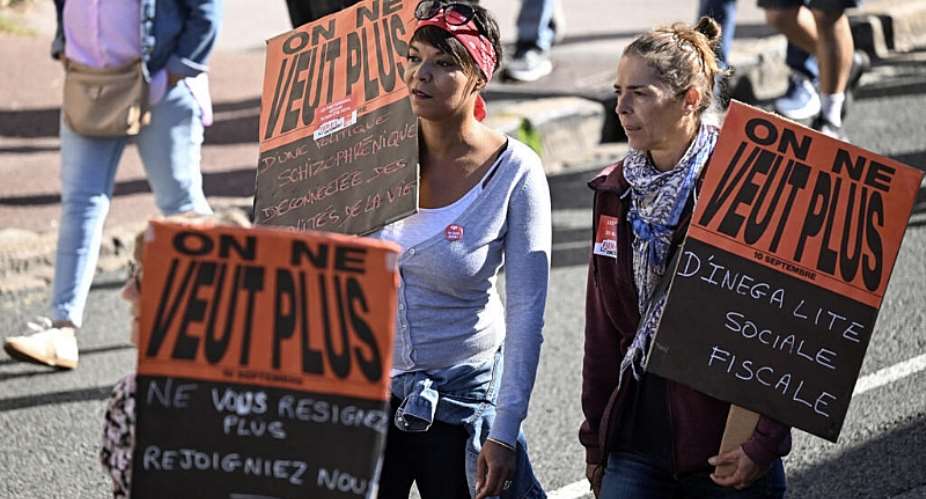
Oxfam France on Tuesday warned that a trend towards larger shareholder payouts was fuelling inequality and called for new limits on executive pay and dividend payments.
The charity argues that major firms have the resources to help strengthen Europe's long-term economic future.
“While public finances run dry, companies have more than enough resources to invest in our future and Europe's economic competitiveness, but they prefer to reward shareholders,” said Alexandre Poidatz, Oxfam's spokesperson on multinational regulation.
Oxfam said this pattern was visible across Europe's biggest corporate players. Its report found that the 100 largest companies in Europe by turnover paid out an average of 70 percent of their profits to shareholders between 2022 and 2024.
Some companies, including Spain's Telefónica, British oil giant BP and the Zurich Insurance Group, paid shareholders more than they made in profits over the period, it said.
Billionaire wealth on the rise, says Oxfam, warning of 'aristocratic oligarchy'
'Inequality is a choice'
Oxfam said the figures showed that Europe's biggest firms were prioritising short-term shareholder returns over wider social and environmental goals.
According to the report, nearly half of the companies surveyed paid out 32 times more to shareholders than they invested in green transition measures.
The charity said such spending choices mattered at a time when governments across Europe were facing strained public finances, businesses were under pressure to adapt to climate targets and many workers were struggling with the cost of living.
“When regulatory measures are in place, things work out, and when they aren't, everything goes haywire,” said Cécile Duflot, executive director of Oxfam France.
Oxfam argued that the current model was not "inevitable", but rather the result of choices made by corporate leaders and policymakers.
“Inequality is not inevitable: it is a choice. Europe's largest companies must stop choosing a model that benefits only a minority and start acting in the interests of the many,” it said.
World's richest one percent made over $40 trillion in a decade, says Oxfam
Calls for fairer rules
Poidatz said a fairer distribution of company profits would create a more “virtuous” long-term model and, in his view, one that would also prove “much more competitive in the medium term”.
He added that rules designed to curb excessive payouts should not be seen as holding companies back.
“Regulation is not a barrier to competitiveness. On the contrary, it is the framework for a desirable future. Ambitious nations cannot wait for Brussels to set things right."
Could tackling climate change and levelling inequality go hand in hand?
Oxfam is urging European lawmakers and business leaders to cap CEO pay at a maximum of 20 times the median employee salary.
It also wants companies to limit dividend payments until they can guarantee “decent” wages and put in place an “ambitious climate strategy”.
The NGO is also calling for quotas to increase women's representation in senior management roles.
Oxfam said its recommendations would help ensure that Europe's largest companies contribute more effectively to a fairer and greener economy, while still supporting competitiveness over the longer term.
(with newswires)

 KATH doctors suspend strike after Otumfuo’s intervention
 Mahama is losing control of his government — NPP Communicator
 Health Minister’s suspension of KATH CEO technically right — Prof Beyuo
 Korle Bu Teaching Hospital conducts Ebola emergency simulation to strengthen fro...
 Abandoned newborn baby found near gutter at Agona Swedru Woaraba
 Reparations Justice Forum questions imported schnapps for African libation ritua...
 AG to meet US counterparts on pending extradition requests — Kwakye Ofosu
 JHS graduate, another drown in Twifo-Atti-Morkwa rivers during heavy rainfall
 27-year-old jailed 4years for stealing church musical equipment at Hohoe
 Call 'Rambo-style' Mintah Akandoh to order — Minority tells Mahama


