




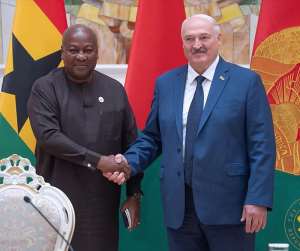
President John Dramani Mahama with President Lukashenko
There is a particular symbolism in the fact that President John Dramani Mahama's first stop upon arriving in Minsk was a wreath-laying ceremony at Belarus's Victory Monument, honoring Soviet soldiers who fell resisting Nazi Germany during the Second World War. It was a diplomatic gesture, carefully choreographed and entirely conventional in its form. But it also communicated something more substantive: that Ghana had come to Belarus not as a supplicant seeking favor from a pariah state, but as a sovereign partner paying the full measure of respect that a state visit demands. In the language of diplomacy, such gestures matter. They set the tone for everything that follows.
What followed was historic. The summit between President Mahama and President Lukashenko at the Palace of Independence in Minsk on June 8 marked the first highest-level visit in the entire history of bilateral relations between the two countries. (BELTA) As Lukashenko himself noted, the relationship marked its 34th anniversary on June 5, the very day Mahama arrived in Minsk. (Belarus) Three decades of diplomatic existence had produced remarkably little in the way of substantive engagement. What this visit produced, in a single week, was a structural framework for a relationship that had previously existed largely on paper.
The engagements culminated in the signing of three Memoranda of Understanding covering the establishment of a Joint Commission for Cooperation in Trade and Economic Affairs, enhanced collaboration between the Chambers of Commerce of both countries, and cooperation in the field of agriculture. These are not decorative agreements. Each carries operational implications. A joint intergovernmental commission, in diplomatic practice, functions as the engine room of a bilateral relationship the institutional mechanism through which general goodwill is converted into specific contracts, technical exchanges and investment decisions.
President Lukashenko confirmed the commission would begin work immediately, developing a roadmap for cooperation in the coming weeks and months. The centerpiece of the substantive discussions was agriculture and for good reason. Ghana's food import bill remains one of the most persistent drains on its foreign exchange reserves. President Mahama stressed that agriculture remains central to Ghana's development agenda, with the government's goal being to transform the sector into a modern, technology-driven industry capable of creating jobs, supporting industrialization and strengthening food security.
Crucially, the Ghanaian position was not simply to procure machinery. Mahama made clear that Ghana was interested in acquiring technical expertise and attracting investment into modern agriculture rather than merely importing machinery, and that any future machinery purchases would depend on the availability of spare parts, technical support and reliable after-sales services.
This is a materially different posture from the transactional equipment deals that have characterized many African agricultural partnerships over the decades, and it signals a more sophisticated negotiating position.
Belarus, for its part, arrived with concrete proposals rather than diplomatic generalities. Belarusian Industry Minister Andrei Kuznetsov indicated that the two sides would explore joint assembly operations in Ghana aimed at building a full production cycle, pointing to Belarus's experience in Zimbabwe, where agricultural mechanization had enabled the country to supply grain to neighboring states by 2025. The Zimbabwe precedent is significant.
It suggests Belarus has already developed a replicable model for agricultural technology transfer in Africa one that goes beyond machinery sales to encompass knowledge transfer, local assembly and regional supply chain development. By the close of the visit, Mahama had secured a major procurement arrangement with Belarus for the supply of 1,840 pieces of agricultural equipment, which he described at the first-ever Belarus-Ghana Business Forum as a practical example of deepening economic ties between the two nations.
The most commercially significant proposal to emerge from the summit, however, may prove to be the hub concept. At a joint press conference following the signing ceremony, President Lukashenko expressed Belarus's keen interest in establishing a distribution hub in Ghana to facilitate the spread of Belarusian products across West Africa, saying: "I would like to emphasize once again our great interest in creating a corresponding hub of Belarusian products in West Africa."
The strategic logic here is transparent and worth naming clearly. Belarus is a landlocked country in Eastern Europe, geographically remote from West African markets and operating under severe Western sanctions following its alignment with Russia over Ukraine. Ghana, by contrast, is a coastal, politically stable, English-speaking democracy with functioning port infrastructure, a relatively open investment climate and demonstrated capacity to serve as a regional commercial gateway.
For Belarus, a distribution hub in Accra is not merely a business convenience. It is a sanctions circumvention architecture dressed in the language of trade partnership.
During the second day of his state visit, Mahama toured one of Belarus's largest agro-processing facilities in Brest, focusing on the plant's advanced technology in dairy production, including baby food, milk, cheese and milk powder destined for global markets, and noted Ghana's commitment to adopting modern processing techniques to transition from smallholder farming to large-scale commercial agriculture.
The Brest visit was carefully chosen. Belarus has built genuine industrial competence in agro-processing, and Mahama's willingness to observe production lines personally before signing agreements reflects a pragmatic approach to partnership verifying capability before making commitments.
President Lukashenko also disclosed that defence and military-industrial cooperation featured in discussions held behind closed doors, saying there were no closed topics between the two countries.
This disclosure deserves more attention than it has received in most Ghanaian media coverage of the visit. Belarus remains one of Russia's closest allies, deeply implicated in the logistics of the Ukraine war and subject to sweeping Western sanctions. A Ghanaian head of state holding closed-door discussions on defence cooperation with Minsk is not a trivial diplomatic development. It will be noted in Brussels, Washington and London, and it will color how Ghana's Western partners read Accra's foreign policy intentions going forward.
Mahama used the Belarus-Ghana Business Forum to showcase Ghana's economic recovery, citing inflation dropping from approximately 54.1 per cent in 2023 to 3.4 per cent in 2026, international reserves strengthening from $8.6 billion in 2024 to $13.9 billion in 2025, and GDP surpassing $100 billion to reach $114 billion, making Ghana the eighth largest economy on the continent.
The decision to lead with economic data at a business forum in Minsk reflects a calculated pitch: Ghana is presenting itself not as a country in need of rescue but as a stable, growing market offering genuine returns to investors willing to engage seriously.
The latest agreements come as Ghana seeks to deepen economic cooperation with emerging partners beyond its traditional allies. That sentence, anodyne in its phrasing, contains the political essence of the entire visit. Ghana under Mahama is conducting what might be described as diversification diplomacy a deliberate effort to expand the range of substantive partnerships beyond the Euro-Atlantic axis that has historically defined much of Accra's external engagement. This is not anti-Western policy. It is post-dependency policy. The distinction matters enormously.
There is a version of the Belarus visit that reads as straightforwardly pragmatic: a developing country exploring a non-traditional partner for agricultural technology, with genuine potential gains for Ghana's food security agenda. There is another version that reads as geopolitically consequential: a West African democracy deepening ties with a Lukashenko government that is internationally isolated, closely aligned with Moscow, and actively seeking to use Africa as a market and influence platform while Western sanctions constrict its options elsewhere. Both versions are simultaneously true. Managing that duality extracting genuine developmental value from the partnership while avoiding entanglement in Belarus's geopolitical liabilities will require exactly the kind of careful, conditional diplomacy that Mahama's insistence on technology transfer over simple machinery imports suggests he understands.
Lukashenko described the talks as productive and said the two countries were opening a new chapter in cooperation, adding that the visit would mark the beginning of a strong friendship and fruitful economic cooperation, while thanking Mahama for inviting him to visit his farm.
That final detail an invitation to a farm is the most human note in an otherwise carefully scripted diplomatic performance. It is also, in its way, the most revealing. Two leaders who had never met before this week ended their first summit with a personal invitation. Whether Ghana ultimately benefits from this new chapter will depend not on the warmth of the personal chemistry in Minsk, but on the rigor and vigilance with which Accra manages what comes next.
Sources: Ghanaian Times, Daily Graphic, GBC Ghana Online, NewsGhana, Ghanamma, BelTA (Belarusian state news agency), Belarus.by, Diplomatic Times Online, MyNewsGH, ABC News Ghana, Rainbow Radio Online, The Herald Ghana.
Mustapha Bature Sallama.
Medical/ Science Communicator,
Private Investigator, Criminal investigation and Intelligence Analysis.
International Conflict Management and Peace Building.USIP
[email protected]
+233-555-275-880

 Belarus manufacturers to storm Ghana next week after President's visit
 Government to offer tax incentives for factories located outside Accra
 White House World Cup chief defends visa ban for Somali referee, Iranians
 Talensi DCE courts investors for revival of Pwalugu Tomato Factory
 Manhyia South MP says free speech under threat, cites 17 arrests in 16 months un...
 KATH doctors suspend strike after Otumfuo’s intervention
 Mahama is losing control of his government — NPP Communicator
 Health Minister’s suspension of KATH CEO technically right — Prof Beyuo
 Korle Bu Teaching Hospital conducts Ebola emergency simulation to strengthen fro...
 Abandoned newborn baby found near gutter at Agona Swedru Woaraba


