




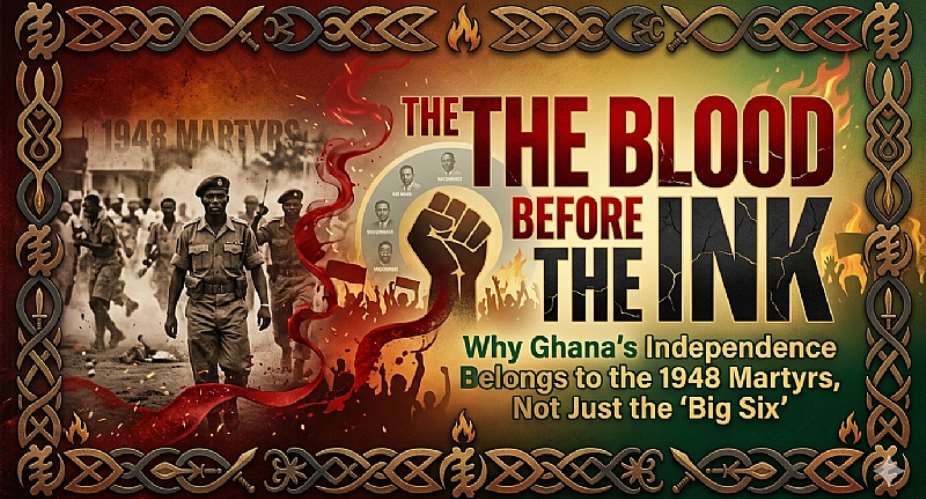
For decades, Ghana’s national independence narrative has been heavily weighted toward the boardroom. We trace our liberation to the eloquent speeches, political theories, and legal maneuvering of the "Big Six". But long before constitutional ink was dried by politicians, the ultimate price for our freedom was paid in crimson red on the dusty asphalt of the Christiansborg Crossroads.
On 28 February 1948, Sergeant Cornelius Adjetey, Corporal Patrick Gagbale Attipoe, and Private Odartey Lamptey—unarmed, decorated World War II veterans—were shot dead by colonial police. They were not marching for political offices; they were marching for basic human dignity, fair pensions, and the broken promises of a deceitful colonial empire. Their deaths did not just protest an empire—it shattered it. It was their spilled blood that transformed a slow, elite political negotiation into an unstoppable, radical mass movement for self-government.
As Ghanaians, we must correct our historical bias. The politicians did not give us Ghana; these grassroots soldiers did. This article outlines the true identities of our martyrs, the immediate political earthquake their deaths caused, the current state of our living heroes, and a blueprint for giving these frontline fighters the ultimate prominence they deserve over the political elite.
The Frontline Heroes: Who Were the Three Martyrs?
- Sergeant Cornelius Frederick Adjetey (1893–1948): A native of Labadi, Accra, educated at the Osu Presbyterian Primary School. A hardened career soldier, he fought for the British Empire in both World War I (East Africa) and World War II (the brutal Burma campaign). Highly decorated and fiercely respected, he was the unyielding operational leader leading the march toward the Governor's residence.
- Corporal Patrick Gagbale Attipoe: A disciplined, fierce soldier from Anloga in the Volta Region. Having survived the unforgiving jungle warfare of the Burma campaign against Axis forces, he returned home to face stark poverty, unemployment, and institutional neglect, forcing him to the frontlines of the protest.
- Private Odartey Lamptey: A passionate, young Ga soldier from Accra who represented the disillusioned, lower-ranking youth of the demobilised forces.
Eyewitness Account: Fellow World War II veteran and eyewitness WO1 Joseph Ashitey Hammond recalled the exact moments of British brutality at the crossroads: “Supt. Imray ordered a police sergeant to shoot three times. When the sergeant did not shoot, Imray, highly annoyed, grabbed the gun and shot... Supt. Imray took the gun and shot Private Odartey Lamptey first, Corporal Attipoe second and Sergeant Adjetey last.”
The Watson Commission: The Shocking Validation of Their Blood
The 1948 Accra Riots sparked by the shootings forced the colonial government to set up a Commission of Enquiry chaired by Sir Aiken Watson. The resulting July 1948 report did not defend the British; it unexpectedly validated the veterans and legalised the march toward sovereignty:
- "Outmoded at Birth": The commission boldly condemned the existing 1946 Burns Constitution as totally useless, famously writing that it was “outmoded at birth” because it completely failed to give native Africans genuine political representation.
- Justification of Grievances: It officially documented that World War II veterans were severely marginalized, suffering under unpaid war benefits, inflation, and broken colonial promises.
- The Path to Self-Governance: The Watson Report directly forced the British to allow Ghanaians to draft their own constitution via the 1949 Coussey Committee, which paved the way for the historic 1951 elections and eventual independence on 6 March 1957.
The Silent Crisis: Modern Veteran Welfare in Ghana
True honor to the dead is measured by how we treat the living who wear the same uniform. Today, the Veterans Administration, Ghana (VAG) oversees ex-servicemen, but their conditions remain heavily underappreciated:
- Basic Medical Access: Veterans receive free medical screening access under the National Health Insurance Scheme (NHIS), but specialized geriatric and psychological healthcare remains scarce.
- Chronically Low Pensions: Many aged ex-servicemen survive on minimal monthly stipends that fail to match the modern cost of living in Ghana.
- The Forgotten Poppy Drive: The annual Poppy Appeal ahead of Remembrance Day (11 November) remains a highly formal ritual that raises insufficient funds to pull disabled and destitute veterans out of poverty.
Recommendations: How Ghana Can Elevate the Martyrs Above the "Big Six"
To de-emphasize the political monopoly of the "Big Six" and place the grassroots martyrs at the peak of our national memory, the government and civil society must take these immediate, aggressive steps:
- Introduce Martyr Currency: The Bank of Ghana should introduce a permanent or commemorative legal tender banknote featuring the faces of Adjetey, Attipoe, and Lamptey, physically placing our frontline fighters into the daily hands and pockets of citizens.
- Rescue and Rebuild Gravesites: Landmarks like Sergeant Adjetey's grave at La Salem Park in Osu must be immediately rescued from their current states of neglect and transformed into pristine, state-protected national mausoleums and tourist hubs.
- Rebrand National Holidays: Adjust the focus of "Founders' Day" or "Constitution Day" to officially establish a National Martyrs and Heroes Day, ensuring the focus shifts from elite political figures to the military and civilian grassroots who bled for the land.
- Teach the "Imray-Kanjaga" Defiance: Rewrite the basic and high school history curricula to contrast the villainy of Major Imray with Lance Corporal Issah Kanjaga—the African colonial police officer who bravely defied direct British orders and refused to fire on his fellow Ghanaians, teaching our youth real patriotism over blind institutional obedience.
- Fund Living Veterans via Heritage Tourism: Legally mandate that a significant percentage of all tourism revenues generated from the Christiansborg Castle and the Nationalism Park be funneled directly into funding modern VAG medical centers and housing units.
A Call to Action for the Ghanaian Youth
To the youth of modern Ghana: our freedom was not a diplomatic donation or a gentleman's agreement signed over tea. It was paid for in cash, and the currency was the warm blood of young men who survived global trenches in Burma only to be executed on their own soil.
When you look at the relative stability, peace, and sovereignty we enjoy today, do not look only to the statues of politicians in suits. Look to the crossroads. Look to the scars of the ordinary Ghanaian who refused to bow to oppression.
As stated beautifully in our National Pledge, we must “hold in high esteem our heritage, won for us through the blood and toil of our fathers.” To compromise the integrity of Ghana through corruption, apathy, or unpatriotic acts is to spit on the graves of Adjetey, Attipoe, and Lamptey. The foundations of this Republic are built on sacrifice; let our generation be the mortar that holds it together, proving to the world that the toil and blood of our forebears were not shed in vain.
Author Bio Box
About the Author:
The author is a passionate Ghanaian cultural historian, essayist, and advocate for grassroots historical justice. Writing from Accra, his work focuses on decolonising the African historical narrative, amplifying forgotten working-class heroes, and bridging the gap between colonial archives and the consciousness of modern Ghanaian youth.
✍️By A Concerned Retired Senior Citizen
For and on behalf of all Senior Citizens of the Republic of Ghana 🇬🇭
Teshie-Nungua
[email protected]

 Abandoned newborn baby found near gutter at Agona Swedru Woaraba
 Reparations Justice Forum questions imported schnapps for African libation ritua...
 35-year-old teacher found dead in room at Akyem Anweam
 If 2024 anti-LGBTQ bill was good, why wasn't same given to Mahama for assent? — ...
 'Oga should be worried' — Kwaku Azar reacts as pressure mounts on Ofori-Atta af...
 Nigerians facing xenophobic attacks in South Africa are legal migrants — Foreign...
 AG to meet US counterparts on pending extradition requests — Kwakye Ofosu
 JHS graduate, another drown in Twifo-Atti-Morkwa rivers during heavy rainfall
 27-year-old jailed 4years for stealing church musical equipment at Hohoe
 Call 'Rambo-style' Mintah Akandoh to order — Minority tells Mahama


