




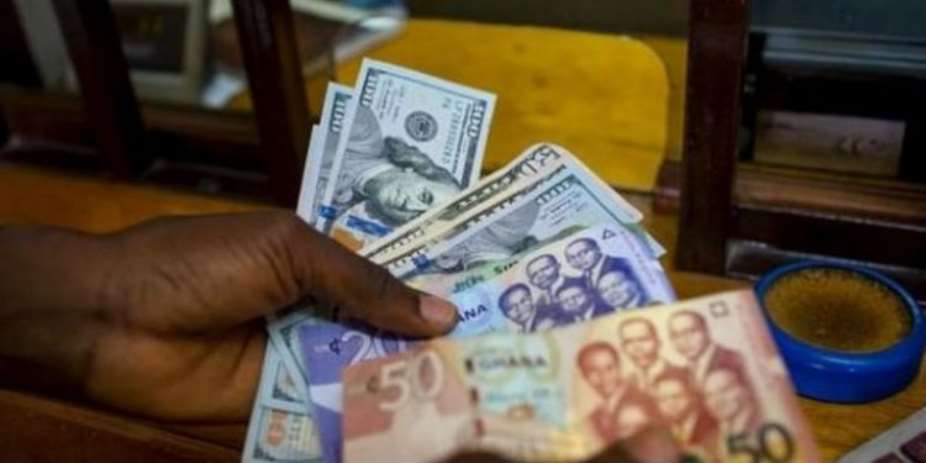
The Ghana cedi has continued its downward trend against major international currencies over the past two weeks, driven by rising demand for foreign exchange and increased corporate repatriation pressures.
According to the latest market data, the local currency weakened across both the interbank and retail markets, with analysts pointing to stronger demand for US dollars amid relatively limited foreign exchange supply.
In the interbank market, the cedi traded at GHS 11.85 to the US dollar, down from GHS 11.63 recorded in the previous period.
It also depreciated against the British pound and the euro, with rates rising to GHS 15.85 per pound and GHS 13.66 per euro, compared to GHS 15.62 and GHS 13.49 respectively.
The retail market reflected a similar trend, with the cedi losing 0.81 percent against the dollar, 1.83 percent against the pound, and 1.40 percent against the euro. Mid-market rates closed at GHS 12.30/USD, GHS 16.35/GBP, and GHS 14.30/EUR.
On a month-on-month basis, the cedi depreciated by an average of 4.18 percent between April and May 2026, higher than the 3.23 percent recorded at the end of April, despite the Bank of Ghana injecting about $1.1 billion in foreign exchange support during May.
Market analysts say sentiment remains largely negative, as foreign currency demand continues to outstrip available supply.
They also point to broader global factors, including sustained US dollar demand and increased import costs linked to elevated crude oil prices, which have prompted some central banks to liquidate non-dollar assets.
Looking ahead, analysts expect some stability in the short term, supported by an announced $1.2 billion monthly foreign exchange support programme for June.
However, they caution that renewed pressure could emerge as multinational companies begin repatriating profits and dividends in the second quarter, typically a period of heightened foreign exchange demand.
This seasonal trend, analysts note, could push the dollar–cedi rate beyond the current interbank level of GHS 11.85 unless inflows improve significantly.
In a related development, the South African rand also weakened during the period, falling 1.15 percent to close at ZAR 16.28 to the US dollar.
The decline was attributed to rising global oil prices and geopolitical tensions, which have reduced investor risk appetite and increased import cost concerns.
 Former MASLOC CEO Sedina Tamakloe returns to Ghana after extradition to serve 10...
 Tension in Birim North as angry NDC youth attempt to disrupt cooperative mining ...
 One dead, several injured in tipper truck and fuel tanker crash on Accra–Tema Mo...
 How 70-year-old building was finally demolished over fear of collapse in Osu
 Minority MPs thank Afenyo-Markin for capacity-building programme in Canada
 Ghana has everything needed to prosper yet graduates remain unemployed — Dr Step...
 June 9: Cedi sells at GHS12.50 on forex market, GHS11.85 on BoG interbank
 Stephen Amoah advocates mixed market economy to tackle rising cost of living in ...
 KMA to reintroduce enhanced ‘Samansaman’ sanitation enforcement system from July...
 Nyinahin Catholic SHS teacher seen fighting female student in viral video arrest...


