




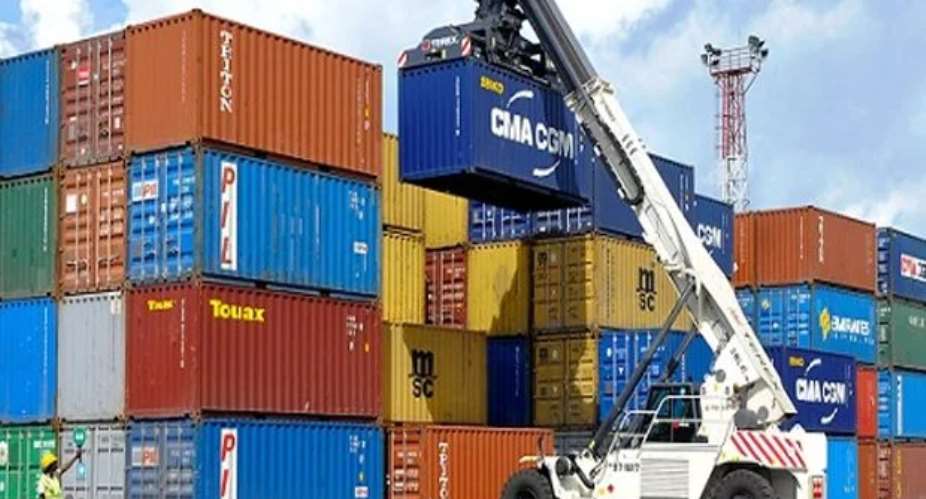
The Importers and Exporters Association of Ghana (IEAG) has thrown its full support behind the Ghana Shippers’ Authority’s recent directive to streamline and cap Container Administrative Charges (CAC) at the country’s ports, describing the intervention as both necessary and long overdue.
According to the Association, the decision marks a critical step toward addressing long standing concerns over excessive and opaque charges imposed by international shipping lines and their local agents, which they say have significantly increased the cost of doing business in Ghana.
In a strongly worded statement, the IEAG argued that for decades, importers and exporters have been burdened with what it describes as unjustified local handling charges, which have eroded Ghana’s competitiveness as a regional trade hub.
The Association also criticised recent threats reportedly issued by some shipping line workers, insisting such actions would not deter regulatory reforms aimed at protecting national economic interests.
The IEAG explained that under global shipping practices, freight charges already include key port-related costs such as pilotage, towage, berth charges and terminal handling fees. These, it said, are typically built into ocean freight rates and ultimately borne by cargo owners.
It therefore argued that the imposition of separate Container Administrative Charges amounts to double charging, as importers and exporters are effectively made to pay twice for the same service components.
The Association further questioned the legitimacy of CAC, noting that the charge was introduced in the late 1980s when Ghana’s ports lacked modern container handling equipment and shipping lines relied on ship-mounted gear. It said that justification no longer exists.
Today, IEAG pointed out, Ghana’s ports including the Tema Port and Takoradi Port are equipped with modern infrastructure such as ship-to-shore gantry cranes, rubber-tyred gantry cranes, automated terminal operating systems and advanced yard facilities, making the continued imposition of CAC outdated and unjustifiable.
The statement also highlighted wide disparities in CAC levels across the sub-region, noting that Ghanaian importers are charged as high as USD 165 per Twenty Foot Equivalent Unit, compared to about USD 30 in Nigeria, USD 45 in Benin, USD 65 in Côte d’Ivoire and USD 68 in Togo. It described this as a major competitive disadvantage for Ghanaian traders.
On concerns that the directive could affect workers’ welfare, the Association dismissed such claims as misplaced, arguing that shipping lines are agents of foreign principals responsible for staff welfare and operational costs. It maintained that CAC was never intended to fund employee remuneration but has instead evolved into an additional revenue stream.
The IEAG also revealed that in 2024 alone, Ghanaian shippers and traders paid an estimated GH¢1.69 billion, equivalent to about USD 108.32 million, in Container Administrative Charges, describing it as a heavy burden on trade and a contributor to inflationary pressures.
The Association has therefore endorsed the Ghana Shippers’ Authority’s decision to cap CAC at GH¢550 per Twenty Foot Equivalent Unit, effective May 1, 2026. It said the cap represents a fair and balanced regulatory measure that protects businesses while maintaining operational efficiency within the shipping sector.
The IEAG concluded that the era of unchecked and non-transparent charges in Ghana’s maritime logistics space must come to an end, urging full compliance from all stakeholders. It also warned that attempts to resist the reform through intimidation or pressure would not succeed, stressing that the directive is in the national interest.
 One dead, fire officer hospitalised after bee attack at Quarry Site in Sokode Gb...
 Israel and Iran step back from further strikes after renewed clashes
 Patients stranded as doctors, nurses refuse to see new patients over KATH CEO su...
 Avenor Rural Bank CEO’s house destroyed by fire
 Three arrested in Winneba for illegal mining near GWL water lines
 Two pupils of Alice Elite Academy laid to rest after fatal school bus crash
 Here are areas to be affected by ECG's planned maintenance on Tuesday
 Family of civil engineer killed in alleged military shooting demands justice
 SHS teacher allegedly beats female student over unpaid hostel fees
 Blow to EU defence cooperation as France, Germany abandon joint fighter jet prog...



Comments
Ghanaians have one specific problem. They don't want or have the patient to wait for any thing to go through it's formal procedure and they'd rather pay bribes to get their way fast hence the corruption. They love to complain while being the one causing the problem. don't blame the SHITSTYM.