




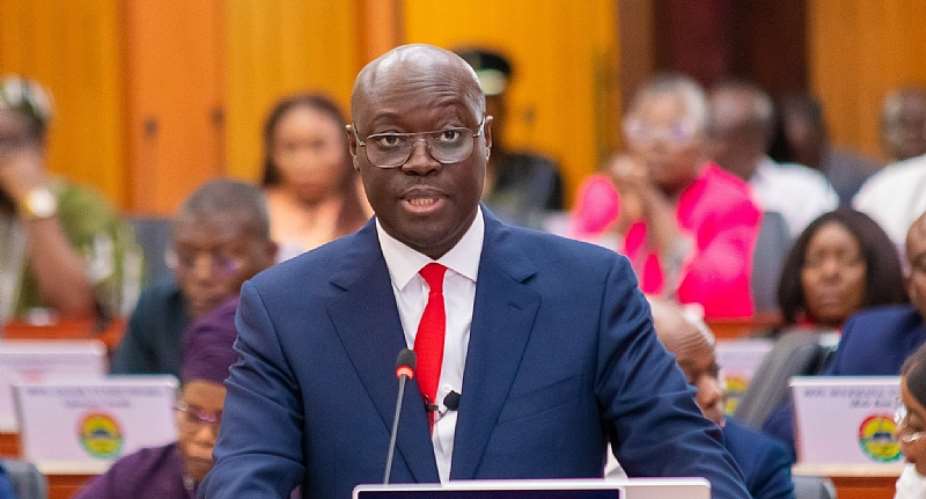
The Minister for Finance has announced that government is taking steps to establish a “Gold Village”, envisioned as a continental hub for gold jewellery design, manufacturing, and export to position Ghana as Africa’s leader in high-value gold craftsmanship.
Dr Ato Forson said the Ghana Gold Board was working with the Bank of Ghana and developing partnerships with local refineries to expand domestic refining capacity and strengthen the country’s gold value chain. He made this known when he presented the 2026 Budget Statement and Economic Policy to Parliament in Accra, under the theme “Resetting for Growth, Jobs and Economic Transformation.”
He stated that since its establishment, the Board has redefined Ghana’s gold sector through significant structural and regulatory reforms that continue to shape both small scale and large scale mining. The Gold Board has introduced far reaching licensing reforms to promote responsible sourcing, strengthened oversight across the gold supply chain, and implemented a transparent and competitive pricing framework for licensed miners and gold buyers.
Dr Forson noted that the Board has also rolled out an efficient gold aggregation system across all mining regions and intensified the fight against illegal trading and smuggling through a dedicated Task Force, supported by a whistleblower reward scheme. These reforms, together with the removal of the 1.5 percent withholding tax on unprocessed small scale gold in the 2025 Budget, have produced exceptional results.
Between January and October 2025, small scale gold exports hit a record 81.7 tonnes valued at about US$8.1 billion, the highest in Ghana’s history. During the same period, large scale exports stood at 74.1 tonnes valued at an estimated US$6.6 billion. Dr Forson said it was the first time small scale exports had surpassed large scale production in both volume and value, a clear indication of the impact of recent policy interventions.
He added that to further strengthen the local gold economy, the Gold Board has partnered with the Bank of Ghana to support reserve accumulation. A total of 137.7 kilograms of gold from large scale producers has so far been purchased and added to the country’s official reserves. He said these inflows have helped stabilise foreign exchange reserves, improved the balance of payments, and contributed to the stability of the cedi.
Dr Forson underscored that these achievements highlight the Gold Board’s strategic importance to Ghana’s economic transformation. He said the Board remains committed to responsible sourcing, environmental sustainability, and full traceability across the supply chain. From 2026, a comprehensive Gold Traceability System will be introduced to ensure every gram of gold purchased can be traced to its verified, licensed, and environmentally compliant source.
He explained that in line with government’s broader industrialisation agenda and value addition vision, the Gold Board has been tasked to lead Ghana’s transition from raw gold exports to refined gold production. He added that government remains committed to supporting this transition through incentives, investor partnerships, and a favourable business environment to maximise domestic value addition in 2026 and beyond.
 One dead, fire officer hospitalised after bee attack at Quarry Site in Sokode Gb...
 Israel and Iran step back from further strikes after renewed clashes
 Patients stranded as doctors, nurses refuse to see new patients over KATH CEO su...
 Avenor Rural Bank CEO’s house destroyed by fire
 Three arrested in Winneba for illegal mining near GWL water lines
 Two pupils of Alice Elite Academy laid to rest after fatal school bus crash
 Here are areas to be affected by ECG's planned maintenance on Tuesday
 Family of civil engineer killed in alleged military shooting demands justice
 SHS teacher allegedly beats female student over unpaid hostel fees
 Blow to EU defence cooperation as France, Germany abandon joint fighter jet prog...


