




When Prof. Agyeman-Badu Akosa asserts that Nkrumah's so-called Preventive Detention Act (PDA), a copycat from India, “was legitimate and necessary[,] considering the scale of the destructive nature of the opposition who were at that time bent on assassinating him” (Daily Guide 3/20/07), some far more knowledgeable and levelheaded Ghanaian student of the period ought to point out to this obviously politically misguided Nkrumah fanatic that most of the suspects arrested in the wake of Kulungugu were stalwarts of Nkrumah's own Convention People's Party, among them Dr. Ako Adjei, who introduced the Show Boy to Dr. Danquah and mainstream Ghanaian politics; Mr. Tawiah Adamafio, a firebrand editor of the CPP mouthpiece, the Accra Evening News and the man who is widely credited with having conferred the glaringly oversized honorific of “Osagyefo” on the Show Boy; and Kofi Crabbe, another CPP stalwart.
Of course, it also bears recognizing the fact that several members of the ideological opposition were also arrested and convicted in the wake of Kulungugu. Still, what is quite curious and significant to observe here is the fact that although a three-member panel of Supreme Court judges tried and acquitted the aforementioned CPP stalwarts for lack of culpable evidence, President Nkrumah promptly and summarily nullified the verdict of Messrs. Arku Korsah (the Chief Justice), Akufo-Addo and Van Lare, to the unreservedly damnable extent of summarily dismissing Sir Arku Korsah from the highest court of the land. Shortly thereafter, President Nkrumah constituted his own special kangaroo court which promptly returned a verdict of guilty and sentenced the trio – Messrs. Ako Adjei, Tawiah Adamafio and Kofi Crabbe – to life imprisonment. It would be the auspicious and landmark Kotoka-led National Liberation Council (NLC) revolution that would free these innocent but woefully misguided Nkrumah lieutenants from terminal incarceration.
And regarding the tired and vacuous Nkrumaist contention that “Dr. Nkrumah created jobs for the youth and that [for the first time?] in the history of the country, there was a shortfall of workers to take up one million jobs during 1964 and 1965,” our simple answer is that such characteristically Nkrumaist vaunt is outright poppycock and totally devoid of substance. First of all, Prof. Akosa ought to have provided relevant statistical figures regarding the magnitude of the country's labor force during the period in question, and also the kinds of jobs available, the minimum qualifications required to perform each and every job description and how long the CPP could guarantee those so employed perennial job and economic security.
Then again, just what sort of government is wont to creating jobs far in excess of its labor force, but a government without a good sense of focus and direction? A wasteful government, in essence, which is exactly what the Convention People's Party was renowned for.
But even more significant is the fact that most of the high-end jobs created by the Nkrumah government had to be taken up by the very same “expelled” British expatriates whom Nkrumah claimed had no role, whatsoever, in his retrospectively bogus “Africanization” program. And once these British expatriates had been, literally, recalled to Ghana by the now-groveling Nkrumah and his CPP, they ended up being paid twice, and even in some cases thrice, the salaries for which they had performed these same tasks prior to the Show Boy's so-called Africanization program.
Indeed, many Ghanaians may not be aware of this fact, but more Europeans had, in fact, been imported by the CPP with overly attractive benefits to take up jobs which the Nkrumah regime had myopically not prepared Ghanaians to perform than had been the case during the undeniably invidious British colonial administration (see Dennis Austin's Politics in Ghana: 1946-1960).
And to be certain, just about the same time that Nkrumah was vociferously denouncing Apartheid South Africa, and even calling on his fellow African leaders to marshal their forces in order to drive the white settlers into the Atlantic Ocean, if these settlers would not voluntarily vacate their ill-gotten landed property, more than 50 percent of Ghana's trade with other continental African countries was actually transacted directly, as well as indirectly, between Nkrumah's Ghana and Apartheid South Africa (see Nkrumah's Foreign Trade Policy in Kwame Arhin's The Life and Work of Kwame Nkrumah). And so in terms of bold-face hypocrisy among postcolonial Ghanaian leaders, the African Show Boy stands in a class by himself!
Indeed, contrary to what Prof. Akosa would have his audience believe, on the eve of his overthrow, the country was so bankrupt that then-Col. E. K. Kotoka, the man who spearheaded the NLC revolution which auspiciously ousted the CPP, is reported to have lamented that had he known of the dire straits into which the splurging Show Boy had unconscionably plunged Ghana, he, Kotoka, would have held his proverbial peace for a few more months, at least, to enable popular indignation to cause the logical and timely ouster of Nkrumah and his CPP lackeys. And so it could not be that Prof. Akosa is talking about the same Ghana that the rest of us levelheaded Ghanaians have gotten to know and experience (see L. H. Ofosu-Appiah's Lieutenant-General E. K. Kotoka; also Okoampa-Ahoofe's When Dancers Play Historians and Thinkers).
Now regarding Nkrumah's educational policies, what needs to be instructively pointed out is the fact that in his zeal to egocentrically lay false claim to having “founded” virtually every worthwhile institution in postcolonial Ghana and thus deserving of being called “Founder of Modern Ghana,” Nkrumah promulgated a blanket policy of nationalization of all educational institutions, particularly those owned and operated by such major Christian churches as the Presbyterians, Methodists, Anglicans and Roman Catholics which, for much of colonial Ghanaian history up to the eve of the country's independence, had operated the bulk of the nation's schools. These cannibalized schools then became known as “Government-Assisted Schools” (see Kwame Arhin's The Life and Work of Kwame Nkrumah).
Remarkably enough, those privately-owned institutions that did not seem to be resourceful or possess a proven educational track-record, as it were, got promptly proscribed through harassment. Consequently, when he cavalierly talks about the prime beneficiaries of Nkrumah's educational policies being hell-bent on “distorting history,” perhaps somebody ought to remind Prof. Akosa of the fact that his political hero was no pioneer at all, and that, indeed, it was illustrious traditional Ghanaian rulers like Osagyefo Sir Nana Ofori-Atta I who had facilitated the landmark establishment of the Achimota School (the former Prince of Wales School), for example, for Nkrumah and his ilk to rise to the level and stature that they ultimately achieved.
Finally, it is rather amusing to hear Prof. Akosa make the at once hyperbolic and outrageous claim that “some political opponents have over the years tried without success to associate Dr. Nkrumah with ruthlessness and draconian laws, let's give credit where credit is due.” Perhaps his apparent tone-deafness prevented Prof. Akosa from hearing Prof. Francis Nkrumah's recent desperate plaint that the “revisionist” likes of yours truly were threatening his father's legacy. Of course, this was Dr. Francis Nkrumah's visceral way of acknowledging the excruciating nature of historical truth and accuracy, particularly where studied mendacity has been the hallmark of Nkrumaist historiography.
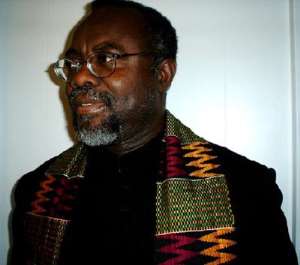
Kwame Okoampa-Ahoofe, Jr., Ph.D., teaches English and Journalism at Nassau Community College of the State University of New York, Garden City. He is the author of “When Dancers Play Historians and Thinkers” (2007). E-mail: [email protected].

 One dead, fire officer hospitalised after bee attack at Quarry Site in Sokode Gb...
 Israel and Iran step back from further strikes after renewed clashes
 Patients stranded as doctors, nurses refuse to see new patients over KATH CEO su...
 Avenor Rural Bank CEO’s house destroyed by fire
 Three arrested in Winneba for illegal mining near GWL water lines
 Two pupils of Alice Elite Academy laid to rest after fatal school bus crash
 Here are areas to be affected by ECG's planned maintenance on Tuesday
 Family of civil engineer killed in alleged military shooting demands justice
 SHS teacher allegedly beats female student over unpaid hostel fees
 Blow to EU defence cooperation as France, Germany abandon joint fighter jet prog...



Comments
Poor man, I really feel sorry for you. What makes you think you're a educated and levelheaded? Is it your cheap PHD in a cheap subject? Your ignorance is beyond imagination!