




Every morning in cities and towns across Ghana and beyond, life begins in motion cars honking, traders arranging goods, workers rushing to jobs, students in uniforms heading to school. It is a familiar rhythm of survival and ambition.
But in the middle of that rhythm, there is another reality we have learned to normalize.
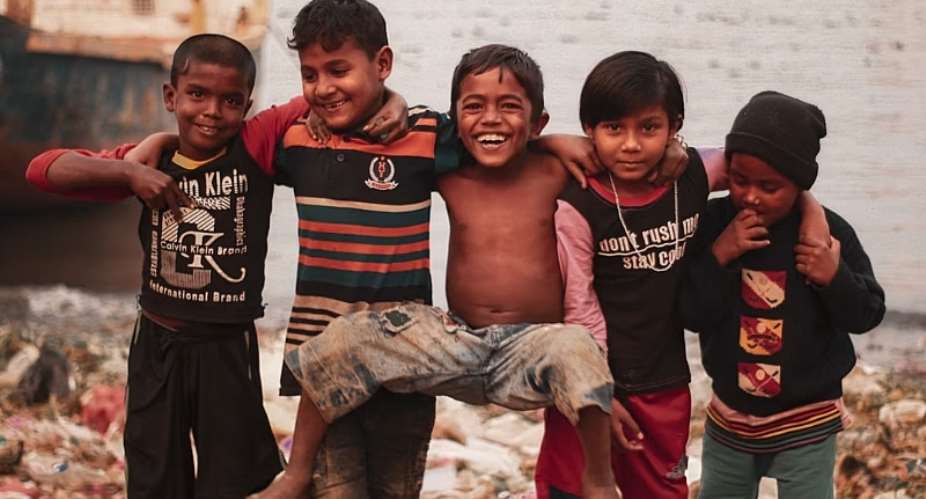
A child stretches out a hand at a traffic light. Another sleeps on a cardboard slab near a shop front. A group gathers around leftover food near a market dump. Bare feet on burning asphalt. Eyes that have seen too much, too early.
And we keep walking.
Not because we are evil. Not because we do not see. But because, slowly and silently, we have learned to look without seeing.
The Uncomfortable Question: When Did We Stop Being Shocked?
At what point did street children become part of the scenery instead of a crisis?
If a child in a classroom misses school, we call it a problem.
If a child in a home goes hungry, we call it neglect.
But when a child is living on the street, exposed to hunger, abuse, exploitation, and invisibility what do we call that?
Why does society respond with pity instead of urgency?
Why does policy often arrive after damage is already permanent?
And perhaps the most painful question of all how long has suffering become “normal” enough that we no longer demand accountability?
Imagine If It Were Your Child
Pause for a moment.
Not as a passerby. Not as a policymaker. Not as a statistic. But as a parent.
Imagine your child sleeping outside tonight with no protection. No certainty of food tomorrow. No adult to protect them from harm. No promise that they will wake up safe.
Would you call it misfortune? Or would you call it a national emergency?
Now ask yourself honestly: why is that urgency often missing when the child is not “ours”?
The Invisible Economy of Street Childhood
There is a harder truth many avoid discussing.
Street children are not only victims of poverty they are often caught in systems that benefit from their vulnerability.
Some are used for cheap labour.
Some are exploited in informal trading networks.
Some are exposed to trafficking risks.
Some become invisible workers in economies that function precisely because they are unprotected.
So we must ask uncomfortable questions:
Who profits from their invisibility?
Who benefits when children remain unregistered, unprotected, and unaccounted for?
And why are the systems designed to protect them so often underfunded, underpowered, or overwhelmed?
Where Does Childhood Go When It Is Lost?
A child is not born hardened. No child chooses hunger over home, or survival over education. Street life is not a destination it is a forced transition.
So what breaks first?
Is it the family structure under economic pressure?
Is it policy failure in child protection systems?
Is it urban planning that ignores displacement?
Or is it a collective silence that allows the crisis to continue without consequence?
The truth is likely all of the above.
The Most Dangerous Form of Poverty Is Being Unseen
Hunger is visible.
Poverty is measurable.
But invisibility is harder to fight.
A street child learns early that they are not expected. Not protected. Not prioritized. And once a child learns that society does not see them, survival becomes their only education.
What future grows from that lesson?
What kind of adulthood emerges from abandonment disguised as “street life”?
The Moral Test of a Society
A nation is not judged only by its highways, its skyscrapers, or its economic reports.
It is judged by how it treats the smallest among it the ones with no vote, no voice, no protection.
So the real question is not whether street children exist. They do.
The question is:
What does their existence say about us?
What does it say about leadership, community, and collective responsibility when children grow up in public spaces with no guaranteed childhood at all?
A Final Question We Cannot Keep Avoiding
If tomorrow every street child disappeared from the roads, would we celebrate the end of a problem or confront the reasons they were there in the first place?
Because removing children from sight is not the same as removing suffering from society.
And until we answer that honestly, we are not solving a crisis we are only learning how to walk past it more comfortably.
If you ever find yourself passing one of these children again, ask quietly:
If this were my child, what would I expect the world to do?
And then ask the harder question:
Why am I not already doing it?
By:
Patrick Belebang Yagsori
+233240292413
[email protected]
 KATH doctors suspend strike after Otumfuo’s intervention
 Mahama is losing control of his government — NPP Communicator
 Health Minister’s suspension of KATH CEO technically right — Prof Beyuo
 Korle Bu Teaching Hospital conducts Ebola emergency simulation to strengthen fro...
 Abandoned newborn baby found near gutter at Agona Swedru Woaraba
 Reparations Justice Forum questions imported schnapps for African libation ritua...
 AG to meet US counterparts on pending extradition requests — Kwakye Ofosu
 JHS graduate, another drown in Twifo-Atti-Morkwa rivers during heavy rainfall
 27-year-old jailed 4years for stealing church musical equipment at Hohoe
 Call 'Rambo-style' Mintah Akandoh to order — Minority tells Mahama


