




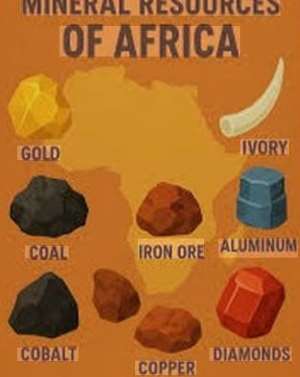
Across global headlines, one uncomfortable truth is often softened, simplified, or avoided entirely: modern civilization runs on minerals that are overwhelmingly extracted from African soil, but controlled, processed, and profited from elsewhere. From the batteries in electric vehicles to the chips powering artificial intelligence, the world’s future is being built on resources that begin in Africa but rarely end there.
So the critical question is no longer what is being extracted. It is: who controls it, who benefits from it, and what happens if Africa changes the rules?
The Hidden Architecture: Africa’s Resource Backbone
Africa is home to some of the most strategically important resources in the world:
Cobalt (over 70% of global supply, largely from the Democratic Republic of the Congo)
Gold (major reserves in Ghana, South Africa, Mali, Sudan)
Bauxite and lithium (critical for batteries and aerospace industries)
Oil, gas, and hydroelectric potential (vast but underutilized or externally controlled)
Rare earth and transition minerals increasingly needed for green technology
Yet despite this abundance, Africa’s position in global value chains remains largely at the extraction level rarely at the refining, manufacturing, or technology ownership stages.
This creates a paradox: resource-rich continents often become economically dependent rather than economically dominant.
A Brief Historical Lens: How We Got Here
To understand the present, we must confront the past without dilution.
During colonial rule, African economies were deliberately structured as export systems:
Raw materials were extracted for European industrial growth
Infrastructure (railways, ports) was designed for extraction, not integration
Local industries were discouraged or destroyed
Wealth flowed outward, not inward
After independence, many African states inherited economies that were already externally oriented. The result was not structural transformation, but structural continuation with new political leadership.
Today, the actors may have changed but the system often has not.
Who Really Controls Critical Minerals Today?
Control is no longer just about ownership of land. It is about:
Refining capacity
Global commodity trading systems
Technology manufacturing
Currency and pricing systems
Logistics and insurance networks
Even when minerals are mined in Africa, they are often:
Processed in China, Europe, or North America
Traded through multinational commodity firms
Integrated into products manufactured elsewhere
This means control is upstream in Africa, downstream outside Africa.
So the real question becomes:
Is ownership of resources meaningful without control of value addition?
The Silent Power Dynamics Nobody Talks About
Here are the uncomfortable questions often left out of global discussions:
Why do African countries still export raw minerals instead of finished batteries or electronics?
Who benefits from keeping refining technologies concentrated outside Africa?
Why are African currencies weaker despite vast natural wealth?
Why do multinational mining contracts often last longer than political administrations?
Why do some “development partnerships” resemble long-term dependency agreements?
These are not conspiracy questions. They are structural economics questions.
Why Africa Is Not Fully Benefiting
Several structural barriers explain the imbalance:
1. Capital and Technology Gaps
Processing minerals requires advanced technology and massive capital investment areas where many African states depend on foreign partners.
2. Contract Imbalances
Long-term mining agreements often favor stability for investors over flexibility for host nations.
3. Governance Challenges
Weak regulatory frameworks and corruption in some regions reduce negotiation power and national benefit retention.
4. Fragmented Markets
African states often negotiate individually rather than as a unified bloc, reducing bargaining strength.
5. Global Supply Chain Lock-In
Existing global industries are designed to maintain current supply routes because changing them would disrupt profits.
What Happens If Africa Stops Exporting Cheap Raw Materials?
This is where global implications become profound.
For Africa:
Short-term revenue shocks
Job disruptions in mining sectors
Possible diplomatic and trade pressure
But also:
Increased industrialization incentives
Growth of local refining and manufacturing
Stronger currency and fiscal independence
Job creation in high-value sectors
Strategic leverage in global negotiations
For the Western and Industrialized World:
Supply chain disruptions for EVs, electronics, defense systems
Rising costs of green energy transition
Increased competition for alternative sources (Latin America, Australia, etc.)
Strategic recalibration of foreign policy toward Africa
In short: global stability in technology industries depends heavily on African extraction continuity.
The Power Question: Resource Wealth vs Economic Sovereignty
Africa’s challenge is not lack of resources. It is the conversion problem:
How do raw materials become national wealth instead of exported value?
Until that is solved, Africa risks remaining what some economists call a “warehouse continent” rich in inventory, poor in ownership of outcomes.
The Mind-Bending Reality
Here is the most difficult truth to accept:
The modern global economy is not just interdependent it is asymmetrically dependent.
Some countries can survive without African minerals temporarily.
But the global green transition, digital economy, and defense manufacturing cannot scale without them.
Yet Africa remains economically peripheral in the very systems it sustains.
The Road Ahead: Breaking the Cycle
Real change would require:
Regional industrial policy coordination (AfCFTA activation beyond trade)
Investment in refining and manufacturing hubs
Stronger contract negotiation frameworks
Local ownership stakes in extraction industries
Technology transfer requirements in mining agreements
Strategic resource diplomacy
This is not resource nationalism. It is value-chain realism.
Final Question Nobody Wants to Answer
If Africa holds some of the most critical inputs to the future of the global economy then why does it remain one of the least industrially powerful regions on earth?
And more importantly:
What would global power structures look like if Africa finally decided to stop exporting its future in raw form?
The answer to that question may define the next century.
By:
Patrick Belebang Yagsori
+233240292413
[email protected]
 KATH doctors suspend strike after Otumfuo’s intervention
 Mahama is losing control of his government — NPP Communicator
 Health Minister’s suspension of KATH CEO technically right — Prof Beyuo
 Korle Bu Teaching Hospital conducts Ebola emergency simulation to strengthen fro...
 Abandoned newborn baby found near gutter at Agona Swedru Woaraba
 Reparations Justice Forum questions imported schnapps for African libation ritua...
 AG to meet US counterparts on pending extradition requests — Kwakye Ofosu
 JHS graduate, another drown in Twifo-Atti-Morkwa rivers during heavy rainfall
 27-year-old jailed 4years for stealing church musical equipment at Hohoe
 Call 'Rambo-style' Mintah Akandoh to order — Minority tells Mahama


