




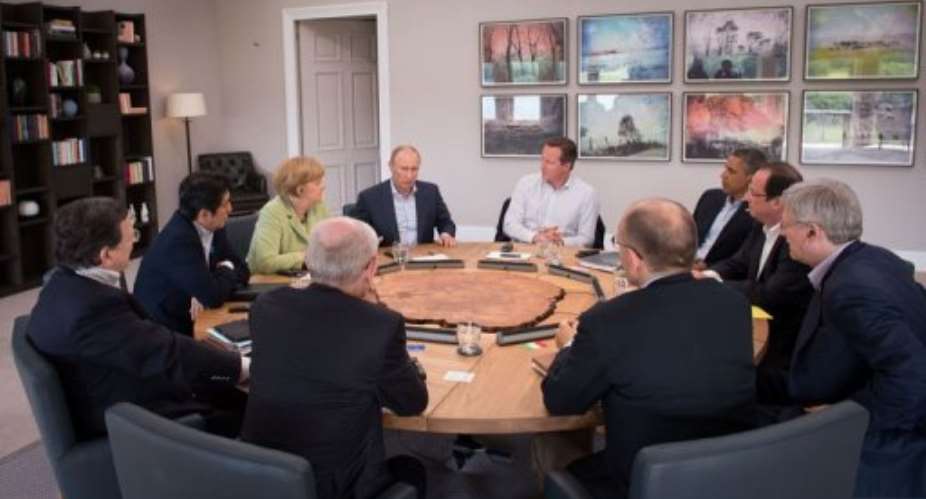
ENNISKILLEN, United Kingdom (AFP) - G8 leaders agreed on Tuesday to eradicate the payment of ransoms for hostages kidnapped by "terrorists" in an attempt to remove one of the key incentives for extremists.
The world's most industrialised nations also called on companies to follow their lead in refusing to pay for the release of abducted employees.
British Prime Minister David Cameron, the summit host, had been keen to push the deal because funds raised by ransom payments are a substantial source of funding for terror groups, especially those in north Africa.
Al-Qaeda-linked groups around the world have made $70 million (52 million euros) from mainly Western hostages over the last two years, British officials said.
For Al-Qaeda in the Islamic Maghreb, the north African branch of the extremist group, ransoms obtained have reached 33 million euros over the last three years.
The G8 leaders said in their final communique they "unequivocally reject the payment of ransoms to terrorists".
They added: "The payment of ransoms to terrorist groups is one of the sources of income which supports their recruitment efforts, strengthens their operational capability to organise and carry out terrorist attacks, and incentivises future incidents of kidnapping for ransom."
Britain was particularly focused on the subject following a hostage crisis at a gas plant in Algeria in January in which 37 foreign hostages were killed, among them six Britons.
Five of the G8 nations had been "shifting" on the issue while three did not pay ransoms as a matter of principle, British officials said.
Although no countries were named, it is believed G8 member Italy has paid ransoms for the release of hostages.
Japan is also reported to have offered to pay ransoms during the In Amenas crisis, during which it lost 10 nationals, the most of any country.
In Britain, it is illegal to pay a ransom from the UK to anywhere else.
Cameron's spokesman said the agreement among his G8 colleagues was "very strong".
"That the G8 sending a very clear, unambiguous message on this is important," the spokesman told reporters.
It would target "proscribed organisations".
But the G8 leaders said that "when the worst happens" they agreed to provide assistance to other states whose nationals are kidnapped including specialist help "or the provision of resources related to hostage rescue".
The ransom agreement was signed off during counter-terrorism discussions at the G8 summit, which was overshadowed by the war in Syria.
The leaders called for a peace conference to be held as soon as possible and expressed deep concerns about the rise of extremism and "terrorism" in Syria.
 One dead, fire officer hospitalised after bee attack at Quarry Site in Sokode Gb...
 Israel and Iran step back from further strikes after renewed clashes
 Patients stranded as doctors, nurses refuse to see new patients over KATH CEO su...
 Avenor Rural Bank CEO’s house destroyed by fire
 Three arrested in Winneba for illegal mining near GWL water lines
 Two pupils of Alice Elite Academy laid to rest after fatal school bus crash
 Here are areas to be affected by ECG's planned maintenance on Tuesday
 Family of civil engineer killed in alleged military shooting demands justice
 SHS teacher allegedly beats female student over unpaid hostel fees
 Blow to EU defence cooperation as France, Germany abandon joint fighter jet prog...


