




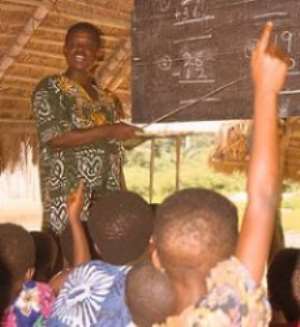
37 years ago (1976 -2013) today in Soweto, South Africa, thousands of black school children took to the streets in a march more than half a mile long, to protest the inferior quality of their education and to demand their right to be taught in their own language. Hundreds of young boys and girls were short down; and in the two weeks of protest that followed, more than a hundred people were killed and more than a thousand were injured. To honour the memory of those killed and the courage of all those who marched, the Day of the African Child has been celebrated on 16 June every year since 1991, when it was first initialized by the then organization of African Unity, now the African Union. The day draws attention to the lives of African Children today.
IDAY-Ghana (International Day of the African Child and Youth), will celebrate this day by focusing on Teacher Absenteeism, girl's child education and Raise awareness on school dropout
Today, the African child faces huge challenges to which they contribute very little, which includes the falling educational standards, increasingly declining of social infrastructures, unjustifiable political instability, conflict and refugee environments; inadequate economic infrastructure and trade injustices. They have been forced to live their lives as adults as they are; forced into child labour, sex slaves, child-parenting as elderly AIDS orphaned children take care their younger siblings, the plight of child soldiers, the worst of child labour, have compelled brutalized and deeply traumatized children by their experiences to suffer post-traumatic stress disorders. Most children spend their school going age struggling to find meals that fill their hungry stomachs but provide little nutrition. Their plight is worsened by the breakdown of the external family system and adverse effects of trade injustices which has compelled most parents and guardians to loose their jobs and livelihoods.
More children are trapped in abject of drop out from school and girls are denied of basic/primary education, the society in general believes that the girl child is not as important as the male child. The common belief is that female after all her education will end up in the kitchen by cooking for her husband. In our society boys are given the opportunity to learn more than girls. For example, the female work to sell water, oranges, toffees and other things by the road side for the family to enable them to earn money and to take care of the male child's education. The female child is left with fewer opportunities for any formal\par education. The girls have to take care of more house chores like washing of bowls, cooking, cleaning and sweeping than the boys who only study, play and eat. The boys are able to take their education seriously than the girls because boys do nothing apart from studying. The girls get tired and are not able to concentrate in the classroom and sometimes sleep in the classroom whilst the teacher is teaching. This also reflects adversely upon the performance of the girls as they tend to drop out from school. We have observed that when the children are in the basic school the enrollment of the females is more than the males but as they climb the academic ladder the number of females continues to drop. This is due to lack of parental guidance and sex education in the home.
In Africa only 14% of children have access to preschool initiation as compared to a worldwide average of 40%. About 31 million children aged between 6 and 12 have no access to a full cycle of primary education and 43 million youngsters aged less than 24 are illiterate. Contrary to the trend on other continents, their number is increasing, thus making the issue an even greater challenge requiring an urgent and comprehensive response
We in sharing the principles of the Day of the African Child and plight and experiences of the African Child, IDAY-Ghana (International Day of the African Child and Youth) will organizing child-centered advocacy and campaigning on current problems, challenge and appropriate policy on African child. IDAY- Ghana will bring together children, women and youth organizations, policy makers, academics and policy research and advocacy organizations and networks. On Tuesday, 18 June 2013 at the TMA Conference Hall in Tema, to engage district assemblies, governments and international institutions accountable on girl's child educational and school dropout The Information obtained from this forum will be tailored into the advocacy campaigns and policy recommendations
IDAY-Ghana (International Day of the African Child and Youth), Abibiman Foundation, AYICC -Ghana and Global Call to Action against Poverty (GCAP-Ghana), Believe special efforts, radically different from the past are needed if the Millenium Development Goal promising a quality basic education to all by 2015 is to be achieved in Africa. Governments, donors and civil society must commit resources and collaborate more closely to achieve sustainable solutions. It is the interest of Africa and of Europe to urgently work together to fill the education gap in Africa.
Kenneth Nana Amoateng
IDAY-Ghana Coordinator
Chief Executive Officer
Abibiman Foundation
www.iday.org, www.abibimmanfoundation.org/ Tel +233-303-213918, Mob:+233244023651
 One dead, fire officer hospitalised after bee attack at Quarry Site in Sokode Gb...
 Israel and Iran step back from further strikes after renewed clashes
 Patients stranded as doctors, nurses refuse to see new patients over KATH CEO su...
 Avenor Rural Bank CEO’s house destroyed by fire
 Three arrested in Winneba for illegal mining near GWL water lines
 Two pupils of Alice Elite Academy laid to rest after fatal school bus crash
 Here are areas to be affected by ECG's planned maintenance on Tuesday
 Family of civil engineer killed in alleged military shooting demands justice
 SHS teacher allegedly beats female student over unpaid hostel fees
 Blow to EU defence cooperation as France, Germany abandon joint fighter jet prog...



Comments
TRUE TALK