




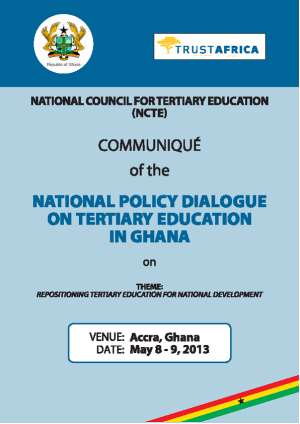
Accra, Ghana
May 8 - 9, 2013
INTRODUCTION
The Ministry of Education and the National Council for Tertiary Education (NCTE), Ghana, in partnership with TrustAfrica, Senegal organised a national policy dialogue on tertiary education in Ghana at the Mensvic Hotel in Accra from May 8 to 9, 2013 under the theme: Repositioning Tertiary Education for National Development.
The aims of the dialogue were to:
1. Build a national multi-stakeholders' platform for transformation of tertiary education in Ghana;
2. Identify issues that require policy research; and
3. Constitute multi-stakeholder-working groups that will work on various thematic policy issues with the aim of making inputs into a government White Paper on tertiary education.
His Excellency, President John Mahama, represented by the Minister of Education, Prof. Naana Jane Opoku-Agyemang, was the Guest of Honour for the occasion. She also delivered the keynote address.
The dialogue was attended by 150 participants, including two former Ministers of Education, Dr. Ekow Spio-Garbrah and Dr. Christine Amoako Nuamah; the Deputy Minister of Education responsible for Tertiary Education, Hon. Samuel Okudzeto Ablakwa; the Deputy Minister for Pre-tertiary Education, Hon. Alex Kyeremeh; Parliamentarians; the Chairman of the National Development Planning Commission (NDPC) and Senior Adviser to the President, Mr. P.V Obeng; the Director-General of the NDPC, Dr. Regina O. Adutwum; the Chief Director of the Ministry of Education, Mr. Enoch Cobinnah; Administrator of the Ghana Education Trust Fund, Mr. Sam Garba; representatives of the business community, think-tanks, civil society organisations; members of the tertiary education sector including Vice-Chancellors of Universities, Chairpersons of University Councils; Rectors of Polytechnic and Principals of Colleges of Education; representatives of lecturers and students; Executive Secretaries of other regulatory bodies (Council for Technical and Vocational Education and Training, National Accreditation Board, and National Board for Professional and Technician Examinations); and development partners.
Speakers at the opening ceremony included Prof. Clifford N.B. Tagoe, Chairman of the National Council for Tertiary Education and former Vice-Chancellor, University of Ghana; and Dr Omano Edigheji, Consultant/Advisor, Africa's Higher Education Dialogues, TrustAfrica, Senegal.
OBSERVATIONS:
After comprehensive discussions and analyses from different perspectives, participants made the following major observations:
1. There is no comprehensive national policy on tertiary education in the country.
2. In the last decade, Ghana has experienced an exponential increase in access to tertiary education. Vigorous participation of the private sector, distance learning opportunities coupled with an increase in the number of programmes mainly in business and administration, account for the trend.
3. The growth in the number of tertiary education institutions and programmes is not adequately guided by policies on differentiation and diversity nor targeted at addressing specific national needs. Some higher education institutions have diverted from their original missions, resulting in 'mission creep'.
4. The above has contributed to the production of many university graduates, whose skills do not meet the needs of the labour market, resulting in the crisis of graduate unemployment and unemployability.
5. Admission policies have failed to address the imbalance between science and technology programmes and the humanities, as more students are admitted in the latter.
6. Some of the reasons accounting for the unfortunate state of affairs include a weak regulatory oversight, a disconnect between industry and academia, failure of institutions to redesign their curricula and admission policies to cope with the prevailing exigencies, and resource constraints.
7. The meeting observed that higher education is grossly underfunded.
8. There is low research and post-graduate output as well as lack of innovation in science and technology.
9. In the management of Higher Education Institutions, strong governance and leadership are required to foster institutional conditions that would support quality teaching and research for the attainment of institutional mission and vision.
10. There is no policy to guide private-participation in tertiary education.
RESOLUTION
Having discussed the above issues, the meeting resolved as follows:
1. National Vision and Plan for Tertiary Education in Ghana
In order for the tertiary sector to contribute meaningfully to Ghana's development, participants resolved that a national tertiary education vision and plan needs to be formulated and implemented.
The vision and plan must be formulated and agreed upon by the key stakeholders (key government ministries, NDPC, MDAs, regulatory bodies, tertiary institutions, industry, MMDAs, think tanks, national research councils, professional bodies and civil society).
This vision and plan for tertiary education must be anchored on the overall national development vision and plan.
The national plan for tertiary education should promote research and innovation.
The plan must provide for a diversified and differentiated mix of institutions with a clear mandate, characterized by robust and relevant knowledge production focus.
Centres of excellence should be established in tertiary institutions to focus on strategic areas for national development.
With the proliferation of tertiary education institutions, there is need to develop strong governance and leadership structures that will ensure accountability and realization of the full potential of the sector.
2. Addressing the challenges of graduate employability
It was acknowledged that part of the problem of graduate unemployability is the structure of the economy that is unable to absorb our graduates, and partly due to some factors internal to the higher education sector. To address this, it was resolved that:
Government needs to articulate and promote an industrial policy that will lead to the diversification of the economy which should, among other things, promote the manufacturing sector.
An appropriate policy framework should be put in place to ensure a well-differentiated national tertiary education system that will ensure steady production of a workforce with the right mix of skills.
Higher Education Institutions (HEIs) need to review their curricula to give graduates diverse skills and knowledge.
HEIs need to adopt new pedagogies, including ICT usage.
The NDPC should collate data on labour market trends in the country to enable HEIs develop relevant courses and programmes to meet the country's human resource needs.
Government should provide a policy framework that would encourage and foster participation of the private sector in skills development for the teeming youth of the country.
In the next five years, government should prioritize research and innovation, and skills development, to address the problem of graduate unemployability.
3. Funding
It was acknowledged that there is over-reliance on government for funding tertiary education. To address this it was resolved that:
Government, business, parents, HEIs and other stakeholders in sector should develop a sustainable funding policy for higher education in Ghana. This policy should include mechanisms for diversified funding.
The era of government as the sole provider of higher education seems to have come to an end. As a result, an institutionalised mutually beneficial relationship should be built between private providers of higher education and government.
CONCLUSION: Ghana Higher Education Summit
1. It was recognized that currently there is no institutionalised platform where national stakeholders on the higher education sector in the country come together to share ideas, share information, discuss challenges, propose solutions facing the sector and build consensus and ownership around a common agenda.
2. To overcome the challenge observed above, it was resolved that the NCTE in partnership with other key stakeholders in the tertiary education sector should hold a biennial national summit on higher education development. This will institutionalise regular interactions among stakeholders in the sector.
Prof. Mahama Duwiejua
Executive Secretary
National Council of Tertiary Education
Ghana
www.ncte.edu.gh
Dr. Omano Edigheji
Consultant
Africa's Higher Education Dialogues
TrustAfrica, Senegal
www.trustafrica.org
 One dead, fire officer hospitalised after bee attack at Quarry Site in Sokode Gb...
 Israel and Iran step back from further strikes after renewed clashes
 Patients stranded as doctors, nurses refuse to see new patients over KATH CEO su...
 Avenor Rural Bank CEO’s house destroyed by fire
 Three arrested in Winneba for illegal mining near GWL water lines
 Two pupils of Alice Elite Academy laid to rest after fatal school bus crash
 Here are areas to be affected by ECG's planned maintenance on Tuesday
 Family of civil engineer killed in alleged military shooting demands justice
 SHS teacher allegedly beats female student over unpaid hostel fees
 Blow to EU defence cooperation as France, Germany abandon joint fighter jet prog...


