




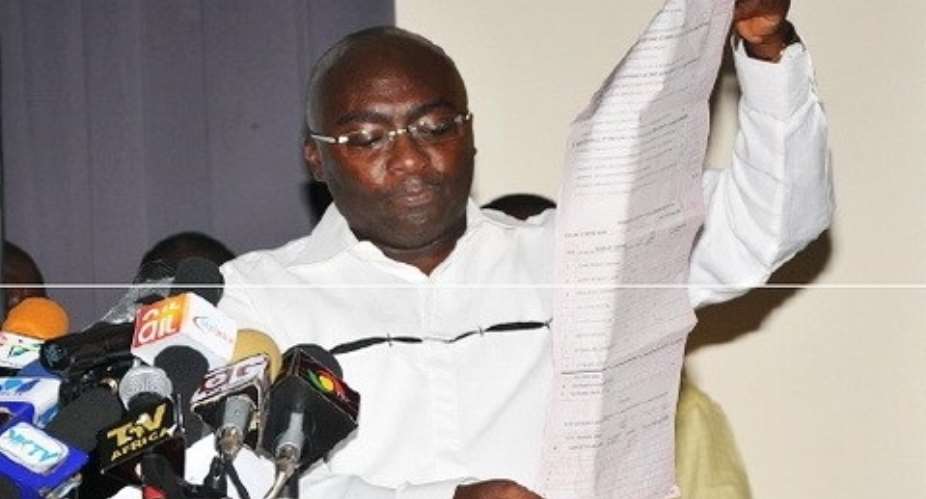
The Supreme Court (SC) hearing of the substantial case in the presidential petition entered its second day on Thursday April 19, 2013 and with the live broadcast of proceedings on the electronic media, the world witnessed what would be a very interesting court room showcase that will expose Ghana's judiciary and Ghanaians to global assessment of the interpretation and application law and civility respectively.
Already, the Justices have had concern about the behaviour of some of the few present in the court room and have threatened to bar the public from attending the hearing if they continue to misbehave. This brief article is a contribution to the debate on the proceedings, particularly, the second day.
The key witness for the applicants who is also the second petitioner having completed his evidence-in-chief, that is, the witness being led (or questioned) by his own (leading) Attorney in the witness box to clarify, especially the important matters in his evidence (in this case, the sworn affidavit), was immediately cross examined by the Attorney of the opponents. The first to start the cross examination was the leading Attorney for the first respondent (the President).
The first bone of contention was the question of whether it was legal for the witness to use a document that was not part of the originals materials presented to the court as part of the sworn affidavit.
When the Attorneys of the respondents became aware of what was described as foreign material, an objection was raised on the basis that the petitioners could not introduce new evidence or amend their sworn affidavit through the back door.
The Justices after a brief consideration overruled the objection and allowed the material as evidence. The reason was not on matters of law but technicality (belated objection).
The reason given by the Justices for their decision is disputable, because in my view, this petition is too important for decisions be be based on technicalities and not law. I am not conversant with procedures within the Ghanaian judiciary but I believe they are not different from the British system.
From my experience in the UK (as former Employment Caseworker, one time Employment Tribunal Member and a trainer of magistrates and judges and who also observed court proceedings), once discovery, exchange of documents and witness statements have been agreed, presented to the court and parties involved, sworn to by a witness and proceedings begin, no material could be admitted as evidence or the pleading amended without prior agreement between contesting parties and the permission of the court (judge/s), if that material would be relied upon as evidence by any of the parties, then it must be done through the appropriate channel.
First, the party seeking to use the material as part of its evidence must seek and secure the agreement of the opponent/s before permission of the judge/s to add or amend accordingly. If agreement is secured and permission granted, then, the material is labelled as appropriate and added to the bundle.
However, if the opponent/s refuse to agree to the request, then a formal application is made to the court (judge/s) either in advance or at the hearing for permission to add the material either as evidence or amendment to the pleadings.
In the case in question, it was not only additional material but material that amended the pleadings of the petitioners. The Justices by allowing the the amendment to the sworn affidavit this way and not through a formal application have set a dangerous precedent, even if the Supreme Court is a master of its own rules.
Notwithstanding my disagreement with the decision, it is my view that, perhaps, the Justices do not want to put any impediment in the way of the petitioners and in so doing, inhabit their ability to present the salient facts of their case. Moreover, since the overrule presents no detriment to the respondents because the respondents can still make reference to the unreliability of petitioners' evidence as their figures keep changing, no harm is caused.
The second matter of interest was the accusation of pink sheets duplication by the the petitioners' key witness to mislead the court. Having listened to the radio broadcast instead of viewing the televised one (I had to use my laptop screen at the same time), I became increasingly frustrated by the repetitive nature of the cross examination and felt that the Justices had lost control over the direction of proceedings.
I wondered how many of the duplications had been identified, if counsel would go through all of them and how long that would take, especially, since the witness gave the same answer and explanation to each and every duplication.
In my view, the tactics of the lead Attorney was problematic for a number of reasons. I appreciate that the objectives of going through all the duplicates were to show that the evidence were unreliable and the witness not trust worthy.
This is particularly important since one of the petitioners' claim was that the Electoral Commission forged, duplicated results and made mistakes. Since the petitioners have also made similar or even worst mistakes such as alleged forgery of signatures on some pink sheets, it was only right and proper for counsel to have questioned the witness on them and to prove to the court that the figures do not add up.
However, the same objectives could have been achieved by using a sample of the total duplicated pink sheets and forged signatures and to draw the judges attention to the fact that such duplications and forgeries occur X number of times and provide a list of the of the total sum with all the relevant polling station reference numbers as in the bundle to the judges and all other parities. I am glad the Justices have now issued directives on this matter for future hearings (see “SC set out modalities for cross examination”, Ghanaweb April 20, 2013).
Now let's consider the relevance of the duplication to the claims of the petitioners. First, assuming it is accurate that pink sheets from some polling stations were duplicated by the petitioners to deceive the court, the question we must answer is: are the numbers mathematically or statistically significant enough to materially affect the claims of the petitioners and therefore the outcome of the case? We do not know the answer to this question yet because the total number of duplicated pink sheets and forged signatures are yet to be disclosed.
If they are in tens and not hundreds or thousands, then in my view, they could be a matter of dishonesty and the figures may not be mathematically or statistically significant enough to have any impact on the the claims by the petitioners. On the other hand, even if the total of the duplicated pinks sheets and forged signatures are in tens but each one contains large numbers of votes, then they could have significant impact on the mathematical and statistical figures provided by the petitioners.
What is the truth in the allegation of pink sheets duplication? My understanding from the explanation offered by the key witness is that, though the pink sheets were duplicated, the actual figures computed by them were not duplicated. In other words, there were no double, triple or quadruple counting. This explanation is highly likely. This can be best explained by the Venn Diagram Mathematics below.
Three polling stations are represented by circles 1, 2 and 3. The alleged statutory malpractices, irregularities and omissions are represented by the circles A, B and C. Areas A, B and C represent pink sheets that had only one of the three statutory malpractice, irregularity and omission respectively. Area AB represents statutory malpractices and irregularities in polling stations 1 and 2.
This follows that some pink sheets from the two polling stations would be duplicated. The same is applicable to statutory irregularities and omissions in polling station 2 and 3 and therefore there would be duplication of some pink sheets from polling station 3 and triplicate from polling station 2. Again, statutory malpractices and omissions occurred in both polling stations 1 and 3 as represented by area AC.
This would result in duplication of some pink sheets from polling station 3 and triplicate of polling station 1. Finally, all three statutory malpractices, irregularities and omissions occurred in all three polling station as represented by area ABC. This will also result in quadrupricate of some pink sheets from all the three polling stations.
My understanding of Venn Diagram Mathematics tells me that, the methodology for calculating the total figure for all the three polling stations 1, 2 and 3 (that is, the sum total of A, B, C, AB,BC, AC and ABC) is different from the sum of AB, the sum of BC, the sum of AC, the sum of ABC as well as the sum of AB and ABC and the sum of ABC and AC as below. For these reasons, I agree with Dr Bawumia that there were no double counting, irrespective of the some pink sheets duplications.
However, I find the explanation by Dr Bawumia that the duplication occurred because some of the pink sheets were manually generated whilst others were computer generated confusing, if not troubling. In other words, he was admitting that there should have been no pink sheets duplications and therefore the mistakes were due to the dual methodology used. Dr Bawumia is wrong and in danger of accepting something that did not and has not happen/ed, if he is right that there were no double counting.
By the Venn Diagram representation, there must be duplicating, triplication and quadrupling of pink sheets from the same polling stations representing the statutory malpractices, irregularities and omissions being complained of and put in their respective statutory categories. This is not Econometrics (which Dr Bawumia is familiar with) but simple Venn Diagram Mathematics. Whether the some pink sheets were generated manually or computer or both is irrelevant, duplication must occur.
I also heard Gloria Akufo one of the Attorneys for the petitioners in an interview outside the court house immediately after the hearing and justifying the alleged mistakes of the pink sheets duplication.
According to her, they had only five days to put the evidence together. That is, from the day the Justices made the order for the petitioners to serve their affidavits on the respondents and considering the volume of pink sheets involved and the time frame, mistakes were bound to happen. That is not only unfortunate error of interpretation of the order but a complete lie by the learned lady of the law.
Indeed, the petitioners have had the privilege of assembling their evidence from the day they rejected the results of the presidential election results announced by the EC on December 9, 2012.
Rather, it is the respondents who have had the disadvantage of a few days to examine the evidence as presented by the petitioners prior to the hearing. The admission by Dr Bawumia that the duplications were mistakes and the excuse or the lie by Gloria Akufo that they had only five days to put the evidence together and therefore the mistakes, if true, could be an indication that the petitioners may not be well prepared for the case or there are weaknesses in their figures. The two examples also smack of confusion or trial and error attempts.
What about the alleged forged signatures on some of the duplicated pink sheets? That should never have happened if they were true photo copies or printed copies. They must contain the same signatures and therefore the petitioners must explain how on earth that happened, even if they were only two.
The petitioners have also complained about the tactics being used by the leading Attorney for the first respondent in the cross examination. I really do not understand the reason behind the complaint.
In an inquisitorial and adversarial system of trial such as this, the Attorneys have no option but to adopt tough cross examination. This is crucial because the petition would be won and lost on nothing but facts and figures. The only way to establish the accuracy of the figures as presented by the petitioners is through inquisitorial and adversarial cross examination.
You may not like the way the potential future Vice-President (if the petition is successful) is being questioned but that is unavoidable. I can guarantee that, the same, if not tougher cross examinations when Nana Akufo Addo (the potential future president, if the petition succeeds) takes the stand in the witness box. This complaint has no basis.
This is very common in inquisitorial and adversarial judicial systems. Attorneys adopt this tough approach as a way of wearing down the witness, confusing him/her, getting him/her angry, tiring him/her and discrediting him/her as unreliable and untrustworthy with the ultimate objective of asking the judge/s to disregard his/her evidence. I would be surprised if the same medicine is not given to the witnesses of the first, second and third respondents, especially, when Mr Asiedu Nketia and Dr Afari-Gyan take their turns in the witness box.
So far it has been two days with no indication of victory or defeat for any of the three main parties involved. It is too early and for me, the sweetness or otherwise of the pudding would be when the EC presents its case and evidence. Thank God the hearing is broadcasted live so we cannot be deceived by the spin from the General Secretaries of NDC and NPP as well as their legal spokespersons in the persons of Nana Ato Dadzie and Gloria Akufo.

 Former MASLOC CEO Sedina Tamakloe returns to Ghana after extradition to serve 10...
 Tension in Birim North as angry NDC youth attempt to disrupt cooperative mining ...
 One dead, several injured in tipper truck and fuel tanker crash on Accra–Tema Mo...
 How 70-year-old building was finally demolished over fear of collapse in Osu
 Minority MPs thank Afenyo-Markin for capacity-building programme in Canada
 Ghana has everything needed to prosper yet graduates remain unemployed — Dr Step...
 June 9: Cedi sells at GHS12.50 on forex market, GHS11.85 on BoG interbank
 Stephen Amoah advocates mixed market economy to tackle rising cost of living in ...
 KMA to reintroduce enhanced ‘Samansaman’ sanitation enforcement system from July...
 Nyinahin Catholic SHS teacher seen fighting female student in viral video arrest...




Comments
I very much like your critical analysis. Such are the healthy knowledge one can learn from such cases, looking it its magnitude. Great job.