




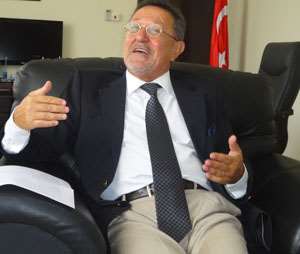
Since strengthening diplomatic ties with Ghana in 2010, Turkey, an economic giant located in what could have been Eastern Europe, has quickly become one of the most important foreign partners to Ghana in terms of political and economic relations. DAILY GUIDE's editor, Fortune Alimi and senior writer Raphael Adeniran caught up with the Turkish Ambassador to Ghana, Aydin Nurhan, who delightfully highlighted the depth of the relations.
DG ( DAILY GUIDE ): How would you describe the Ghana-Turkey relations?
Aydin (Ambassador): One of your diplomats said that Turkey is number one country in Ghana in terms of economic and political relations rocketing. Our relations are really rocketing; Turkish Airlines is here [in Ghana], seven days a week. That's a great booster of course. They are also starting a cargo service; this means that they will be able to export Ghanaian goods through Istanbul to Europe and other parts of the world. A lot of Turkish people are coming in; they are pouring in. I want you to realize how many Ghanaian businesses people and politicians are going to Turkey. There is incredible traffic nowadays. We will have Turkish Exim Bank CEO and vice president coming to Ghana [On September 29, 2012] to sign an agreement for the Achimota water project. So, our relations are growing exponentially; my office is inundated with Turkish business people; we have a lot of Ghanaian students in Turkey now too, and they are having good education. We have sent Ghanaian teachers to Turkey to teach our children!
DG: Obviously, education has become a key part of the Ghana- Turkey relations; are there any specific initiatives that further deepen cooperation in this area?
Aydin: We have the Galaxy schools here; we also intend to have a university here. We are looking for land now and if we get it, we would especially concentrate on two areas that are very important to us; i.e. nursing and a technical training. At the planned university, there would be a two-year nursing school and a two-year technical school. We are doing this because throughout the world, we lack quality nurses. Between the two years, we would send them [the nurses] to Turkey for three months; they would work in a Turkish University hospital. Same for the technical school; there are many fields here in this country that technicians are needed. In fact, this is a big problem throughout the world. So our priority will be world-class technicians and nurses; we need real skilled people.
DG: Would these professionals from the schools be working in Ghana, or they would be taken to Turkey to support the Turkish economy?
Aydin: (Laughs) Why do you think we made these schools especially two years? Because they are the sons and daughters of Ghana and they should stay here. If they study for four years, they will go for their Masters, and PhDs and they may travel outside and wouldn't want to come back. We want them to stay here, that's why these are two-year schools. Of course we are going to build universities with four-year sections, but these two [two-year nursing and technical school] are more important to us now. Let me tell you, nurses are very important, especially operation room nurses.
DG: Where are the resources for building the institution coming from?
Aydin: From Turkish business people…Turkey built the Galaxy Schools and it would be a Galaxy University. This is one of the most important projects; it is important for Ghana and we want to have it as an example. It would be state-of-the art university and medical school. Nurses and technicians will be taken from the poorest families free of charge. But the other parts of the university would be like other universities- they would be paying. For the nurses and technicians, we would be choosing the brightest students from the poorest families and it will be free.
DG: What about other infrastructures?
Aydin: I understand that in the north, a lot of agricultural products cannot be brought to markets because of the roads, so I will be advising my government through the Exim Bank authorities when they come here that we use some credit, perhaps next year, for building roads in the northern part where there is good agriculture and then the economy would be boosted. That is another priority that I have seen for your country. Of course, there are other projects- sewages systems are priority too.
DG: What are your thoughts about the socio-economic potential of Ghana?
Aydin: Ghana has a bright future and everybody is optimistic. You know all the NATO allies in the USA and Europe; we all care for the prosperity and stability of Ghana. We know that you have more oil and more gas and you would have a bright future. I think all of us would like to see Ghana as the new Dubai, you have the potential for that, we see that, so we would be working towards that end.
DG: Why is there such keen optimism about Ghana's future?
Aydin: Have you ever asked yourselves why Europe, US, China, Turkey, etc, all these countries think so much of Ghana? If you look at the grand global picture, Ghana is a tiny country, it has resources, yes, but that can't be all. I don't think that is the case, especially for my country. The real point is having centres of excellence, beacons that serve as examples to the neighbouring countries and that you can radiate your light to the surrounding countries gradually. In Ghana, we see that potential. I mean, you may have Gold, others have gold too. You may have oil, others may have it too; that's not the point. I think the most important thing for everybody is for the prosperity of Ghana. I think we all want to build a beacon; an example of stability. When you have it, gradually it would spread to the neighbours, and Ghana, just like in the time of Nkrumah, can be a leader for other countries.
DG: Ghana is getting ready to send an Ambassador to Ankara. What impact will this have on the Ghana-Turkey relations?
http://www.dailyguideghana.com/wp-content/uploads/2012/09/turkey.jpg
Ambassador Aydin Nurhan flanked by Raphael Adeniran (left) and Fortune Alimi
Aydin : H.E. Ambassador Ibrahim already sent an advance team to Turkey and they are opening the office and are looking for residences. Based on reciprocity, we are going to give Ghana a beautiful land in the diplomatic enclave of Turkey. The opening of the embassy would help us know more about Ghana. We opened our embassy [in Ghana] in 1960, and then because things went bad for Turkey, we closed it in 1981, and then of course, we opened it again in 2010. When we opened it, very few people in Ghana knew much about Turkey, but now everywhere we go, people have a smile on their face, they know Turkey now.
DG: Could the renewal of diplomatic ties be responsible for the massive influx of Turkish goods into Ghana. Noticeably, these goods are of high quality, and are comparative to European standards.
Aydin: Yes, Now after Turkish Airlines opened to Africa, Turkish Airline flights are bedeviled with baggage commerce and the airplanes are 94 percent full all the time and the luggage is so much that your luggage comes the next day. But they [Turkish Airlines] are bringing the cargo airplanes that will solve all the problems. Coming to the quality of the goods, as I said, very few people know that Turkey is a member of the EU-not politically, but economically, we are a member of the EU. So to sell to the EU, you have to produce in European standards, so if somebody else comes to buy goods from Turkey, they see European quality.
DG: How can the good relations between Ghana and Turkey be further enhanced?
Aydin: There are a lot of delegations who go from Ghana to Turkey; a lot of them, including ministers, other commercial people etc. When they go to Turkey, they come back with wonderful feelings and ideas. You know Turks come here too. In some countries, the altitude of the local people is a problem, but here, people are so friendly, so nice, so welcoming and it is so easy to become friends and make business in Ghana. There are so many opportunities; the country is welcoming. The only problem of course, to be frank, is land issues. It is not only for foreigners, but also for Ghanaians. There are no closed countries anymore, a lot of things in the world, apply everywhere. There are certain economic principles that apply everywhere. Land regime is one of them; land is number one. Number one for the economy-for the banking system to run, is property and the most important property is land. I understand that your government is keen on it. If we can solve this land problem, I will say Ghana will just skyrocket. I believe in Ghana.
DG: Apart from the political relations existing between the two countries at governmental level, how can we achieve greater integration amongst their citizens?
Aydin: We call it grassroots relations, in the past, diplomacy and relations were government level, nobody cared about the people, but in the 21 st Century, it is grassroots diplomacy-public diplomacy, people should know each other. How to do that is of course tourism, commerce, education, cultural relations, transportation-that's Turkish Airline, and free Visa regimes. Yes grassroots is very important, now we have two million foreigners illegally working in Turkey including a lot of Africans and they love it! The best thing about Turkey is that we lived these things that Africa is living today. In the 70s, we were like Africans, we understand everything; they [Europe] were putting Visa barriers against us etc, we thought that it was against humanity. (Laughing) and now what are we going to do now, people are trying to go into Turkey illegally! We don't want to employ inhumane methods, we don't want to dishonor people, but without dishonoring people, how can you manage this influx? This is important; we try to be as kind as we could.
D.G: How would you describe the role and position of the Republic of Turkey in world Affairs in terms of economic and political influence, especially considering the fact that in the past people were flocking to Europe to seek greener pastures, now suddenly Turkey has become an economic superpower and people are now turning to Turkey?
Aydin: I will use one word to describe the Turkish nation: Patience. If anybody asks me about one nature of the Turkish nation, I will say Turkey is one of the most patient nations in the world. As individuals, we may not be patient, but as a nation, we are very patient. We had so much stress and tough years in Turkey; inflation was nearly 100 percent; the banks were charging over 180 percent interest. We lost US$80 billion to the banks. Those were incredible days and this nation didn't revolt. We have a wonderful government. I am not a politician and I am not advertising them, but this government is the most successful government in the world to pull the economy out of those horrendous days and on track.
What they did is that, they stopped corruption at every single point and then they put all the money going into corruption into government projects. There are about 15 automobile companies in Turkey; we are making F16 fighter jets; we are building transport aircrafts, helicopters, etc. They [the government] did 20,000 kilometers of highways in six years; built 600,000 houses for poor people and they sold these houses for US$60 a month! Today, there is universal coverall for healthcare in Turkey, you pay $150. Schools are also free- even universities. These are miracles. President Turgut Özal http://en.wikipedia.org/wiki/Turgut_%C3%96zal opened Turkey to the world.
DG: You mean university education is free in Turkey?
Aydin: Of course it is free. There are 140 government universities and all of them are free?
DG: What about secondary school and basic schools?
Aydin: Everything is free, free-of-charge, including Masters and PhD.
DG: It appears that Turkey is becoming the China of Europe?
Aydin: We are the China of Europe, everybody says that. Turks are known as the soldier nation historically-from the Ottomans, from the Huns, from the Celtic Turks, etc, we are warriors. Very few people know that Turks come from the Walls of China, those walls [China Great Wall] were made against us. We could not go east, so we came west (Laughs)…anyway, so we are known as a warrior nation. That military discipline turned into industrial discipline.
DG: It is interesting you mentioned discipline and how you curbed corruption. you would agree that generally, corruption is a very difficult thing to tackle. How did Turkey confront it?
Aydin: The Prime Minister [ Recep Tayyip ErdoÄŸan http://en.wikipedia.org/wiki/Recep_Tayyip_Erdo%C4%9Fan ], he chose the right people, correct team and they, in-turn, chose the correct people. He was very keen on it.
D.G: As Ghana prepares for general elections in December, what lessons or support can Ghana derive from the Republic of Turkey?
Aydin: We are already cooperating; we are already cooperating with Ghana in e-Justice. Turkey is number two in the world in e-Government and if we are successful in e-Justice, we will spread it to e-Government, which also covers elections. Apart from that, Turkey's foreign policy in general does not allow it to interfere in the internal affairs of other countries. What we care for, of course, is peaceful elections.
DG: Thank you.
 Former MASLOC CEO Sedina Tamakloe returns to Ghana after extradition to serve 10...
 Tension in Birim North as angry NDC youth attempt to disrupt cooperative mining ...
 One dead, several injured in tipper truck and fuel tanker crash on Accra–Tema Mo...
 How 70-year-old building was finally demolished over fear of collapse in Osu
 Minority MPs thank Afenyo-Markin for capacity-building programme in Canada
 Ghana has everything needed to prosper yet graduates remain unemployed — Dr Step...
 June 9: Cedi sells at GHS12.50 on forex market, GHS11.85 on BoG interbank
 Stephen Amoah advocates mixed market economy to tackle rising cost of living in ...
 KMA to reintroduce enhanced ‘Samansaman’ sanitation enforcement system from July...
 Nyinahin Catholic SHS teacher seen fighting female student in viral video arrest...




Comments
I strongly disagree with the ambassador's conclusive remarks. He suggested that Turkey does not interfere in the internal affairs of any country. Really? What about Syria? Is it not the Turkish government that is financing, arming and training the terrorists to cause more chaos in Syria? This man should not throw dust into our eyes. for we know what is going on. Turkey has been working agressively against its own neibor Syria in a bit to overthrow the Syrian government using insergents and rebel...