




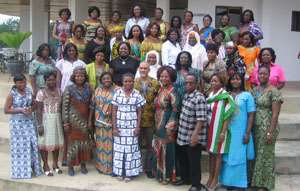
The Institute of Economic Affairs (IEA) has called on Ghanaians to vote for women to represent them in Parliament come December 2012 to strengthen the governance of the country.
At a four-day capacity building workshop organized for aspiring female parliamentary candidates in the country, various speakers noted that the imbalance in the participation in the decision-making process has negatively affected the progress of the country.
The four-day workshop, which opened at Akosombo in the Eastern region on Wednesday, was organized by IEA, in partnership with the United Nations Development Programme (UNDP) and the European Union (EU).
The workshop was themed 'Strengthening the capacity of female candidates for election 2012'.
Hilary Gbedemah, Rector, The Law Institute, in a presentation on the topic 'Greater Representation of Women in Politics/Public Life,' stressed that without the active participation of women and the incorporation of women's perspectives at all levels of decision-making, the goals of equality, development and peace could not be achieved.
'Women's equal participation in decision-making is not only a demand for simple justice or democracy but could also be seen as a necessary condition for women's interests to be taken into account,' she said.
Currently, there are only 19 women in Ghana's Parliament consisting of 230 legislators. Statistics indicate that the number of women candidates in 1992 was 23, which increased to 53 in 1996 and improved to 95 in 2000.
Out of the aforementioned figures, 16 were elected in 1992, 18 in 1996, 19 in 2000 and 25 in 2004.
Brigadier General Francis A. Agyemfra, Senior Fellow of the IEA, in a welcome address, stressed that since women make up 51.2 per cent of Ghana's population, Ghanaians should encourage them to become legislators.
According to him, the workshop was instituted to strengthen the participation of women in the governance of the country.
Lawrence Lachmansingh, Senior and Peace Governance Advisor of the UNDP, on his part, noted that the UNDP, over the past years, has provided financial and technical assistance to women.
He therefore urged the candidates to take advantage of the workshop to improve their skills and contribute to the development of Ghana.
Sarah Akrofi-Quarcoo, Lecturer, School of Communications Studies, Legon, in a presentation on the topic, 'Media Relations Building Effective Communications Skills,' urged the women to always understand the message they put across and avoid using big words.
Dr Rose Mensah-Kutin, Executive Director for ABANTU for Development, in a presentation on the topic 'Campaign Strategies,' appealed to the women to focus on their strengths.
She stressed that women should conduct their campaign in various ways to canvass for votes.
Dr. Mensah-Kutin advised the women to desist from making empty promises and using foul languages since that would make them unpopular.
'Using foul languages and empty promises during campaign periods would not augur well in bringing development in the country neither would it help you gain any votes.'
She advised women holding political positions not to respond to attacks from opponents during the campaign, adding that such negative practices would affect them negatively during the elections.
By Stella Danso Addai
 Nyinahin Catholic SHS teacher seen fighting female student in viral video arrest...
 Beijing condemns US move to blacklist Chinese companies
 Trump gets a cold reception at NBA Finals game as Spurs beat Knicks
 One dead, fire officer hospitalised after bee attack at Quarry Site in Sokode Gb...
 Israel and Iran step back from further strikes after renewed clashes
 Patients stranded as doctors, nurses refuse to see new patients over KATH CEO su...
 Avenor Rural Bank CEO’s house destroyed by fire
 Here are areas to be affected by ECG's planned maintenance on Tuesday
 SHS teacher allegedly beats female student over unpaid hostel fees
 Blow to EU defence cooperation as France, Germany abandon joint fighter jet prog...


