Since the December 2008 elections, Ghana woke up to the rude realization that the peace and tranquility prevailing in the country are actually very slippery commodities that cannot be taken for granted.
Ghana has more often than not taken the relative peace it has enjoyed over the years for granted.
However, in 2008, the country drew uncomfortably close to the brink of a catastrophe when the results of the presidential run-off became contentious. At the ninth hour, the good judgment of feuding politicians prevailed, hence saving the country from the path of destruction.
Meanwhile, in the run up to the December 7, 2012, curious phenomenon of peace initiatives have engulfed the country, especially with the 2008 experience serving as a guide. The initiatives are being championed by myriads of peace organizations in Ghana and the phenomenon has hit a dazzling crescendo, with some of the groups virtually soliciting funding in the name of peace.
It is not exactly clear what is fueling the intensified drive for peace; perhaps it could be due to the realization that peace and tranquility in Ghana are so fickle that a seemingly innocuous democratic activity such as elections could erode that state of reassurance at the flick of a finger.
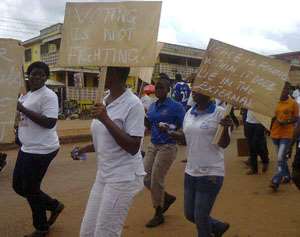
As Ghana prepares for this year's presidential and parliamentary elections, several peace initiatives have been set in motion. A civil society group calling itself the Ghana Peace Campaign is expending an undisclosed amount of money in implementing a series of peace programmes, including a one-million-man peace march through Accra on September 21- World Peace Day. Simultaneously, women's right advocacy group the Ark Foundation is collecting peace signatures from over one thousand leaders across the country.
In the same light, a group calling itself Pure Creation Limited is hoisting the Ghana flag around the country, taking signatures from political, religious and corporate leaders in the country. President John Mahama was given the first opportunity to inscribe his signature on the Ghana flag. Indeed, these three initiatives are just a tip of the iceberg of the extensive so-called peace initiatives slated for this year.
Critics have questioned the rationale for these initiatives, but Nana Yaw Osei-Darkwa, the national coordinator of the Ghana Peace Campaign, justifies them, saying, 'I think that it is legitimate, as much as people go about politicking; as much as our radio stations create the platform for people to call into radio programmes for people to speak their minds on issues, we also need to be that silent voice that will be prepping people that as you speak, as you support a political party, yes you have right to support any political ideology that you believe in, but you have no right to disturb the peace of Ghana.'
According to Mr. Osei-Darkwa, in the past decade, Africa has recorded dozens of armed conflicts mostly sparked by contentions during electioneering processes. He believes Ghana is not immune to that. Ghana's luck has been the fact that these incidences of election violence have been effectively contained.
This time however, the Non-governmental Organizations (NGOs) are determined not to leave the country's peace to the magnanimity of fate; they intend to literarily take the bull by the horns.
The emergence of peace initiatives have become an everyday affair in Ghana now as several organizations join the bandwagon. 'We are not just toeing the line of other organizations,' says Petra Adu-Parkoh, a programme manager at the Ark Foundation. Apparently, the Ark Foundation has extensive programmes designed specifically to empower women and to protect women's interests.
According to Mss Adu-Parkoh, it is therefore just natural for the Ark Foundation to use its already designed programmes to complement the various anti-violence initiatives currently doing the rounds in the country. She explains that the Ark Foundation believes that women and children usually find themselves at the receiving end of violence when it does happen, hence the organization's involvement in the peace drive.
Cashing In?
In the past, NGOs have earned a not-too-pleasant reputation in Ghana in the way their activities impact on their intended targets; on countless occasions, NGOs have been blamed for unduly taking advantage of vulnerable situations and people to enrich themselves.
Critics therefore think the rising phenomenon of peace initiatives is just a classical replay of the modus operandi of NGOs who always cash in on such opportunities.
Even though he admits there may be opportunists in the system, Osei-Darkwa feels this possibility is very minimal. He thinks a lot of the organizations embarking on the peace drive have genuine convictions. 'In the past, some NGOs abused the system and so making it very difficult for even clear-minded organizations to secure the needed support to projects that they want to embark on,' he observes.
'You know that whenever there are opportunities of this nature, we must be conscious that there is that possibility that we will find people who would do those kinds of things,' Most Rev. Prof. Emmanuel Asante, the Chairman of the Ghana Peace Council, the national body mandated to galvanize all peace efforts in the country, says.
'The facilitation of peace does not necessarily mean monopolizing peace, but it means encouraging civil society and other organizations committed to peace to promote peace in the country,' says the Chairman who is also the Presiding Bishop of the Methodist Church in Ghana. 'All things being equal, when things have been fully established, we will give support to genuine groups who are pursuing such efforts so that we will be able to democratize these efforts,' he promises.
The Chairman of the Peace Council thinks that plurality of peace efforts is very critical to upholding peace in the country. 'I am really grateful; everywhere I go; churches preaching peace; religious groups and other organizations etc. It seems to me that people are becoming very much concerned about peace in our sub-region.'
The Flashpoint
In spite of all these efforts however, it appears that the singular factor that may plunge all the peace efforts into oblivion is the EC's controversial decision to create 45 additional constituencies in the country this year.
Opponents of the move are certain that it will tip the balance against certain political interests and the affected political parties do not like this.
The biggest opposition, the New Patriotic Party (NPP), is the strongest opponent of the EC's plans. Incidentally, the NPP's arch-rival and the ruling party, the National Democratic Congress (NDC) is widely believed to be fanning the embers for the EC to go ahead with its new constituency plans. The NPP believes the NDC is giving itself an undue advantage
Ordinarily, the EC's creation of new constituencies should not be a big deal. However, the circumstances around the creation make matters a bit murky. For one thing, the EC had initially wanted to create 20 additional constituencies this year, but the NDC government sprang a surprise on the EC by controversially creating 46 new districts.
This forced the EC to match the number of new districts created by the NDC government in 2012. Constitutionally, no single Member of Parliament is allowed to preside over more than one constituency in a district, hence the EC Chairman, Dr. Afari-Gyan's resolve to push the new constituencies through despite the protests.
The NPP's argument is that the country does not have the requisite resources to accommodate additional lawmakers. The party has also complained about the timing for the creation, since the EC barely has three months to put its acts together to organize the new constituencies as well as the December elections.
The action of the NDC has also sparked serious suspicion from opposition political parties because the NDC is perceived to be in full support of the EC in this plan. This may compromise the credibility of any result that the EC eventually declares after the elections.
Political analyst and a lecturer at the University of Ghana, Legon, Kwasi Jonah believes that as much as the EC is acting within its mandate, the disagreement can cause confusion during the December elections.
Sticking To His Guns
The Electoral Commissioner, Dr Afari-Gyan, however, appears unperturbed by the protests. According to him, he draws his power from the constitutional provision that requires the EC to review constituencies whenever the dynamics of regional and population demarcations are changed.
On Thursday, in an interview on GTV's election programme 'The Campaign Platform', Dr. Afari-Gyan stated that he was in full control, describing the opponents of his move as 'rabble rousers'. He has denied any allegation that seeks to accuse him of compromising his position and allegedly flirting with the NDC. Indeed, his supporters have cited his credentials as the man whose responsible actions have been steering Ghana through its thorny democratic journey since1992.
However, this time, the backlash can threaten the very integrity of the impending elections. Most Rev. Prof Asante advices the Electoral Commissioner on his resolve: 'I think it should be handled carefully. Laws are made for the good of the country, and laws are not made to divide us. From the theological perspective, it is said that all things are lawful, but not all things are expedient.'
'Yes it is within the rights of the EC to create constituencies, and so I believe that institutions that underpin our democracy-the Electoral Commission, should not be given the black eye. They should get the support that they need. But at the same time, institutions that underpin our democracy should also be sensitive to the situation in our country,' he says
'I am of the opinion that it is important for the Electoral Commission and the stakeholders to come together to jaw jaw for us to find a level ground so that we don't prepare the way to reject the elections'.
Osei-Darkwa agrees, 'The EC has every right to do what it has to do, but sometimes, I think that we need to be careful about timing. What everybody is talking about here is that the time is too close and I do not see what this will add or subtract from our electioneering process.'
'The EC has insisted it is going strictly by the rules, yes we might need that, but is it right now? Sometimes, we need to think about the repercussions of what will happen if we take certain actions,' he notes.
Franklin Cudjoe , the Executive Director of the think-thank IMANI Ghana believes that the country should be cautious of giving too much credit to the EC for being responsible for the peaceful outcome of the previous election in Ghana since 1992. He thinks rather that, peaceful outcomes in elections have mostly been due to the charitable behaviours of political leaders.
Political Magnanimity
Cudjoe believes that Ghana owes its peaceful democratic processes to political parties. 'Let's not kid ourselves into thinking that it is the EC that has done so well,' he said this while citing two important instances when the good judgment of political leaders saved Ghana from exploding into armed chaos.
In 2004, after a bumpy election, the NDC lost the race to the then ruling NPP in a run-off whose result was strongly contested. The NDC candidate then, Professor Evans Atta Mills, diffused the tension by conceding defeat. The same thing happened in December 2008; this time the NDC had the upper hand even though it won the race marginally (by a mere 40,000 votes) against the opposition NPP. The NPP was not satisfied with the process that led to its loss; however, its flagbearer, Nana Akufo-Addo conceded defeat.
It could have been a different story now if in those two instances, the political leaders decided to stand their ground and refused to heed appeals.
Mr. Cudjoe however believes that this sense of good judgment cannot be sustained if such frosty conditions continue. He thinks the magnanimity of the political parties can only be sustainable to the extent that institutions behave properly, adding, 'This country's peace is actually at the beck and call of the major parties. If they decide that they don't like something, anything could happen.'
Rev Asante, whose organization is at the helm of ensuring peace in the country, has been at the forefront of several mediation processes between the EC and election stakeholders. Recently, the National Peace Council organized a forum for all stakeholders including the clergy. He described the rapport as 'very lovely'. 'The idea was to listen to them and hear from their perspectives'.
It emerged that nobody really had qualms with the creation; it was the timing that was contentious. It has therefore become incumbent on stakeholders to prevail on the EC to take timing into consideration; otherwise, there is little the various peace initiatives can do.
By Raphael Adeniran
 Former MASLOC CEO Sedina Tamakloe returns to Ghana after extradition to serve 10...
 Tension in Birim North as angry NDC youth attempt to disrupt cooperative mining ...
 One dead, several injured in tipper truck and fuel tanker crash on Accra–Tema Mo...
 How 70-year-old building was finally demolished over fear of collapse in Osu
 Minority MPs thank Afenyo-Markin for capacity-building programme in Canada
 Ghana has everything needed to prosper yet graduates remain unemployed — Dr Step...
 June 9: Cedi sells at GHS12.50 on forex market, GHS11.85 on BoG interbank
 Stephen Amoah advocates mixed market economy to tackle rising cost of living in ...
 KMA to reintroduce enhanced ‘Samansaman’ sanitation enforcement system from July...
 Nyinahin Catholic SHS teacher seen fighting female student in viral video arrest...