




Ghana is undergoing rapid urbanisation. While most projections by the United Nations and other international bodies predict that most countries in Africa will be urbanized by 2030, Ghana achieved this milestone in 2010 with 51% of its population urbanized.
Urban population growth rate of about 4.3% has outstripped the overall national population growth rate of about 2.7%. The proportion of the population residing in urban areas rose from 32% in 1984 to 43.8% in 2000 (GSS 2002) and 49% in 2007 (UNFPA 2007).
Now, as consumers demand more and greater variety of food, the push for increased crop yields means agricultural fields bulge further and further into natural habitats. Busy families and the middle class as a result of long delays in vehicular traffic and long working hours, now seek easier to prepare food or packaged food, representing considerable domestic business or export opportunities or markets in value chain development.
But Ghana still exports raw agricultural materials to the international market which does not command any significant premium thus earning little foreign exchange in the process. Agricultural raw materials exports (% of merchandise exports) in Ghana were last reported at 6.95 in 2010, according to a World Bank report released in 2011. The National Coordinator of the Global Pollination Project Ghana and Entomologist at the University of Cape Coast, Dr Peter Kwapong in an interview says it is important for Ghana to develop and add value to its raw materials before exporting to earn more premium or foreign exchange.
The intense economic competition in the 21st century means countries that fail to add value to their agricultural raw materials become less productive and attract low premium on the products on the global market.
“ These plantain and cocoyam chips we see around could be done in a more refined way, when you are in a vehicle and you want to buy plantain chips, the sachet itself is hot, in addition to all the stapling machine pins in it, and not sure it was done properly and hygienically. But if we could get a commercial machine to make it more crispy, moderate salt, and assured that the oil is good, not re-used several times, several industries and people could be selling it'', he said.
He says farmers need to keep their produce like cassava clean during harvest period before it goes to the market. “So packaging agricultural products is very essential, if you harvest cassava and tomatoes wash it and separate them so that consumers know that they are buying a first class item which will command premium and ensure that 'waakye' is prepared and packaged very well, by ensuring that 'wele' that comes with the 'waakye' is not produced from using tyres to burn cattle skin''.
Dr Kwapong says some section of Ghanaians including himself will not buy 'waakye' due to lorry tyres used to burn the cattle skin which has some ketogenic poisonous substance and the beans is dried on the ground picking up some pebbles, adding, “when you are eating it you crack pebble, we must move away from this, anything we do we can add value to make it better''.
A look at the transition of ice water in Ghana, some time ago, selling of ice water as a business was done by buying ice block in a bowl, carried around, with a cup to fetch the water for customers who demand for it. Now Ghana have graduated from that to sachet (pure) water, and even the sachet water a lot of people doubts the quality and there comes into play brand selectivity. “ I think implications are that certain people may be able to patronage certain things but if we are sure of the quality and hygienic conditions, appraisals, a little of regularisation it could boost up businesses and many people will patronise and many people will go into the business'', he added.
Education then becomes critical to make value chain sustainable. He emphasised that people need to be educated that raw materials can be competitive only by adding value to the raw materials to make it more pleasant to the eye or hygienic.
“Recently the manger of Blue Skies (a fruit juice company) called to inform me that they cannot get enough pawpaw and pineapple so they had to import everything from Ivory Coast, a war torn country now producing more pawpaw than Ghana, then what is farming in Ghana like, we need to be serious to sustain the fruit juice market, otherwise it will collapse'', he said.
Again he stated that the heavy tax imposed on importation of machines at the Tema port also discourage people who plan to import machines to invest in the value chain market thereby making the value chain unsustainable.
Several things contribute to climate change such as forest degradation, urbanisation, and industrialisation in Ghana. “The issue is that in terms of adaption and mitigation we can all look at means of combating it because we allow bush fires to ravaged the bush destroying our forests, biological divestiture, plants and animals, in the long run desertification will be coming down towards us and so mitigating factors will include serious legislation to discourage this rampant or hike of bush burning''.
Another way to mitigate climate change, he said, is planting of trees, especially at some towns where the land is bare and maintain, stabilize, and repair the riverbank, adding, “Ghana is not doing anything about it and as a result illegal mining (galamasey) have taken full benefit to the neglect of the government''.
“ I was in Bunso in the Ashanti Region and discovered that a river had turned from the normal colour to brownish yellow as a result of mining activities, how can people living around the river who use it for drinking and other domestic purposes survive, yet nobody is doing anything about it''.
The influx of the Chinese into Ghana has economic benefits, but what is alarming is that some have also entered into illegal mining creating lots of problems in the agricultural sector, “someone told me he saw some Chinese with guns fighting the indigenes and has resulted in the destruction of cocoa farms'', he added.
Eventually, he says the cocoa business will become risky for people who intend to invest in the sector since lots of investment will be lost through illegal mining, more so when the cocoa industry depends solely on rainfall.
He says interventions necessary to facilitate value chain adaptations requires a serious public private partnership planning. It is imperative for the private sector to not only be making profit but look at the benefit of all Ghanaians, “the banking sector should not increase or lower interest rates and share the bonus among themselves but think about the country as well'', he added.
The Government, he says, through Municipal District Assemblies (MDAs) in particular need to have in a place a locality plan which should continue irrespective of the political party in government.
The plan should look at all the potential resources in all areas detailing areas that are more sensitive to climate change, what measures can be done to ensure the resources can be sustainably harness for national development.
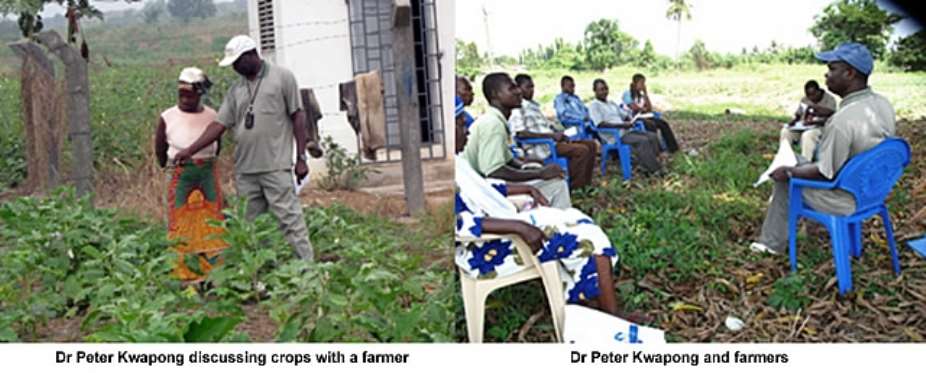
Currently, Dr Kwapong passionately visits rural areas to educate farmers on pollinators and how to use pollinators to pollinate crop and even plants. Few farmers are aware of the importance of pollinators in the food chain. “Almost all farmers saw pollinators especially bees as pests on their crops and sprayed them'', he said.
The farmers are learning to use it sustainably so that the pollinators can settle by spraying the pest, not spray, for example garden eggs, when is ready to go to the market to ensure consumers do not contract diseases that kill slowly.
He also trains farmers on best and bad farming practices as a way to increase their profit margins to cater for other needs such as paying for children's school fees, build houses, etc.
Dr Kwapong says many of the current kind of farming being practiced are unsustainable as a result of bad pesticides in the system which lack all the minerals needed to boost productivity thereby destroying the environment unknowingly.
“The 'big men' are allowing the pesticides to come into the system and they are getting the profit so the area where I operate farmers use chemicals anyhow even it has some negative effects on their health and these are the things I am educating them on.
“I do this across the country and we want government and other stakeholders to come on board to help promote things like that other people are doing in their country and is working and so why not Ghana'', he emphasised.
 Former MASLOC CEO Sedina Tamakloe returns to Ghana after extradition to serve 10...
 Tension in Birim North as angry NDC youth attempt to disrupt cooperative mining ...
 One dead, several injured in tipper truck and fuel tanker crash on Accra–Tema Mo...
 How 70-year-old building was finally demolished over fear of collapse in Osu
 Minority MPs thank Afenyo-Markin for capacity-building programme in Canada
 Ghana has everything needed to prosper yet graduates remain unemployed — Dr Step...
 June 9: Cedi sells at GHS12.50 on forex market, GHS11.85 on BoG interbank
 Stephen Amoah advocates mixed market economy to tackle rising cost of living in ...
 KMA to reintroduce enhanced ‘Samansaman’ sanitation enforcement system from July...
 Nyinahin Catholic SHS teacher seen fighting female student in viral video arrest...


