




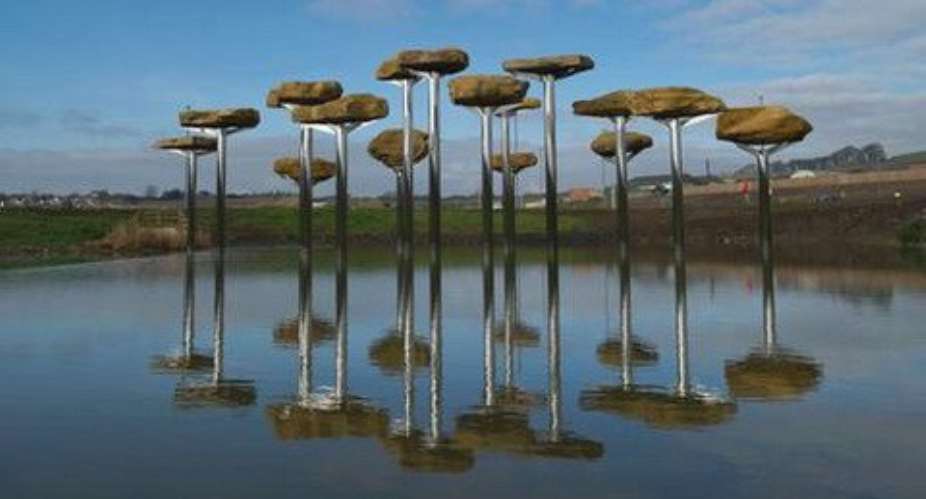
Dozens of works of art have been commissioned over the past four years for the 2012 Olympic Games in London, including 26 pieces in the Olympic Park itself. Jurassic Stones (pictured) is made of 16 boulders elevated on steel plinths in a pond, and is located on a roundabout in Weymouth, Dorset on the way to the Olympic sailing venues. Formed around 160 million years ago in what was then a tropical lagoon, each stone weighs between two and nine tons. The boulders were uncovered when a nearby road was being built in 2009, and British artist Richard Harris created the £335,000 sculpture in 2012 to celebrate the area's prehistoric past. (Jim Wileman)
Steles
Here, 35 crayon-shaped sculptures provide splashes of colour in the tidal waters of East London's Waterworks River. Between three and five metres tall, the sculptures by Keith Wilson have a functional purpose as well as aesthetic: they will be used as mooring posts after the Games. (Andy Keate/Getty)
>b
Three semi-mature trees, a red oak, a silver lime and a common ash, have been planted near the main entrances of the Olympic Park in Stratford, East London, with seven more to be planted at seven more entrance points after the games are over. In the canopy of each tree is a large stainless steel engraved ring six metres in circumference. Designed by renowned British artists Ackroyd & Harvey, the tree branches and the rings will mesh together over time. (David Poultney/ODA)
Run
Three nine-metre-tall mirrored glass and steel letters, each weighing 10 tons, spell the word "run" outside Copper Box, the venue in Olympic Park that will host handball and the modern pentathlon. The artist, Monica Bonivici, was inspired by song titles like Bruce Springsteen's “Born to Run” and The Velvet Underground's “Run Run Run”. During the day the letters reflect their surroundings, and at night they glow from the soft light of 300m of energy efficient lights. (David Poultney/ODA)
Underwhirl
The energy and intensity of the Games inspired artist Martin Richman to design a large-scale installation of swirling colours in an unlikely place – a 50m long pedestrian underpass beneath the six-lane A12 road. Coloured recycled glass and plaster come together to create a sense of excitement as you walk to the northeast corner of the Olympic Park. (David Poultney/ODA)
ArcelorMittal Orbit
At 114.5m tall, the ArcelorMittal Orbit is the UK's tallest sculpture. Designed by Anish Kapoor and Cecil Balmond to become as iconic as Paris' Eiffel Tower, the soaring, looping, latticed tower is made of 2,000 tons of steel and took 18 months to build. Ticket holders can explore the £22 million tower inside Olympic Park by climbing the 455-step spiral staircase to the viewing platforms. On clear days, you can see 20 miles out over London. (ArcelorMittal)
Aquatic Centre
To host 10,500 Olympic athletes, 4,200 Paralympic athletes and the millions of spectators, several state-of-the-art sporting venues have been built. Designed by award-winning architect Zaha Hadid, the sleek and modern building of the new Aquatic Centre in the southeast corner of Olympic Park features a 3,000-ton ceiling made of 37,000 individual hardwood strips that undulate in the shape of a wave. With seating for 17,500 people, two 50m pools and a 25m diving pool that hold a total of 10 million litres of water, the venue is set to be a showpiece of the Games. (Steve Bates/ODA)
Velodrome
London is working to make this the greenest Games ever, and that can be seen in the award-winning Velodrome, designed by Hopkins Architects. The permanent venue in the north of Olympic Park will host the 10 track cycling events, and was built from reclaimed material and sustainable wood sources like western red cedar for the exterior and Siberian pine for the 56km of track. The double curve of the roof collects rainwater that is stored and used for flushing toilets, and white colour of the roof will deflect sun and reduce cooling costs. The glass wall in the main concourse gives stunning 360-degree views of the Olympic Park and provides natural light. To top it off, track designers engineered the temperature, air conditions and geometry (the track is 42 degrees at its highest angle) to ensure that it is the world's fastest velodrome. (Anthony Charlton/ODA2008/Getty)
Basketball arena
Over 18 months, 1,000 tons of steel and 20,000sqm of recyclable white PVC fabric came together inside Olympic Park to create the basketball arena: the largest temporary venue ever built for any Olympic Games. Inside, the locker room doors are 8ft tall and the black and orange seats in the arena echo the colours of a basketball. The rippling, futuristic exterior walls will be used for elaborate changing light displays. (LOCOG)
The shooting venue
Built as indoor shooting ranges, the space-age design of white PVC membrane on the grounds of the Royal Artillery Barracks at Woolwich stand in contrast to the stately, Georgian-style architecture visitors will see upon entering the venue. The three temporary structures will feature brightly coloured openings that will be doors at ground level and sources of natural light and ventilation elsewhere. (Steve Bates/LOCOG)
 Former MASLOC CEO Sedina Tamakloe returns to Ghana after extradition to serve 10...
 Tension in Birim North as angry NDC youth attempt to disrupt cooperative mining ...
 One dead, several injured in tipper truck and fuel tanker crash on Accra–Tema Mo...
 How 70-year-old building was finally demolished over fear of collapse in Osu
 Minority MPs thank Afenyo-Markin for capacity-building programme in Canada
 Ghana has everything needed to prosper yet graduates remain unemployed — Dr Step...
 June 9: Cedi sells at GHS12.50 on forex market, GHS11.85 on BoG interbank
 Stephen Amoah advocates mixed market economy to tackle rising cost of living in ...
 KMA to reintroduce enhanced ‘Samansaman’ sanitation enforcement system from July...
 Nyinahin Catholic SHS teacher seen fighting female student in viral video arrest...


