




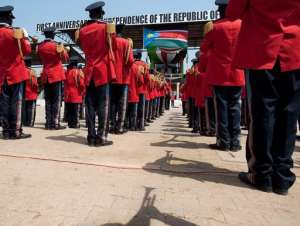
KHARTOUM (AFP) - South Sudanese in Sudan on Monday quietly marked the first anniversary of a homeland they long to return to, as political tensions and lack of money delayed their journey.
Tens of thousands are living, unemployed, in crude shelters at unsanitary transit camps around the Sudanese capital while they wait for transport to the South.
"We are not celebrating," one South Sudanese said. "It is very sensitive."
Those who remain face uncertainty after the April 8 expiry of a deadline to either formalise their status or leave the country.
Aid workers say there is no plan for returning those who want to go South, while people wishing to stay are not sure how to obtain legal residency.
South Sudan's top diplomat in Khartoum said those waiting in the transit camps are in the most difficulty.
"Really the situation is getting worse in the camps because they are unable to get their basic needs. They don't have sanitary facilities... they don't have food, they don't have water, they don't have health services," charge d'affaires Kau Nak told AFP.
The United Nations says there are almost 40 such "departure points" dotted around the Sudanese capital, and they are home to an estimated 38,000 South Sudanese.
A lack of donor funds, and fighting along the border between Sudan and South Sudan in March and April, has limited the return of South Sudanese from Sudan.
Many face difficulties paying for the journey themselves.
The status of each country's nationals in the other nation is among critical issues which the UN said must be settled within three months under African Union-led talks being held in Addis Ababa.
The deadline came in a May 2 Security Council resolution that ordered a ceasefire along the border.
A large number of South Sudanese who remain in the north are former Khartoum civil servants dismissed before independence and still waiting for severance pay.
Canon Sylvester Thomas, dean of All Saints Episcopal Cathedral in Khartoum, said "prayers of thanksgiving for the one-year" anniversary would be held later on Monday in the Haj Yousif district where some of the camps are.
"We want to encourage them," Sylvester said, adding that prayers would also be said for the governments of both countries.
More than 100 people were expected at the prayer service, he said.
South Sudanese are a Christian minority in Muslim Sudan.
Nak said that while South Sudan's embassy in Egypt would hold a formal celebration, there would be nothing in Khartoum to officially mark the anniversary, "because of the current situation in Sudan."
Even the Khartoum government did not commemorate the June 30 anniversary of President Omar al-Bashir's 1989 seizure of power, Nak said.
The Sudanese regime is facing an unprecedented three weeks of scattered public protests sparked by high inflation.
Nak said the government in Juba invited Bashir for the anniversary, but Sudan's ministry of foreign affairs told AFP that the president would not attend.
Bashir was guest of honour at last year's independence festivities.
Many of the South Sudanese still in Sudan have spent their entire lives in the north or arrived when they were children, as millions fled a 22-year civil war which killed two million people.
The fighting ended in a 2005 peace deal which paved the way for South Sudan's independence on July 9, 2011 following a near-unanimous vote for separation in a referendum.
There are no clear figures on the number of South Sudanese left in the north, but Nak estimates at least 300,000, including about 9,000 students completing their studies.
Some on Monday watched a television broadcast from South Sudan of the anniversary festivities there, where crowds took to the streets in celebration.
Instead of a formal event, Nak said he would meet individually with his countrymen to mark the day privately.
"We shall not have a function," he said. "It's time to remember my colleagues who lost their lives during the struggle."
 Former MASLOC CEO Sedina Tamakloe returns to Ghana after extradition to serve 10...
 Tension in Birim North as angry NDC youth attempt to disrupt cooperative mining ...
 One dead, several injured in tipper truck and fuel tanker crash on Accra–Tema Mo...
 How 70-year-old building was finally demolished over fear of collapse in Osu
 Minority MPs thank Afenyo-Markin for capacity-building programme in Canada
 Ghana has everything needed to prosper yet graduates remain unemployed — Dr Step...
 June 9: Cedi sells at GHS12.50 on forex market, GHS11.85 on BoG interbank
 Stephen Amoah advocates mixed market economy to tackle rising cost of living in ...
 KMA to reintroduce enhanced ‘Samansaman’ sanitation enforcement system from July...
 Nyinahin Catholic SHS teacher seen fighting female student in viral video arrest...


