




JOHANNESBURG (AFP) - South Africa's ruling ANC began a key policy conference Tuesday that pushes for a "second transition" to give black people more ownership of Africa's largest economy, two decades on from apartheid.
Amid lagging growth and increased inequality, the African National Congress hopes to draw up a five-year plan to give the economy fresh impetus.
"The policy conference will represent a paradigm shift in the approach of the ANC towards the economic development of our country," one of the discussion documents said.
Around 3,500 delegates from the country's nine provinces are expected at the four-day conference in Johannesburg, but most of the sessions will be closed to the public.
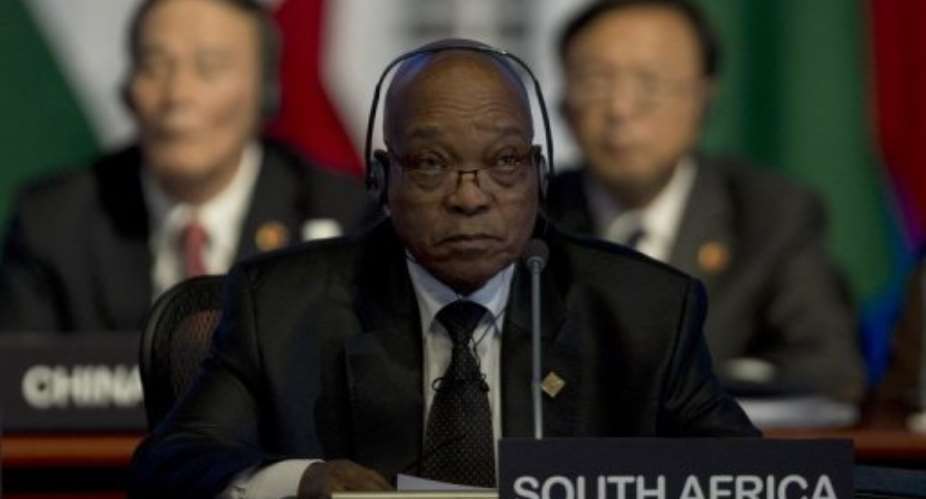
The conference was due to start late as delegates queued to enter conference venue in Midrand, north of Johannesburg. President Jacob Zuma is expected to deliver the main address later in the day.
Eighteen years after the end of apartheid saw democracy replace white minority rule, critics accuse the ANC-led government of not doing enough to reduce poverty and inequality.
"A lot of black people don't approve of our democracy if it still excludes them of the economic mainstream," said the Young Communist League national secretary Buti Manamela.
"There were successes, yet massive failures like unemployment, poverty and inequality," he told AFP.
One policy document stressed the need to focus "on the social and economic transformation of South Africa over the next 30 to 50 years" to change "a structural crisis we inherited from the apartheid economy."
Radical elements in the ANC youth league have called on the government to nationalise mines and forcefully expropriate white-owned farms.
The conference will discuss reforming the mining sector, so that the state receives more revenue from its mineral resources; and one conference document advocated the use of expropriation "where necessary".
"The willing-buyer-willing-seller principle constrained the pace and efficacy of land reform," it says.
But delegates were aware that simply taking over businesses would be counterproductive, said Manamela.
"We've got to be considerate of the fact that if we move ahead in nationalisation or state intervention without thinking of the negative consequences there will be disinvestment," he said.
Little progress has been made to restore land to people forced away before and during apartheid. White South Africans -- around 10 percent of the population -- still own as much as 80 percent of the land.
"The success of the conference is the convergence of views from the branches of the ANC that gives a direction as to where we're taking not only the ANC but the country in order to meet the challenges that we face now, the challenges of unemployment, of poverty, of inequality," the party's head of policy Jeff Radebe told AFP.
Foreign Minister Maite Nkoana-Mashabane told AFP the country's role in the "Africa agenda", like military interventions on the continent, was a high priority.
The conference will make policy suggestions to be considered at the ANC National Conference in December, when the party will hold its leadership election.
Though the leadership campaign will not be discussed officially at Tuesday's conference, unofficial lobbying among delegates is expected.
Zuma is considered the frontrunner.
 Former MASLOC CEO Sedina Tamakloe returns to Ghana after extradition to serve 10...
 Tension in Birim North as angry NDC youth attempt to disrupt cooperative mining ...
 One dead, several injured in tipper truck and fuel tanker crash on Accra–Tema Mo...
 How 70-year-old building was finally demolished over fear of collapse in Osu
 Minority MPs thank Afenyo-Markin for capacity-building programme in Canada
 Ghana has everything needed to prosper yet graduates remain unemployed — Dr Step...
 June 9: Cedi sells at GHS12.50 on forex market, GHS11.85 on BoG interbank
 Stephen Amoah advocates mixed market economy to tackle rising cost of living in ...
 KMA to reintroduce enhanced ‘Samansaman’ sanitation enforcement system from July...
 Nyinahin Catholic SHS teacher seen fighting female student in viral video arrest...


