




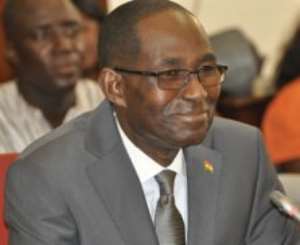
Mr Lee Ocran, Education Minister I was very happy to read in last week's edition of Junior Graphic that the Ghana National Association of the Deaf (GNAD) was finally recognising the problem of deaf students and their poor performance in the Basic Education Certificate Examination (BECE).
I am also hopeful that something will done, sooner than later, to solve this serious problem. Being deaf is a situation that affects the ears. It also has to do with intellectual ability and, for that reason, it is important that the deaf are given the chance/ opportunity to attain their objectives and aspirations.
In Ghana, the level of inclusiveness of the hearing faculty is given attention in intended programmes and policies. Since I moved here from Finland in 2007, this is what I have witnessed while working and associating with the deaf.
The state does well to provide schools for the deaf /hearing impaired. However, most of the teachers for the deaf lack good sign language skills.
In cases where the sign language is taught right, the ability to learn the written English is a challenge for the deaf because of its different grammatical structures.
In most cases, deaf students start their schooling without skills in any language because they do not hear the local languages spoken in their respective families. In view of this, they lack a lot of the concepts that children who do not have such a disability learn automatically. For instance, they do not know their own name, let alone the names of their family members.
In our private institution for the deaf, all our teachers are also deaf. This has ensured very easy communication between the students and the teachers. The challenge I have realised about deaf graduates from senior high schools (SHSs) is the incompatibility of the sign language and the English language.
It is crucial for deaf students to have teachers who are good in both the sign and the English language to enable the students learn the differences between both languages.
It will be appropriate for teachers of deaf students to give their 100 per cent best towards the education of deaf students. Teaching of deafs should not be based solely on the quest for financial rewards but on the passion and love for the deaf, especially in helping the deaf to become achievers in future.
It will also be helpful for teachers of deaf students, who can hear, to do their best in studying sign language, since that was the only way to gain good results for their children.
There is also the need to educate and create awareness among the general public about the sign language.
Most parents still prefer to let their deaf children study with the hearing children and this means, in practice, that the child is just copying from the blackboard, without necessarily understanding what he or she is writing and learning.
Many deaf students continue from class to class, wasting their time, whilst they could be learning and getting explanation for all they learn in the sign language classroom for the deaf.
According to our laws relating to children, no child should be neglected due to disability. Sadly, I know some mothers and fathers who have neglected their children because they are deaf, when, in actual fact, these children must rather be pampered, loved and given attention.
One sure way for the deaf to be empowered is to associate themselves with others and form groups, where they have the opportunity to use their sign language.
-The writer is the Proprietress of the House of Grace School for the Deaf in Accra.
 Former MASLOC CEO Sedina Tamakloe returns to Ghana after extradition to serve 10...
 Tension in Birim North as angry NDC youth attempt to disrupt cooperative mining ...
 One dead, several injured in tipper truck and fuel tanker crash on Accra–Tema Mo...
 How 70-year-old building was finally demolished over fear of collapse in Osu
 Minority MPs thank Afenyo-Markin for capacity-building programme in Canada
 Ghana has everything needed to prosper yet graduates remain unemployed — Dr Step...
 June 9: Cedi sells at GHS12.50 on forex market, GHS11.85 on BoG interbank
 Stephen Amoah advocates mixed market economy to tackle rising cost of living in ...
 KMA to reintroduce enhanced ‘Samansaman’ sanitation enforcement system from July...
 Nyinahin Catholic SHS teacher seen fighting female student in viral video arrest...


