




Government has projected to bag about GH¢1.24 billion as total revenue from the export of crude oil in the 2012 fiscal year.
This is based on an estimated average oil price of $90 per barrel and the production of 90,000 barrels of oil per day.
The amount comprises expected royalty payments of GH¢236.87 million, income from the government’s carried and participating interest of GH¢618.84 million and corporate income tax of GH¢384.11 million.
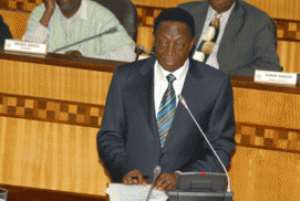
The Minister of Finance and Economic Planning, Dr Kwabena Duffuor, announced this when he laid the 2012 Budget Statement and Economic Policy of the government before Parliament in Accra yesterday.
The budget statement, which was read for the first time in many years virtually without the usual interruptions from members of the House, was crafted on the theme: “Infrastructural Development for Accelerated Growth and Job Creation”, in view of the massive infrastructural development projected for the 2012 fiscal year.
“Madam Speaker, as required by the Petroleum Revenue Management Act, the government wishes to submit to this august House for your consideration and approval a proposal for the Annual Budget Funding Amount for fiscal year 2012 to be set at 70 per cent of the benchmark revenue, consistent with Section 18 of the act,” he said.
Dr Duffuor said the transfer of oil revenue to the National Oil Company would also amount to GH¢361.90 million.
“The benchmark revenue will amount to GH¢877.92 million; the proposed 70 per cent of the benchmark revenue determined as the Annual Budget Funding Amount will amount to GH¢614.55 million; transfer to the Ghana Petroleum Fund will amount to GH¢263.28 million,” the Finance Minister outlined.
On the government’s petroleum hedging programme, he said, “Ghana’s macroeconomic stability has been threatened in the past by external commodity price shocks, the key one being the price of crude oil.”
Dr Duffuor said rising crude oil prices had meant that the government had had to subsidise the ex-pump price of petroleum products to the tune of GH¢267.61 million as of September 30, 2011.
“The entire under-recovery of petroleum pricing for the year is estimated to be GH¢364.94 million based on the assumption of crude oil price of US$110.23 per barrel,” he said.
As a result, he said, the government had put in place a simple hedging mechanism to mitigate the impact of crude oil price fluctuations on crude oil receipts.
“The call option is adopted to manage oil import prices, while the put option is adopted to smoothen fluctuations in crude oil export receipts,” he said.
The hedging programme adopted by the government, which attracted criticisms from some economists and financial analysts, according to the Finance Minister, contributed significantly to the stability of the economy in 2011.
Dr Duffuor said the commencement of crude oil production had created a new price risk exposure for government revenue.
In order to protect the revenue, he explained that the scope of the hedging programme was expanded in May 2011 to include petroleum revenue.
On oil receipts and distribution in 2011, the Finance Minister said the total volume of crude oil from the first three liftings amounted to 2,980,720 barrels, which realised a total sum of US$337.3 million (GH¢ 506 million).
“The Ghana National Petroleum Corporation (GNPC) has, on behalf of the government, lifted oil from the FPSO Kwame Nkrumah four times as of the end of October 2011,” he said.
“The proceeds from the first three liftings have been received and the proceeds for the fourth lifting are expected later in November 2011,” he added.
He said the total oil revenue received so far had been allocated to the various allowable sources, in accordance with the Petroleum Revenue Management Act (PRMA).
“A total of US$112 million (equivalent to GH¢168 million) has been transferred into the Consolidated Fund as the Annual Budget Funding Amount and is being utilised in the four priority areas as set out in the 2011 Supplementary Budget in accordance with relevant sections of the PRMA,” he said.
Dr Duffuor further indicated that US$54.8 million and US$14.4 million had been transferred into the Stabilisation and Heritage Fund accounts, respectively, in accordance with relevant sections of the PRMA.
“In line with Section 7 of the PRMA, an amount of US$156.1 million has been transferred to the GNPC as equity financing cost and the GNPC’s share of net carried and participating interest,” he said.
 White House World Cup chief defends visa ban for Somali referee, Iranians
 Talensi DCE courts investors for revival of Pwalugu Tomato Factory
 Manhyia South MP says free speech under threat, cites 17 arrests in 16 months un...
 KATH doctors suspend strike after Otumfuo’s intervention
 Mahama is losing control of his government — NPP Communicator
 Health Minister’s suspension of KATH CEO technically right — Prof Beyuo
 Korle Bu Teaching Hospital conducts Ebola emergency simulation to strengthen fro...
 Abandoned newborn baby found near gutter at Agona Swedru Woaraba
 Reparations Justice Forum questions imported schnapps for African libation ritua...
 27-year-old jailed 4years for stealing church musical equipment at Hohoe


