




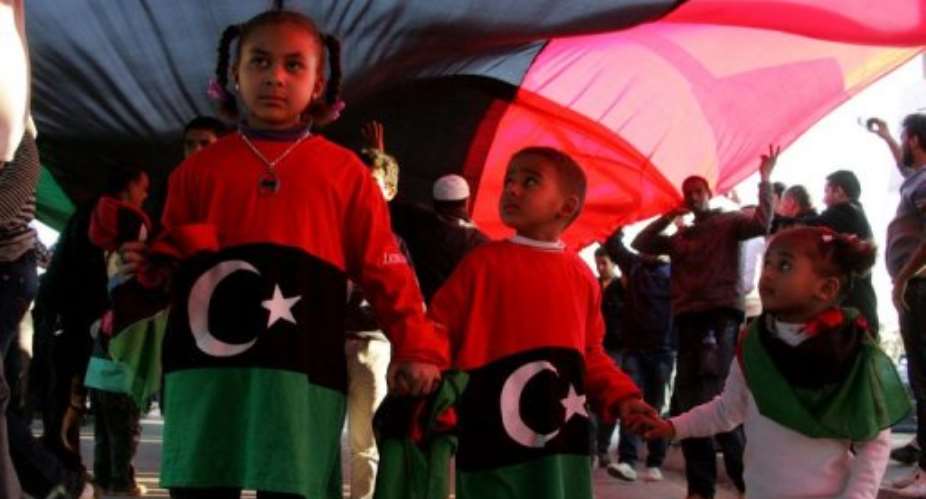
TRIPOLI (AFP) - Libyan authorities on Tuesday passed legislation governing the formation of political organisations which rules out religious, regional and tribal platforms and bans foreign funding.
"Political parties and associations should not be built on the basis of regional, tribal or religious affiliation," a member of the ruling National Transitional Council told AFP.
"They cannot be an extension of a political party abroad or receive foreign funding," said Mustafa Landi, a member of the legal committee.
Political parties must have a minimum of 250 founding members while associations need only 100, according to legislation which was agreed on late Tuesday, he said.
Libya's electoral committee warned on April that legislation on forming political parties must be adopted soon if June elections are to go ahead as scheduled.
But even without it, dozens of parties have launched in the past months with the intention of contesting elections to a constituent assembly, which should be held by June 19.
A full 120 of the assembly's seats are reserved for independent candidates but political associations are to contest the remaining 80.
Political organisations of any kind were banned for decades under the iron-fisted rule of Moamer Kadhafi, who was toppled and killed in last year's popular uprising.
Since the start of the so-called Arab Spring, elections in the region have benefited Islamists, including in Egypt, Libya's neighbour to the east, and in Tunisia to the west.
Similar outcomes are expected in June when Libya, which often emphasises its all-Muslim and moderate identity, is due to elect a constituent assembly.
Libya's Muslim Brotherhood, which already represents a major political force, has said it will not participate directly in elections but will focus instead on social development.
Its members, however, have been urged to create parties.
One of them was elected early March to lead the Justice and Construction Party which advocates a moderate Islam.
NTC member Fathi Baja, who heads the political affairs committee, said the law does not target moderate Islamists but seeks to exclude more radical elements "whose politics exclude others."
 Former MASLOC CEO Sedina Tamakloe returns to Ghana after extradition to serve 10...
 Tension in Birim North as angry NDC youth attempt to disrupt cooperative mining ...
 One dead, several injured in tipper truck and fuel tanker crash on Accra–Tema Mo...
 How 70-year-old building was finally demolished over fear of collapse in Osu
 Minority MPs thank Afenyo-Markin for capacity-building programme in Canada
 Ghana has everything needed to prosper yet graduates remain unemployed — Dr Step...
 June 9: Cedi sells at GHS12.50 on forex market, GHS11.85 on BoG interbank
 Stephen Amoah advocates mixed market economy to tackle rising cost of living in ...
 KMA to reintroduce enhanced ‘Samansaman’ sanitation enforcement system from July...
 Nyinahin Catholic SHS teacher seen fighting female student in viral video arrest...


