




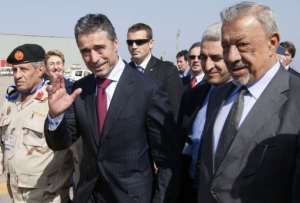
TRIPOLI (AFP) - NATO chief Anders Fogh Rasmussen made a surprise visit to Tripoli on Monday, saying he foresaw no major role left for the alliance in Libya hours before its air mission was due to officially end.
"At midnight tonight, a successful chapter in NATO's history is coming to an end. But you have also started writing a new chapter in Libya's history," he told a joint press conference with Libya's interim leader Mustafa Abdel Jalil.
The visit comes seven months after Western powers fired the first barrage of missiles against Moamer Kadhafi's forces in an air war that played a major role in ousting the veteran dictator.
The no-fly zone and naval blockade, enforced by NATO since March 31, will end Monday at 11:59 pm Libyan time (2159 GMT), as stipulated by a UN Security Council resolution last week that closed the mandate authorising military action.
Operation Unified Protector was terminated even though Abdel Jalil had asked for the alliance to stay until the end of the year, warning that Kadhafi loyalists still posed a threat.
But NATO deemed that civilians were safe from attacks after the new regime declared the country liberated following Kadhafi's death and the fall of his hometown of Sirte on October 20.
Despite having his request for an extension of the mission turned down, the National Transitional Council (NTC)'s chairman hailed NATO's crucial support and the precision of its air strikes.
"On behalf of the Libyan people, we express our appreciation and gratitude to the alliance, both the NATO alliance and Arab countries and friends. Thank you for that effort, which achieved victory for us," Abdel Jalil said.
"The NATO operation in Libya was successful in a great way... It was very accurate in the way that civilians were not affected. I think the people of Tripoli testify to that," he added.
Earlier, in an exclusive interview with AFP, Rasmussen said he intended to discuss with the NTC leaders "their expectations as regards Libya's future and in particular their roadmap for transition to democracy," as well as possible future assistance.
"We have... clearly stated that if the new political leadership in Libya so requests, NATO stands ready to help them in their transformation to a democracy," he said.
Areas where NATO could help included defence and security reform, he said, adding that member countries might be able to assist with border control.
"(But with) no NATO troops on the ground, I don't foresee a major NATO role. It's now for the United Nations to take the lead of the international assistance to the new authorities in Libya," the NATO secretary general told AFP.
His trip comes three days after NATO allies confirmed a decision to end the mission, declaring that the 28-nation alliance had fulfilled its UN mandate to protect civilians from a brutal repression.
Western strikes helped tip the balance of power in Libya's conflict, preventing him from crushing a revolt that erupted in mid-February.
The bombing raids stopped Kadhafi forces from marching into the rebel eastern city of Benghazi in February and pulverised the strongman's air force.
The conflict then appeared headed into a stalemate as the ill-trained rebel forces struggled to fight their way west towards Tripoli. But with NATO destroying thousands of military targets, the NTC eventually took the capital in August, sending Kadhafi into hiding.
While NATO has steadfastly denied targeting Kadhafi during the campaign, it was an alliance air strike that hit his convoy as it fled Sirte, leading to his capture and killing.
Rasmussen insisted NATO did not know Kadhafi was in the convoy.
"No, we didn't know. Kadhafi was not a target of our operations. We hit legitimate military targets and an armed convoy is a legitimate military target because it can constitute a threat to civilians," he told AFP on Monday.
A coalition led by the United States, France and Britain launched the first salvos in the air war on March 19, before handing over command of the mission to NATO at the end of March.
The alliance, joined by Arab partners Qatar and United Arab Emirates, flew some 26,000 sorties and hit almost 6,000 targets during the conflict.
Rasmussen said NATO had no confirmed civilian casualties caused by its operations.
"On one occasion we publicly declared that we could not exclude the possibility that we might have caused civilian casualties but the follow up investigation couldn't confirm that," he said.
© 2011 AFP
 Belarus manufacturers to storm Ghana next week after President's visit
 Government to offer tax incentives for factories located outside Accra
 White House World Cup chief defends visa ban for Somali referee, Iranians
 Talensi DCE courts investors for revival of Pwalugu Tomato Factory
 Manhyia South MP says free speech under threat, cites 17 arrests in 16 months un...
 KATH doctors suspend strike after Otumfuo’s intervention
 Mahama is losing control of his government — NPP Communicator
 Health Minister’s suspension of KATH CEO technically right — Prof Beyuo
 Korle Bu Teaching Hospital conducts Ebola emergency simulation to strengthen fro...
 Abandoned newborn baby found near gutter at Agona Swedru Woaraba


